Event submissions
Published
This submission belongs to the session S1. Air Quality and Human Health of the event The 8th International Electronic Conference on Atmospheric Sciences
Published date
09 Oct, 2026
Academic Editor
'%3e%3cpath%20d='M12.6657%2010.9104C12.4185%2010.325%2012.0599%209.79327%2011.6097%209.34482C11.1609%208.89508%2010.6293%208.5365%2010.0442%208.28888C10.0389%208.28626%2010.0337%208.28495%2010.0285%208.28233C10.8446%207.69279%2011.3752%206.73249%2011.3752%205.64904C11.3752%203.8542%209.92103%202.39999%208.1262%202.39999C6.33136%202.39999%204.87715%203.8542%204.87715%205.64904C4.87715%206.73249%205.40774%207.69279%206.22393%208.28364C6.21869%208.28626%206.21345%208.28757%206.20821%208.29019C5.62129%208.5378%205.09463%208.89284%204.64265%209.34613C4.1929%209.79493%203.83432%2010.3266%203.58671%2010.9117C3.34345%2011.4845%203.21226%2012.0987%203.20023%2012.7209C3.19988%2012.7349%203.20233%2012.7488%203.20744%2012.7619C3.21255%2012.7749%203.22022%2012.7867%203.22998%2012.7968C3.23975%2012.8068%203.25142%2012.8147%203.26431%2012.8202C3.2772%2012.8256%203.29105%2012.8284%203.30504%2012.8284H4.09109C4.14874%2012.8284%204.19459%2012.7825%204.1959%2012.7262C4.2221%2011.7148%204.62823%2010.7676%205.34617%2010.0497C6.08899%209.30683%207.0755%208.89808%208.1262%208.89808C9.17689%208.89808%2010.1634%209.30683%2010.9062%2010.0497C11.6242%2010.7676%2012.0303%2011.7148%2012.0565%2012.7262C12.0578%2012.7838%2012.1037%2012.8284%2012.1613%2012.8284H12.9474C12.9613%2012.8284%2012.9752%2012.8256%2012.9881%2012.8202C13.001%2012.8147%2013.0126%2012.8068%2013.0224%2012.7968C13.0322%2012.7867%2013.0398%2012.7749%2013.0449%2012.7619C13.0501%2012.7488%2013.0525%2012.7349%2013.0522%2012.7209C13.0391%2012.0947%2012.9094%2011.4855%2012.6657%2010.9104ZM8.1262%207.9024C7.52486%207.9024%206.9589%207.6679%206.53312%207.24211C6.10733%206.81633%205.87283%206.25037%205.87283%205.64904C5.87283%205.0477%206.10733%204.48174%206.53312%204.05596C6.9589%203.63018%207.52486%203.39567%208.1262%203.39567C8.72753%203.39567%209.29349%203.63018%209.71927%204.05596C10.1451%204.48174%2010.3796%205.0477%2010.3796%205.64904C10.3796%206.25037%2010.1451%206.81633%209.71927%207.24211C9.29349%207.6679%208.72753%207.9024%208.1262%207.9024Z'%20fill='%235D1EE1'/%3e%3c/g%3e%3c/svg%3e) Daniele Contini
Daniele ContiniCitation
Hiroyuki Sasaki, Tsukasa TAKAHASHI, Mari FUTAMI, Tomomi ENDO, Mizuho HIRANO, Yuka KOTAKE, Kim-Oanh PHAM, Characterizing Airborne Microplastics Using Tracer Components in Particulate Matter, in Proceedings of The 8th International Electronic Conference on Atmospheric Sciences, 14 October–16 October 2026, MDPI: Basel, Switzerland
Share
Email
Facebook
Twitter
LinkedIn
Characterizing Airborne Microplastics Using Tracer Components in Particulate Matter
'%3e%3cpath%20d='M12.6647%2010.9104C12.4176%2010.325%2012.0589%209.7933%2011.6088%209.34485C11.16%208.89511%2010.6283%208.53653%2010.0432%208.28891C10.038%208.28629%2010.0327%208.28498%2010.0275%208.28236C10.8437%207.69282%2011.3743%206.73252%2011.3743%205.64907C11.3743%203.85423%209.92005%202.40002%208.12522%202.40002C6.33038%202.40002%204.87618%203.85423%204.87618%205.64907C4.87618%206.73252%205.40677%207.69282%206.22296%208.28367C6.21772%208.28629%206.21248%208.2876%206.20724%208.29022C5.62031%208.53783%205.09365%208.89287%204.64167%209.34616C4.19192%209.79496%203.83334%2010.3266%203.58573%2010.9117C3.34247%2011.4846%203.21128%2012.0987%203.19925%2012.721C3.1989%2012.735%203.20135%2012.7489%203.20646%2012.7619C3.21157%2012.7749%203.21924%2012.7868%203.22901%2012.7968C3.23877%2012.8068%203.25045%2012.8148%203.26334%2012.8202C3.27623%2012.8256%203.29007%2012.8284%203.30406%2012.8284H4.09012C4.14776%2012.8284%204.19362%2012.7825%204.19493%2012.7262C4.22113%2011.7148%204.62726%2010.7676%205.34519%2010.0497C6.08802%209.30686%207.07452%208.89811%208.12522%208.89811C9.17592%208.89811%2010.1624%209.30686%2010.9052%2010.0497C11.6232%2010.7676%2012.0293%2011.7148%2012.0555%2012.7262C12.0568%2012.7839%2012.1027%2012.8284%2012.1603%2012.8284H12.9464C12.9604%2012.8284%2012.9742%2012.8256%2012.9871%2012.8202C13%2012.8148%2013.0117%2012.8068%2013.0214%2012.7968C13.0312%2012.7868%2013.0389%2012.7749%2013.044%2012.7619C13.0491%2012.7489%2013.0515%2012.735%2013.0512%2012.721C13.0381%2012.0947%2012.9084%2011.4856%2012.6647%2010.9104ZM8.12522%207.90243C7.52388%207.90243%206.95792%207.66793%206.53214%207.24215C6.10636%206.81636%205.87185%206.2504%205.87185%205.64907C5.87185%205.04773%206.10636%204.48177%206.53214%204.05599C6.95792%203.63021%207.52388%203.3957%208.12522%203.3957C8.72655%203.3957%209.29252%203.63021%209.7183%204.05599C10.1441%204.48177%2010.3786%205.04773%2010.3786%205.64907C10.3786%206.2504%2010.1441%206.81636%209.7183%207.24215C9.29252%207.66793%208.72655%207.90243%208.12522%207.90243Z'%20fill='%235D1EE1'/%3e%3c/g%3e%3c/svg%3e)
Hiroyuki Sasaki 1
Tsukasa TAKAHASHI 2
Mari FUTAMI 1
Tomomi ENDO 3
Mizuho HIRANO 3
Yuka KOTAKE 2
Kim-Oanh PHAM 1
1. Asia Center for Air Pollution Research, Niigata, 950-2144, Japan
2. Niigata Prefectural Institute of Public Health and Environmental Science, Niigata, Japan
3. East Branch Office, Japan Environmental Sanitation Center, Kawasaki, Japan
Abstract
1. Introduction
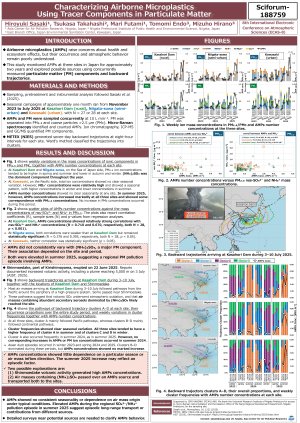
Airborne microplastics (AMPs) have emerged as a potential environmental and health concern; however, their atmospheric behavior and sources remain poorly understood. In this study, AMPs and particulate matter (PM) were simultaneously measured for approximately two years from November 2023 to July 2025 at three sites in Japan with different environmental characteristics (rural, semi-urban, and urban).
2. Materials and Methods
AMPs were identified and quantified using micro-Raman spectroscopy, while PM components were analyzed by ion chromatography, ICP-MS, and GC/MS. The relationships between AMPs concentrations, PM chemical components, and air mass origins were investigated using backward trajectory analysis.
3. Results and discussion
Under typical conditions, AMPs concentrations showed no clear seasonal variation or dependence on air mass origin across the three sites. However, during a regional pollution episode in the summer of 2025, AMPs concentrations simultaneously increased at all sites, in association with elevated levels of sulfate (SO₄²⁻) and ammonium (NH₄⁺) in PM₂.₅. Notably, coarse particle concentrations did not show a corresponding increase.
Correlation analysis indicated that AMPs concentrations were significantly associated with sulfate and ammonium concentrations at rural and semi-urban sites, whereas no significant relationship was observed at the urban site. Backward trajectory analysis suggested that the air masses during this period were influenced by secondary aerosol formation, potentially linked to volcanic activity, as well as transport pathways passing over specific emission sources.
These results suggest that AMPs concentrations are not primarily controlled by seasonal or regional air mass patterns under normal conditions, but can be strongly influenced by episodic atmospheric processes involving secondary particle formation and long-range transport.
Keywords
airborne microplastics
micro-Raman spectroscopy
particulate matter
backward trajectory
clustering
Poster
ECAS8_Poster_English_Revised.pdf
Smart IoT-Based Indoor Air Quality Monitoring and Human Health Assessment Using ESP32 Microcontroller and MQ-135 Gas Sensor
Non-Linear Toxicodynamic Cascades of Urban Aerosol Mixtures: Reframing Exposure–Response Paradigms beyond Threshold-Based Epidemiology