Event submissions
Published
This submission belongs to the session S1. Air Quality and Human Health of the event The 8th International Electronic Conference on Atmospheric Sciences
Published date
09 Oct, 2026
Academic Editor
'%3e%3cpath%20d='M12.6657%2010.9104C12.4185%2010.325%2012.0599%209.79327%2011.6097%209.34482C11.1609%208.89508%2010.6293%208.5365%2010.0442%208.28888C10.0389%208.28626%2010.0337%208.28495%2010.0285%208.28233C10.8446%207.69279%2011.3752%206.73249%2011.3752%205.64904C11.3752%203.8542%209.92103%202.39999%208.1262%202.39999C6.33136%202.39999%204.87715%203.8542%204.87715%205.64904C4.87715%206.73249%205.40774%207.69279%206.22393%208.28364C6.21869%208.28626%206.21345%208.28757%206.20821%208.29019C5.62129%208.5378%205.09463%208.89284%204.64265%209.34613C4.1929%209.79493%203.83432%2010.3266%203.58671%2010.9117C3.34345%2011.4845%203.21226%2012.0987%203.20023%2012.7209C3.19988%2012.7349%203.20233%2012.7488%203.20744%2012.7619C3.21255%2012.7749%203.22022%2012.7867%203.22998%2012.7968C3.23975%2012.8068%203.25142%2012.8147%203.26431%2012.8202C3.2772%2012.8256%203.29105%2012.8284%203.30504%2012.8284H4.09109C4.14874%2012.8284%204.19459%2012.7825%204.1959%2012.7262C4.2221%2011.7148%204.62823%2010.7676%205.34617%2010.0497C6.08899%209.30683%207.0755%208.89808%208.1262%208.89808C9.17689%208.89808%2010.1634%209.30683%2010.9062%2010.0497C11.6242%2010.7676%2012.0303%2011.7148%2012.0565%2012.7262C12.0578%2012.7838%2012.1037%2012.8284%2012.1613%2012.8284H12.9474C12.9613%2012.8284%2012.9752%2012.8256%2012.9881%2012.8202C13.001%2012.8147%2013.0126%2012.8068%2013.0224%2012.7968C13.0322%2012.7867%2013.0398%2012.7749%2013.0449%2012.7619C13.0501%2012.7488%2013.0525%2012.7349%2013.0522%2012.7209C13.0391%2012.0947%2012.9094%2011.4855%2012.6657%2010.9104ZM8.1262%207.9024C7.52486%207.9024%206.9589%207.6679%206.53312%207.24211C6.10733%206.81633%205.87283%206.25037%205.87283%205.64904C5.87283%205.0477%206.10733%204.48174%206.53312%204.05596C6.9589%203.63018%207.52486%203.39567%208.1262%203.39567C8.72753%203.39567%209.29349%203.63018%209.71927%204.05596C10.1451%204.48174%2010.3796%205.0477%2010.3796%205.64904C10.3796%206.25037%2010.1451%206.81633%209.71927%207.24211C9.29349%207.6679%208.72753%207.9024%208.1262%207.9024Z'%20fill='%235D1EE1'/%3e%3c/g%3e%3c/svg%3e) Daniele Contini
Daniele ContiniCitation
Manisha Manisha, Ashish Ranjan, Shankar G. Aggarwal, Sachchidanand Singh, Sanjay K. Uniyal, Vijender Kumar Bambal, Sudhir Kumar Sharma, Interaction of ambient NH₃ with other trace gases (NO, NO₂, O₃ & CO) and meteorology in a suburban environment of the western Himalaya, in Proceedings of The 8th International Electronic Conference on Atmospheric Sciences, 14 October–16 October 2026, MDPI: Basel, Switzerland
Share
Email
Facebook
Twitter
LinkedIn
Interaction of ambient NH3 with other trace gases (NO, NO2, O3 & CO) and meteorology in a suburban environment of the western Himalaya
'%3e%3cpath%20d='M12.6647%2010.9104C12.4176%2010.325%2012.0589%209.7933%2011.6088%209.34485C11.16%208.89511%2010.6283%208.53653%2010.0432%208.28891C10.038%208.28629%2010.0327%208.28498%2010.0275%208.28236C10.8437%207.69282%2011.3743%206.73252%2011.3743%205.64907C11.3743%203.85423%209.92005%202.40002%208.12522%202.40002C6.33038%202.40002%204.87618%203.85423%204.87618%205.64907C4.87618%206.73252%205.40677%207.69282%206.22296%208.28367C6.21772%208.28629%206.21248%208.2876%206.20724%208.29022C5.62031%208.53783%205.09365%208.89287%204.64167%209.34616C4.19192%209.79496%203.83334%2010.3266%203.58573%2010.9117C3.34247%2011.4846%203.21128%2012.0987%203.19925%2012.721C3.1989%2012.735%203.20135%2012.7489%203.20646%2012.7619C3.21157%2012.7749%203.21924%2012.7868%203.22901%2012.7968C3.23877%2012.8068%203.25045%2012.8148%203.26334%2012.8202C3.27623%2012.8256%203.29007%2012.8284%203.30406%2012.8284H4.09012C4.14776%2012.8284%204.19362%2012.7825%204.19493%2012.7262C4.22113%2011.7148%204.62726%2010.7676%205.34519%2010.0497C6.08802%209.30686%207.07452%208.89811%208.12522%208.89811C9.17592%208.89811%2010.1624%209.30686%2010.9052%2010.0497C11.6232%2010.7676%2012.0293%2011.7148%2012.0555%2012.7262C12.0568%2012.7839%2012.1027%2012.8284%2012.1603%2012.8284H12.9464C12.9604%2012.8284%2012.9742%2012.8256%2012.9871%2012.8202C13%2012.8148%2013.0117%2012.8068%2013.0214%2012.7968C13.0312%2012.7868%2013.0389%2012.7749%2013.044%2012.7619C13.0491%2012.7489%2013.0515%2012.735%2013.0512%2012.721C13.0381%2012.0947%2012.9084%2011.4856%2012.6647%2010.9104ZM8.12522%207.90243C7.52388%207.90243%206.95792%207.66793%206.53214%207.24215C6.10636%206.81636%205.87185%206.2504%205.87185%205.64907C5.87185%205.04773%206.10636%204.48177%206.53214%204.05599C6.95792%203.63021%207.52388%203.3957%208.12522%203.3957C8.72655%203.3957%209.29252%203.63021%209.7183%204.05599C10.1441%204.48177%2010.3786%205.04773%2010.3786%205.64907C10.3786%206.2504%2010.1441%206.81636%209.7183%207.24215C9.29252%207.66793%208.72655%207.90243%208.12522%207.90243Z'%20fill='%235D1EE1'/%3e%3c/g%3e%3c/svg%3e)
Manisha Manisha 1,2
Ashish Ranjan 1,2
Shankar G. Aggarwal 1,2
Sachchidanand Singh 1,2
Sanjay K. Uniyal 3
Vijender Kumar Bambal 1
Sudhir Kumar Sharma 1,2
1. CSIR-National Physical Laboratory, Dr. K. S. Krishnan Road, New Delhi 110012, India
2. Academy of Scientific and Innovative Research (AcSIR), Ghaziabad 201002, India
3. CSIR-Institute of Himalayan Bioresource Technology, Palampur 176061, India
Abstract
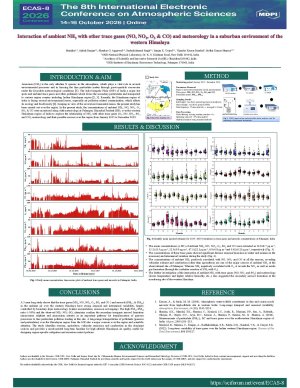
Ammonia (NH3) is the only alkaline N species in the atmosphere, which plays a vital role in several environmental processes and in forming the fine particulate matter through gas-to-particle conversion under favourable meteorological conditions. In the present study, the concentrations of ambient NH3, NO, NO2, O3 and CO were monitored along with meteorology at Palampur, Himachal Pradesh (HP), over the western Himalayan region of India to study the relationship of NH3 with other trace gases (O3, NO, NO2 and CO) and their possible sources over the region from January 2015 to December 2019. The mean concentrations (± SD at 1σ) of ambient NH3, NO, NO2, O3 and CO were extracted as 12.9±8.7 µg m-3, 15.2±11.5 µg m-3, 12.9±9.9 µg m-3, 67.3±22.1 µg m-3 and 0.42±0.23 µg m-3, respectively. The concentrations of these trace gases showed significant diurnal, seasonal (maxima in winter and minima in the monsoon) and interannual variation during the study. The concentrations of ambient NH3 positively correlated with NO, NO2 and CO in all the seasons, revealing that vehicular exhaust and combustion (other than agriculture) are some of the major sources of ambient NH3 at the observational site of Palampur. Whereas NH3 negatively correlated with O3, it revealed NOx as well as acidic gas formation (through the oxidation reaction of NH3 with O3). The further investigation of the interaction of ambient NH3 with trace gases (NO, NO2 and O3) and meteorology also suggested secondary aerosol formation at the monitoring site of the western Himalaya.
Keywords
trace gases
meteorology
sources
Himalayas.
Poster
ECAS-NPL-KS-2026-Final.pdf
Non-Linear Toxicodynamic Cascades of Urban Aerosol Mixtures: Reframing Exposure–Response Paradigms beyond Threshold-Based Epidemiology
Vehicle Tailpipe Emissions, Secondary Aerosol Formation and Pertinent Health Implications