Event submissions
Published
This submission belongs to the session S2. Meteorology of the event The 8th International Electronic Conference on Atmospheric Sciences
Published date
09 Oct, 2026
Academic Editor
'%3e%3cpath%20d='M12.6657%2010.9104C12.4185%2010.325%2012.0599%209.79327%2011.6097%209.34482C11.1609%208.89508%2010.6293%208.5365%2010.0442%208.28888C10.0389%208.28626%2010.0337%208.28495%2010.0285%208.28233C10.8446%207.69279%2011.3752%206.73249%2011.3752%205.64904C11.3752%203.8542%209.92103%202.39999%208.1262%202.39999C6.33136%202.39999%204.87715%203.8542%204.87715%205.64904C4.87715%206.73249%205.40774%207.69279%206.22393%208.28364C6.21869%208.28626%206.21345%208.28757%206.20821%208.29019C5.62129%208.5378%205.09463%208.89284%204.64265%209.34613C4.1929%209.79493%203.83432%2010.3266%203.58671%2010.9117C3.34345%2011.4845%203.21226%2012.0987%203.20023%2012.7209C3.19988%2012.7349%203.20233%2012.7488%203.20744%2012.7619C3.21255%2012.7749%203.22022%2012.7867%203.22998%2012.7968C3.23975%2012.8068%203.25142%2012.8147%203.26431%2012.8202C3.2772%2012.8256%203.29105%2012.8284%203.30504%2012.8284H4.09109C4.14874%2012.8284%204.19459%2012.7825%204.1959%2012.7262C4.2221%2011.7148%204.62823%2010.7676%205.34617%2010.0497C6.08899%209.30683%207.0755%208.89808%208.1262%208.89808C9.17689%208.89808%2010.1634%209.30683%2010.9062%2010.0497C11.6242%2010.7676%2012.0303%2011.7148%2012.0565%2012.7262C12.0578%2012.7838%2012.1037%2012.8284%2012.1613%2012.8284H12.9474C12.9613%2012.8284%2012.9752%2012.8256%2012.9881%2012.8202C13.001%2012.8147%2013.0126%2012.8068%2013.0224%2012.7968C13.0322%2012.7867%2013.0398%2012.7749%2013.0449%2012.7619C13.0501%2012.7488%2013.0525%2012.7349%2013.0522%2012.7209C13.0391%2012.0947%2012.9094%2011.4855%2012.6657%2010.9104ZM8.1262%207.9024C7.52486%207.9024%206.9589%207.6679%206.53312%207.24211C6.10733%206.81633%205.87283%206.25037%205.87283%205.64904C5.87283%205.0477%206.10733%204.48174%206.53312%204.05596C6.9589%203.63018%207.52486%203.39567%208.1262%203.39567C8.72753%203.39567%209.29349%203.63018%209.71927%204.05596C10.1451%204.48174%2010.3796%205.0477%2010.3796%205.64904C10.3796%206.25037%2010.1451%206.81633%209.71927%207.24211C9.29349%207.6679%208.72753%207.9024%208.1262%207.9024Z'%20fill='%235D1EE1'/%3e%3c/g%3e%3c/svg%3e) Merhala Thurai
Merhala ThuraiCitation
KIRAN SALUNKE, Vandana Dhingra, ADITYA ABHYANKAR, Enhancing ENSO and ISMR Predictability Under Global Warming: A Multi-Model Deep Learning Framework, in Proceedings of The 8th International Electronic Conference on Atmospheric Sciences, 14 October–16 October 2026, MDPI: Basel, Switzerland
Share
Email
Facebook
Twitter
LinkedIn
Enhancing ENSO and ISMR Predictability Under Global Warming: A Multi-Model Deep Learning Framework
'%3e%3cpath%20d='M12.6647%2010.9104C12.4176%2010.325%2012.0589%209.7933%2011.6088%209.34485C11.16%208.89511%2010.6283%208.53653%2010.0432%208.28891C10.038%208.28629%2010.0327%208.28498%2010.0275%208.28236C10.8437%207.69282%2011.3743%206.73252%2011.3743%205.64907C11.3743%203.85423%209.92005%202.40002%208.12522%202.40002C6.33038%202.40002%204.87618%203.85423%204.87618%205.64907C4.87618%206.73252%205.40677%207.69282%206.22296%208.28367C6.21772%208.28629%206.21248%208.2876%206.20724%208.29022C5.62031%208.53783%205.09365%208.89287%204.64167%209.34616C4.19192%209.79496%203.83334%2010.3266%203.58573%2010.9117C3.34247%2011.4846%203.21128%2012.0987%203.19925%2012.721C3.1989%2012.735%203.20135%2012.7489%203.20646%2012.7619C3.21157%2012.7749%203.21924%2012.7868%203.22901%2012.7968C3.23877%2012.8068%203.25045%2012.8148%203.26334%2012.8202C3.27623%2012.8256%203.29007%2012.8284%203.30406%2012.8284H4.09012C4.14776%2012.8284%204.19362%2012.7825%204.19493%2012.7262C4.22113%2011.7148%204.62726%2010.7676%205.34519%2010.0497C6.08802%209.30686%207.07452%208.89811%208.12522%208.89811C9.17592%208.89811%2010.1624%209.30686%2010.9052%2010.0497C11.6232%2010.7676%2012.0293%2011.7148%2012.0555%2012.7262C12.0568%2012.7839%2012.1027%2012.8284%2012.1603%2012.8284H12.9464C12.9604%2012.8284%2012.9742%2012.8256%2012.9871%2012.8202C13%2012.8148%2013.0117%2012.8068%2013.0214%2012.7968C13.0312%2012.7868%2013.0389%2012.7749%2013.044%2012.7619C13.0491%2012.7489%2013.0515%2012.735%2013.0512%2012.721C13.0381%2012.0947%2012.9084%2011.4856%2012.6647%2010.9104ZM8.12522%207.90243C7.52388%207.90243%206.95792%207.66793%206.53214%207.24215C6.10636%206.81636%205.87185%206.2504%205.87185%205.64907C5.87185%205.04773%206.10636%204.48177%206.53214%204.05599C6.95792%203.63021%207.52388%203.3957%208.12522%203.3957C8.72655%203.3957%209.29252%203.63021%209.7183%204.05599C10.1441%204.48177%2010.3786%205.04773%2010.3786%205.64907C10.3786%206.2504%2010.1441%206.81636%209.7183%207.24215C9.29252%207.66793%208.72655%207.90243%208.12522%207.90243Z'%20fill='%235D1EE1'/%3e%3c/g%3e%3c/svg%3e)
KIRAN SALUNKE 1,2
Vandana Dhingra 2
ADITYA ABHYANKAR 2
1. Monsoon Mission, Indian Institute of Tropical Meteorology, PUNE, 411008, India
2. Department of Technology, Savitribai Phule Pune University, Pune, Maharashtra, 411007, India
Abstract
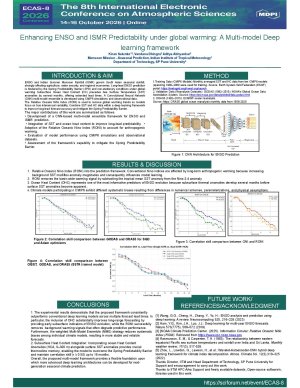
Reliable long-range prediction of the El Niño–Southern Oscillation (ENSO) and its associated teleconnection with the Indian Summer Monsoon Rainfall (ISMR) is critical for global climate risk management; however, conventional dynamical and statistical models remain constrained by nonlinear ocean–atmosphere interactions and the spring predictability barrier. This study introduces a robust deep learning framework that integrates multiple CMIP6 climate models with reanalysis datasets to enhance seasonal-to-interannual forecast skill for both ENSO and the monsoon.
The methodology initiates with a rigorous bias evaluation against observational data to quantify systematic deviations in model simulations prior to training. Subsequently, a Convolutional Neural Network (CNN) is trained using key oceanic predictors, specifically sea surface temperature (SST) and ocean heat content (HC) anomalies. To accurately capture ENSO variability amidst anthropogenic global warming, the Relative Oceanic Niño 3.4 Index (RONI) is adopted as the target metric in place of the conventional ONI. By explicitly accounting for background warming trends, RONI ensures that interannual ENSO signals—which serve as the primary drivers of ISMR variability—remain distinct from long-term climate change.
Model performance is rigorously evaluated using Mean Squared Error (MSE), Mean Absolute Error (MAE), correlation skill, and residual diagnostics. Results demonstrate strong predictive capability at short lead times (correlation > 0.8 up to 5 months) and sustained skill beyond 11 months, providing crucial early-warning signals for ISMR forecasting. Furthermore, multi-model ensemble techniques are applied to mitigate individual model biases and stabilize forecasts. The ensemble approach consistently outperforms individual models, maintaining correlations above 0.6 at seasonal-to-annual horizons. Ultimately, this framework demonstrates that integrating deep learning with RONI and multi-model ensembling can extend ENSO predictability and significantly improve ISMR forecasting, offering practical value for agriculture, disaster preparedness, and climate resilience planning.
Keywords
ISMR
CNN
RONI
ENSO
Poster
ECAS8--206595-Poster.pdf
From Methodological Evaluation to Operational Implementation: Development of an Integrated Climate Service for Drought Monitoring and Forecasting in Cuba
Evaluating Key Meteorological Parameters Associated with Lightning Activity over Madhya Pradesh, India