Event submissions
Published
This submission belongs to the session S2. Meteorology of the event The 8th International Electronic Conference on Atmospheric Sciences
Published date
09 Oct, 2026
Academic Editor
'%3e%3cpath%20d='M12.6657%2010.9104C12.4185%2010.325%2012.0599%209.79327%2011.6097%209.34482C11.1609%208.89508%2010.6293%208.5365%2010.0442%208.28888C10.0389%208.28626%2010.0337%208.28495%2010.0285%208.28233C10.8446%207.69279%2011.3752%206.73249%2011.3752%205.64904C11.3752%203.8542%209.92103%202.39999%208.1262%202.39999C6.33136%202.39999%204.87715%203.8542%204.87715%205.64904C4.87715%206.73249%205.40774%207.69279%206.22393%208.28364C6.21869%208.28626%206.21345%208.28757%206.20821%208.29019C5.62129%208.5378%205.09463%208.89284%204.64265%209.34613C4.1929%209.79493%203.83432%2010.3266%203.58671%2010.9117C3.34345%2011.4845%203.21226%2012.0987%203.20023%2012.7209C3.19988%2012.7349%203.20233%2012.7488%203.20744%2012.7619C3.21255%2012.7749%203.22022%2012.7867%203.22998%2012.7968C3.23975%2012.8068%203.25142%2012.8147%203.26431%2012.8202C3.2772%2012.8256%203.29105%2012.8284%203.30504%2012.8284H4.09109C4.14874%2012.8284%204.19459%2012.7825%204.1959%2012.7262C4.2221%2011.7148%204.62823%2010.7676%205.34617%2010.0497C6.08899%209.30683%207.0755%208.89808%208.1262%208.89808C9.17689%208.89808%2010.1634%209.30683%2010.9062%2010.0497C11.6242%2010.7676%2012.0303%2011.7148%2012.0565%2012.7262C12.0578%2012.7838%2012.1037%2012.8284%2012.1613%2012.8284H12.9474C12.9613%2012.8284%2012.9752%2012.8256%2012.9881%2012.8202C13.001%2012.8147%2013.0126%2012.8068%2013.0224%2012.7968C13.0322%2012.7867%2013.0398%2012.7749%2013.0449%2012.7619C13.0501%2012.7488%2013.0525%2012.7349%2013.0522%2012.7209C13.0391%2012.0947%2012.9094%2011.4855%2012.6657%2010.9104ZM8.1262%207.9024C7.52486%207.9024%206.9589%207.6679%206.53312%207.24211C6.10733%206.81633%205.87283%206.25037%205.87283%205.64904C5.87283%205.0477%206.10733%204.48174%206.53312%204.05596C6.9589%203.63018%207.52486%203.39567%208.1262%203.39567C8.72753%203.39567%209.29349%203.63018%209.71927%204.05596C10.1451%204.48174%2010.3796%205.0477%2010.3796%205.64904C10.3796%206.25037%2010.1451%206.81633%209.71927%207.24211C9.29349%207.6679%208.72753%207.9024%208.1262%207.9024Z'%20fill='%235D1EE1'/%3e%3c/g%3e%3c/svg%3e) Merhala Thurai
Merhala ThuraiCitation
Abderrazak ARIF, Performance Evaluation of Global Numerical Weather Prediction Models over Tunisia: A 2025 Annual Assessment Using RMSE, MAE, and Pearson Correlation, in Proceedings of The 8th International Electronic Conference on Atmospheric Sciences, 14 October–16 October 2026, MDPI: Basel, Switzerland
Share
Email
Facebook
Twitter
LinkedIn
Performance Evaluation of Global Numerical Weather Prediction Models over Tunisia: A 2025 Annual Assessment Using RMSE, MAE, and Pearson Correlation

Abderrazak ARIF 1
1. Research and Development Department, National Institute of Meteorology, Tunis-Carthage, 2035, Tunisia
Abstract
Accurate numerical weather prediction (NWP) is critical for effective meteorological services, particularly in the Mediterranean region, where complex terrain and climatic gradients pose significant forecasting challenges. This study presents a comprehensive annual evaluation of four operational global NWP models — ARPEGE (Météo-France), GFS (NCEP/NOAA), IFS (ECMWF), and ICON (DWD) — over Tunisia for the full year 2025 (January–December). Model outputs are systematically compared against ground-truth SYNOP observations from 30 meteorological stations distributed across three climatic zones (North, Centre, and South). Three meteorological variables are assessed: maximum temperature (Tmax), minimum temperature (Tmin), and daily precipitation accumulation. Performance is quantified using the Root Mean Square Error (RMSE), Mean Absolute Error (MAE), and Pearson correlation coefficient (R). Results demonstrate that ICON consistently achieves the lowest RMSE for temperature forecasts across all regions, with values as low as 1.22°C for Tmax in the Centre zone and 2.18°C for Tmin in the South. IFS emerges as the superior model for precipitation, particularly over the North (MAE: 4.89 mm, R: 0.62) and South (MAE: 2.95 mm). A performance Weighted Ensemble Forecasting (WEF) strategy is proposed, assigning dominant weights to the best-performing model per parameter and region. These findings provide actionable guidance for operational meteorological vigilance in Tunisia, with direct implications for heat-wave, frost, and convective precipitation warnings.
Keywords
Numerical Weather Prediction
ARPEGE
GFS
IFS
ICON
Model Verification
RMSE
MAE
Tunisia
Mediterranean Climate
Weighted Ensemble Forecasting.
Poster
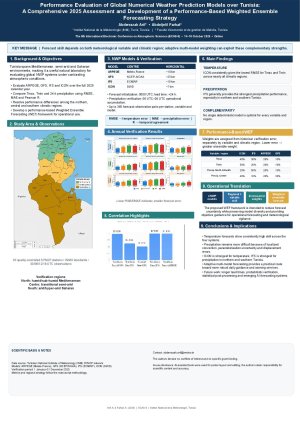
ECAS8_Tunisia_NWP_WEF_Poster_A1.pdf
Effect of Intense Heat and Cold Conditions on Arterial Hypertension in Older Adults. Management Measures
Significant wind speed values of Hurricane Ike during the days it affected Cuba