Event submissions
EventsMOL2NET'16, Conference on Molecular, Biomed., Comput. & Network Science and Engineering, 2nd ed.
Published

This submission belongs to the session 05. NICEXSM-02: North-Ibero-American Congress on Exp. and Simul. Methods, Valencia, Spain-Miami, USA, 2016 of the event MOL2NET'16, Conference on Molecular, Biomed., Comput. & Network Science and Engineering, 2nd ed.
Published date
12 Sep, 2016
Citation
Gabriel Martinez Arzate, Esvieta Tenorio-Borroto, Alberto Barbabosa Pliego, Juan C. Vásquez-Chagoyán, S2SNET Model for prediction of epitopes in vaccine design, in Proceedings of MOL2NET'16, Conference on Molecular, Biomed., Comput. & Network Science and Engineering, 2nd ed., 15 October–20 October 2022, MDPI: Basel, Switzerland, doi: 10.3390/mol2net-02-12001
Share
Email
Facebook
Twitter
LinkedIn
S2SNET Model for prediction of epitopes in vaccine design
'%3e%3cpath%20d='M12.6647%2010.9104C12.4176%2010.325%2012.0589%209.7933%2011.6088%209.34485C11.16%208.89511%2010.6283%208.53653%2010.0432%208.28891C10.038%208.28629%2010.0327%208.28498%2010.0275%208.28236C10.8437%207.69282%2011.3743%206.73252%2011.3743%205.64907C11.3743%203.85423%209.92005%202.40002%208.12522%202.40002C6.33038%202.40002%204.87618%203.85423%204.87618%205.64907C4.87618%206.73252%205.40677%207.69282%206.22296%208.28367C6.21772%208.28629%206.21248%208.2876%206.20724%208.29022C5.62031%208.53783%205.09365%208.89287%204.64167%209.34616C4.19192%209.79496%203.83334%2010.3266%203.58573%2010.9117C3.34247%2011.4846%203.21128%2012.0987%203.19925%2012.721C3.1989%2012.735%203.20135%2012.7489%203.20646%2012.7619C3.21157%2012.7749%203.21924%2012.7868%203.22901%2012.7968C3.23877%2012.8068%203.25045%2012.8148%203.26334%2012.8202C3.27623%2012.8256%203.29007%2012.8284%203.30406%2012.8284H4.09012C4.14776%2012.8284%204.19362%2012.7825%204.19493%2012.7262C4.22113%2011.7148%204.62726%2010.7676%205.34519%2010.0497C6.08802%209.30686%207.07452%208.89811%208.12522%208.89811C9.17592%208.89811%2010.1624%209.30686%2010.9052%2010.0497C11.6232%2010.7676%2012.0293%2011.7148%2012.0555%2012.7262C12.0568%2012.7839%2012.1027%2012.8284%2012.1603%2012.8284H12.9464C12.9604%2012.8284%2012.9742%2012.8256%2012.9871%2012.8202C13%2012.8148%2013.0117%2012.8068%2013.0214%2012.7968C13.0312%2012.7868%2013.0389%2012.7749%2013.044%2012.7619C13.0491%2012.7489%2013.0515%2012.735%2013.0512%2012.721C13.0381%2012.0947%2012.9084%2011.4856%2012.6647%2010.9104ZM8.12522%207.90243C7.52388%207.90243%206.95792%207.66793%206.53214%207.24215C6.10636%206.81636%205.87185%206.2504%205.87185%205.64907C5.87185%205.04773%206.10636%204.48177%206.53214%204.05599C6.95792%203.63021%207.52388%203.3957%208.12522%203.3957C8.72655%203.3957%209.29252%203.63021%209.7183%204.05599C10.1441%204.48177%2010.3786%205.04773%2010.3786%205.64907C10.3786%206.2504%2010.1441%206.81636%209.7183%207.24215C9.29252%207.66793%208.72655%207.90243%208.12522%207.90243Z'%20fill='%235D1EE1'/%3e%3c/g%3e%3c/svg%3e)
Gabriel Martinez Arzate 1
Esvieta Tenorio-Borroto 1
Alberto Barbabosa Pliego 1
Juan C. Vásquez-Chagoyán 1
1. Laboratorio de Biología Molecular, Universidad Autónoma del Estado de México (UAEM), 50200 Estado de México, México.
Abstract
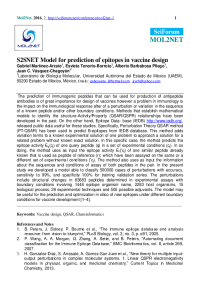
The prediction of immunogenic peptides that can be used for production of antipeptide antibodies is of great importance for design of vaccines however a problem in immunology is the impact on the immunological response after of a perturbation or variation in the sequence of a known peptide and/or other boundary conditions. Methods that establish mathematical models to identify the structure-Activity/Property (QSAR/QSPR) relationships have been developed in the past. On the other hand, Epitope Data- base (IEDB) http://www.iedb.org/, released public data useful for these studies. Specifically, Perturbation Theory QSAR method (PT-QSAR) has been used to predict B-epitopes from IEDB database. This method adds variation terms to a known experimental solution of one problem to approach a solution for a related problem without known exact solution. In this specific case, the method predicts the epitope activity Eq(cj) of one query peptide (q) in a set of experimental conditions (cj). In so doing, the method uses as input the epitope activity Er(ʹcj) of one similar peptide already known that is used as peptide of reference (r); which have been assayed on the same or a different set of experimental conditions (ʹcj). The method also uses as input the information about the sequences and conditions of assay of both peptides in the pair. In the present study we developed a model able to classify 500000 cases of perturbations with accuracy, sensitivity to 99%, and specificity 100% for training validation series. The perturbations include structural changes in 83683 peptides determined in experimental assays with boundary conditions involving 1448 epitope organism name, 2283 host organisms, 15 biological process, 28 experimental techniques and 505 possible adjuvants. The model may be useful for the prediction and optimization in silico of new epitopes under different boundary conditions for vaccine development [1–4].
References and Notes
- B. Peters, J. Sidney, P. Bourne et al., “The immune epitope database and analysis resource: from vision to blueprint,” PLoS Biology, vol. 3, no. 3, p. e91, 2005.
- P. Wang, A. A. Morgan, Q. Zhang, A. Sette, and B. Peters, “Automating document classification for the Immune Epitope Database,” BMC Bioinformatics, vol. 8, article 269, 2007.
- H. Gonzalez-Diaz, S. Arrasate, A. Gomez-San Juan et al., “New theory for multiple input-output perturbations in complex molecular systems. 1. Linear QSPR electronegativity models in physical, organic, and medicinal chemistry,” Current Topics in Medicinal Chemistry, 2013.
Keywords
Vaccine design
QSAR
Cheminformatics
Manuscript
MOL2NET-template gabo.pdf
Poster
mol2net-02_3431_manuscript.pdf
Relation ``structure-anticoagulant activity´´ using topologic indices
Linear Indices Bob-Jenkins operators for development of multi-output models using multi-target inhibitors of ubiquitin-proteasome system