Event submissions
Published
This submission belongs to the session S3. Aerosols of the event The 8th International Electronic Conference on Atmospheric Sciences
Published date
09 Oct, 2026
Academic Editor
'%3e%3cpath%20d='M12.6657%2010.9104C12.4185%2010.325%2012.0599%209.79327%2011.6097%209.34482C11.1609%208.89508%2010.6293%208.5365%2010.0442%208.28888C10.0389%208.28626%2010.0337%208.28495%2010.0285%208.28233C10.8446%207.69279%2011.3752%206.73249%2011.3752%205.64904C11.3752%203.8542%209.92103%202.39999%208.1262%202.39999C6.33136%202.39999%204.87715%203.8542%204.87715%205.64904C4.87715%206.73249%205.40774%207.69279%206.22393%208.28364C6.21869%208.28626%206.21345%208.28757%206.20821%208.29019C5.62129%208.5378%205.09463%208.89284%204.64265%209.34613C4.1929%209.79493%203.83432%2010.3266%203.58671%2010.9117C3.34345%2011.4845%203.21226%2012.0987%203.20023%2012.7209C3.19988%2012.7349%203.20233%2012.7488%203.20744%2012.7619C3.21255%2012.7749%203.22022%2012.7867%203.22998%2012.7968C3.23975%2012.8068%203.25142%2012.8147%203.26431%2012.8202C3.2772%2012.8256%203.29105%2012.8284%203.30504%2012.8284H4.09109C4.14874%2012.8284%204.19459%2012.7825%204.1959%2012.7262C4.2221%2011.7148%204.62823%2010.7676%205.34617%2010.0497C6.08899%209.30683%207.0755%208.89808%208.1262%208.89808C9.17689%208.89808%2010.1634%209.30683%2010.9062%2010.0497C11.6242%2010.7676%2012.0303%2011.7148%2012.0565%2012.7262C12.0578%2012.7838%2012.1037%2012.8284%2012.1613%2012.8284H12.9474C12.9613%2012.8284%2012.9752%2012.8256%2012.9881%2012.8202C13.001%2012.8147%2013.0126%2012.8068%2013.0224%2012.7968C13.0322%2012.7867%2013.0398%2012.7749%2013.0449%2012.7619C13.0501%2012.7488%2013.0525%2012.7349%2013.0522%2012.7209C13.0391%2012.0947%2012.9094%2011.4855%2012.6657%2010.9104ZM8.1262%207.9024C7.52486%207.9024%206.9589%207.6679%206.53312%207.24211C6.10733%206.81633%205.87283%206.25037%205.87283%205.64904C5.87283%205.0477%206.10733%204.48174%206.53312%204.05596C6.9589%203.63018%207.52486%203.39567%208.1262%203.39567C8.72753%203.39567%209.29349%203.63018%209.71927%204.05596C10.1451%204.48174%2010.3796%205.0477%2010.3796%205.64904C10.3796%206.25037%2010.1451%206.81633%209.71927%207.24211C9.29349%207.6679%208.72753%207.9024%208.1262%207.9024Z'%20fill='%235D1EE1'/%3e%3c/g%3e%3c/svg%3e) Dimitris Kaskaoutis
Dimitris KaskaoutisCitation
Anjali Rana, Preeti Tiwari, Sudhir Kumar Sharma, Sachchidanand Singh, Satellite-Based Estimation of PM₂.₅ using Meteorological and Statistical Analysis over Delhi, India, in Proceedings of The 8th International Electronic Conference on Atmospheric Sciences, 14 October–16 October 2026, MDPI: Basel, Switzerland
Share
Email
Facebook
Twitter
LinkedIn
Satellite-Based Estimation of PM2.5 using Meteorological and Statistical Analysis over Delhi, India
'%3e%3cpath%20d='M12.6647%2010.9104C12.4176%2010.325%2012.0589%209.7933%2011.6088%209.34485C11.16%208.89511%2010.6283%208.53653%2010.0432%208.28891C10.038%208.28629%2010.0327%208.28498%2010.0275%208.28236C10.8437%207.69282%2011.3743%206.73252%2011.3743%205.64907C11.3743%203.85423%209.92005%202.40002%208.12522%202.40002C6.33038%202.40002%204.87618%203.85423%204.87618%205.64907C4.87618%206.73252%205.40677%207.69282%206.22296%208.28367C6.21772%208.28629%206.21248%208.2876%206.20724%208.29022C5.62031%208.53783%205.09365%208.89287%204.64167%209.34616C4.19192%209.79496%203.83334%2010.3266%203.58573%2010.9117C3.34247%2011.4846%203.21128%2012.0987%203.19925%2012.721C3.1989%2012.735%203.20135%2012.7489%203.20646%2012.7619C3.21157%2012.7749%203.21924%2012.7868%203.22901%2012.7968C3.23877%2012.8068%203.25045%2012.8148%203.26334%2012.8202C3.27623%2012.8256%203.29007%2012.8284%203.30406%2012.8284H4.09012C4.14776%2012.8284%204.19362%2012.7825%204.19493%2012.7262C4.22113%2011.7148%204.62726%2010.7676%205.34519%2010.0497C6.08802%209.30686%207.07452%208.89811%208.12522%208.89811C9.17592%208.89811%2010.1624%209.30686%2010.9052%2010.0497C11.6232%2010.7676%2012.0293%2011.7148%2012.0555%2012.7262C12.0568%2012.7839%2012.1027%2012.8284%2012.1603%2012.8284H12.9464C12.9604%2012.8284%2012.9742%2012.8256%2012.9871%2012.8202C13%2012.8148%2013.0117%2012.8068%2013.0214%2012.7968C13.0312%2012.7868%2013.0389%2012.7749%2013.044%2012.7619C13.0491%2012.7489%2013.0515%2012.735%2013.0512%2012.721C13.0381%2012.0947%2012.9084%2011.4856%2012.6647%2010.9104ZM8.12522%207.90243C7.52388%207.90243%206.95792%207.66793%206.53214%207.24215C6.10636%206.81636%205.87185%206.2504%205.87185%205.64907C5.87185%205.04773%206.10636%204.48177%206.53214%204.05599C6.95792%203.63021%207.52388%203.3957%208.12522%203.3957C8.72655%203.3957%209.29252%203.63021%209.7183%204.05599C10.1441%204.48177%2010.3786%205.04773%2010.3786%205.64907C10.3786%206.2504%2010.1441%206.81636%209.7183%207.24215C9.29252%207.66793%208.72655%207.90243%208.12522%207.90243Z'%20fill='%235D1EE1'/%3e%3c/g%3e%3c/svg%3e)
Anjali Rana 1,2
Preeti Tiwari 1,2
Sudhir Kumar Sharma 1,2
Sachchidanand Singh 1,2
1. CSIR-National Physical Laboratory, Dr. K. S. Krishnan Road, New Delhi 110012, India.
2. Academy of Scientific and Innovative Research (AcSIR), Ghaziabad 201002, India
Abstract
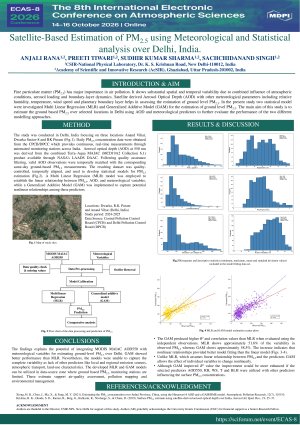
The study aims to estimate ground-level PM2.5 concentrations over Delhi, India, using satellite-derived aerosol optical depth (AOD) and meteorological parameters. Ground-based PM2.5 measurements were obtained from the Central Pollution Control Board/Delhi Pollution Control Committee (CPCB/DPCC) every minute, at multiple monitoring stations, including Anand Vihar, RK Puram, IIT Delhi, and others. The data was then converted to daily mean values which were used for further analysis. The annual mean PM2.5 concentrations ranged from 90 to 105 µg/m³. Meteorological variables, including air temperature, wind speed, atmospheric pressure, and relative humidity, were acquired from the corresponding CPCB/DPCC monitoring stations, while planetary boundary layer height (PBLH) was obtained from the ERA5 reanalysis dataset. Aerosol optical depth (AOD) at 550 nm was derived from the combined Terra–Aqua MAIAC (MCD19A2 Collection 6.1) product available through NASA's LAADS DAAC. Following quality assurance filtering, valid AOD observations were temporally matched with the corresponding same-day ground-based PM2.5 measurements. The resulting dataset was quality-controlled, temporally aligned, and used to develop statistical models for PM2.5 estimation. A Multiple Linear Regression (MLR) model was employed to establish the linear relationship between PM2.5, AOD, and meteorological variables, while a Generalized Additive Model (GAM) was implemented to capture potential nonlinear relationships among these predictors. Model performance was evaluated using cross-validation and standard statistical metrics (R², RMSE, and MAE), and the predictive performance of the MLR and GAM models was compared to assess the benefits of nonlinear modelling. The validated model was subsequently used to generate the spatial and temporal distribution of PM2.5 across Delhi. A detailed analysis will be presented.
Keywords
PM2.5 Estimation
AOD
MLR.
Poster
Anjali_ECAS-2026.pdf
Effects of aerosols on temperature and wind in the planetary boundary layer simulated with ICON NWP model under different synoptic conditions
Comparative Assessment of Crystallinity in Coarse Particulates (PM10) in Urban Environments of IGP and Central IHR