Event submissions
Published
This submission belongs to the session S3. Aerosols of the event The 8th International Electronic Conference on Atmospheric Sciences
Published date
09 Oct, 2026
Academic Editor
'%3e%3cpath%20d='M12.6657%2010.9104C12.4185%2010.325%2012.0599%209.79327%2011.6097%209.34482C11.1609%208.89508%2010.6293%208.5365%2010.0442%208.28888C10.0389%208.28626%2010.0337%208.28495%2010.0285%208.28233C10.8446%207.69279%2011.3752%206.73249%2011.3752%205.64904C11.3752%203.8542%209.92103%202.39999%208.1262%202.39999C6.33136%202.39999%204.87715%203.8542%204.87715%205.64904C4.87715%206.73249%205.40774%207.69279%206.22393%208.28364C6.21869%208.28626%206.21345%208.28757%206.20821%208.29019C5.62129%208.5378%205.09463%208.89284%204.64265%209.34613C4.1929%209.79493%203.83432%2010.3266%203.58671%2010.9117C3.34345%2011.4845%203.21226%2012.0987%203.20023%2012.7209C3.19988%2012.7349%203.20233%2012.7488%203.20744%2012.7619C3.21255%2012.7749%203.22022%2012.7867%203.22998%2012.7968C3.23975%2012.8068%203.25142%2012.8147%203.26431%2012.8202C3.2772%2012.8256%203.29105%2012.8284%203.30504%2012.8284H4.09109C4.14874%2012.8284%204.19459%2012.7825%204.1959%2012.7262C4.2221%2011.7148%204.62823%2010.7676%205.34617%2010.0497C6.08899%209.30683%207.0755%208.89808%208.1262%208.89808C9.17689%208.89808%2010.1634%209.30683%2010.9062%2010.0497C11.6242%2010.7676%2012.0303%2011.7148%2012.0565%2012.7262C12.0578%2012.7838%2012.1037%2012.8284%2012.1613%2012.8284H12.9474C12.9613%2012.8284%2012.9752%2012.8256%2012.9881%2012.8202C13.001%2012.8147%2013.0126%2012.8068%2013.0224%2012.7968C13.0322%2012.7867%2013.0398%2012.7749%2013.0449%2012.7619C13.0501%2012.7488%2013.0525%2012.7349%2013.0522%2012.7209C13.0391%2012.0947%2012.9094%2011.4855%2012.6657%2010.9104ZM8.1262%207.9024C7.52486%207.9024%206.9589%207.6679%206.53312%207.24211C6.10733%206.81633%205.87283%206.25037%205.87283%205.64904C5.87283%205.0477%206.10733%204.48174%206.53312%204.05596C6.9589%203.63018%207.52486%203.39567%208.1262%203.39567C8.72753%203.39567%209.29349%203.63018%209.71927%204.05596C10.1451%204.48174%2010.3796%205.0477%2010.3796%205.64904C10.3796%206.25037%2010.1451%206.81633%209.71927%207.24211C9.29349%207.6679%208.72753%207.9024%208.1262%207.9024Z'%20fill='%235D1EE1'/%3e%3c/g%3e%3c/svg%3e) Dimitris Kaskaoutis
Dimitris KaskaoutisCitation
Preeti Tiwari, Anjali Rana, Sakshi Gupta, Priyanka Srivastava, Bharat Ji Mehrotra, Manish Naja, Manoj K. Srivastava, Manoj Kumar, Sachchidanand Singh, Sudhir Kumar Sharma, Comparative Assessment of Crystallinity in Coarse Particulates (PM₁₀) in Urban Environments of IGP and Central IHR, in Proceedings of The 8th International Electronic Conference on Atmospheric Sciences, 14 October–16 October 2026, MDPI: Basel, Switzerland
Share
Email
Facebook
Twitter
LinkedIn
Comparative Assessment of Crystallinity in Coarse Particulates (PM10) in Urban Environments of IGP and Central IHR
'%3e%3cpath%20d='M12.6647%2010.9104C12.4176%2010.325%2012.0589%209.7933%2011.6088%209.34485C11.16%208.89511%2010.6283%208.53653%2010.0432%208.28891C10.038%208.28629%2010.0327%208.28498%2010.0275%208.28236C10.8437%207.69282%2011.3743%206.73252%2011.3743%205.64907C11.3743%203.85423%209.92005%202.40002%208.12522%202.40002C6.33038%202.40002%204.87618%203.85423%204.87618%205.64907C4.87618%206.73252%205.40677%207.69282%206.22296%208.28367C6.21772%208.28629%206.21248%208.2876%206.20724%208.29022C5.62031%208.53783%205.09365%208.89287%204.64167%209.34616C4.19192%209.79496%203.83334%2010.3266%203.58573%2010.9117C3.34247%2011.4846%203.21128%2012.0987%203.19925%2012.721C3.1989%2012.735%203.20135%2012.7489%203.20646%2012.7619C3.21157%2012.7749%203.21924%2012.7868%203.22901%2012.7968C3.23877%2012.8068%203.25045%2012.8148%203.26334%2012.8202C3.27623%2012.8256%203.29007%2012.8284%203.30406%2012.8284H4.09012C4.14776%2012.8284%204.19362%2012.7825%204.19493%2012.7262C4.22113%2011.7148%204.62726%2010.7676%205.34519%2010.0497C6.08802%209.30686%207.07452%208.89811%208.12522%208.89811C9.17592%208.89811%2010.1624%209.30686%2010.9052%2010.0497C11.6232%2010.7676%2012.0293%2011.7148%2012.0555%2012.7262C12.0568%2012.7839%2012.1027%2012.8284%2012.1603%2012.8284H12.9464C12.9604%2012.8284%2012.9742%2012.8256%2012.9871%2012.8202C13%2012.8148%2013.0117%2012.8068%2013.0214%2012.7968C13.0312%2012.7868%2013.0389%2012.7749%2013.044%2012.7619C13.0491%2012.7489%2013.0515%2012.735%2013.0512%2012.721C13.0381%2012.0947%2012.9084%2011.4856%2012.6647%2010.9104ZM8.12522%207.90243C7.52388%207.90243%206.95792%207.66793%206.53214%207.24215C6.10636%206.81636%205.87185%206.2504%205.87185%205.64907C5.87185%205.04773%206.10636%204.48177%206.53214%204.05599C6.95792%203.63021%207.52388%203.3957%208.12522%203.3957C8.72655%203.3957%209.29252%203.63021%209.7183%204.05599C10.1441%204.48177%2010.3786%205.04773%2010.3786%205.64907C10.3786%206.2504%2010.1441%206.81636%209.7183%207.24215C9.29252%207.66793%208.72655%207.90243%208.12522%207.90243Z'%20fill='%235D1EE1'/%3e%3c/g%3e%3c/svg%3e)
Preeti Tiwari 1,2
Anjali Rana 1,2
Sakshi Gupta 1,2
Priyanka Srivastava 3
Bharat Ji Mehrotra 4

Manish Naja 3
Manoj K. Srivastava 4
Manoj Kumar 1,2
Sachchidanand Singh 1,2
Sudhir Kumar Sharma 1,2
1. CSIR-National Physical Laboratory, Dr. K. S. Krishnan Road, New Delhi 110012, India.
2. Academy of Scientific and Innovative Research (AcSIR), Ghaziabad 201002, India
3. Aryabhata Research Institute of Observational Sciences (ARIES), Nainital 263002, Uttarakhand, India
4. Department of Geophysics, Banaras Hindu University (BHU), Varanasi 221005, India
Abstract
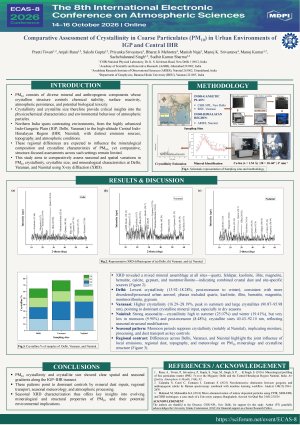
The crystallinity of a particle dictates its chemical stability, atmospheric lifetime, and biological toxicity. It increases the surface reactivity and adsorption, thereby increasing the potential toxicity. The present study focuses on seasonal variations in the mineralogy and crystalline size of ambient particulate matter (PM10) collected from three sites in northern India representing different environments and topographies, Delhi (urban megacity, an ecological transition zone between the Thar Desert to the west and the humid plains to the east), Varanasi (in the heart of the Middle-Ganga Valley, a humid subtropical region), and Nainital (subtropical highland, in the Kumaon foothills of the outer Himalayas), from January to December 2022. The analysis was carried out using an X-ray diffractometer (XRD), which helped deduce the crystal sizes and the percentage of crystallinity for each sample (four samples per site). The results indicate significant regional and seasonal differences in mineral richness and crystal structure across the study sites. Delhi samples had a relatively low crystallinity, ranging from 13.92% in the post-monsoon to 18.28% in winter, with mineral peak areas ranging from 15.72 to 26.97 nm. Varanasi showed considerable seasonal variation, with crystallinity ranging from 16.29% to 28.19% and peaking in summer, while the mineral peak areas remained high (90.87-95.98 nm). Nainital exhibited distinct seasonal variation with peak crystallinity observed in summer (25.07%) and winter (19.41%), while the monsoon (9.90%) and post-monsoon (8.48%) seasons demonstrated substantial decreases. Mineral peak areas for Nainital ranged from 40.43 to 92.10 nm. These patterns show that regional environmental settings and seasonal climatic circumstances have a major influence on the crystalline properties of particulate matter. Consistent with previous studies, annual mineralogy and crystal size of Delhi and Nainital are reported, whereas seasonal investigations remain limited. The present observations enhance the understanding of seasonal aerosol crystallinity in the Indo-Gangetic Plain (IGP) and Indo-Himalayan Region (IHR) contexts, with implications for interpreting aerosol sources, atmospheric processing, and potential environmental consequences.
Keywords
Particulate matter
X-ray diffraction (XRD)
Crystallinity
Crystalline size
IGP
IHR.
Poster
Preeti_ECAS-2026.pdf
Satellite-Based Estimation of PM2.5 using Meteorological and Statistical Analysis over Delhi, India
Season-Specific Diurnal Patterns of Total and Respirable Bacterial Aerosols