Event submissions
Published
This submission belongs to the session S3. Aerosols of the event The 8th International Electronic Conference on Atmospheric Sciences
Published date
09 Oct, 2026
Academic Editor
'%3e%3cpath%20d='M12.6657%2010.9104C12.4185%2010.325%2012.0599%209.79327%2011.6097%209.34482C11.1609%208.89508%2010.6293%208.5365%2010.0442%208.28888C10.0389%208.28626%2010.0337%208.28495%2010.0285%208.28233C10.8446%207.69279%2011.3752%206.73249%2011.3752%205.64904C11.3752%203.8542%209.92103%202.39999%208.1262%202.39999C6.33136%202.39999%204.87715%203.8542%204.87715%205.64904C4.87715%206.73249%205.40774%207.69279%206.22393%208.28364C6.21869%208.28626%206.21345%208.28757%206.20821%208.29019C5.62129%208.5378%205.09463%208.89284%204.64265%209.34613C4.1929%209.79493%203.83432%2010.3266%203.58671%2010.9117C3.34345%2011.4845%203.21226%2012.0987%203.20023%2012.7209C3.19988%2012.7349%203.20233%2012.7488%203.20744%2012.7619C3.21255%2012.7749%203.22022%2012.7867%203.22998%2012.7968C3.23975%2012.8068%203.25142%2012.8147%203.26431%2012.8202C3.2772%2012.8256%203.29105%2012.8284%203.30504%2012.8284H4.09109C4.14874%2012.8284%204.19459%2012.7825%204.1959%2012.7262C4.2221%2011.7148%204.62823%2010.7676%205.34617%2010.0497C6.08899%209.30683%207.0755%208.89808%208.1262%208.89808C9.17689%208.89808%2010.1634%209.30683%2010.9062%2010.0497C11.6242%2010.7676%2012.0303%2011.7148%2012.0565%2012.7262C12.0578%2012.7838%2012.1037%2012.8284%2012.1613%2012.8284H12.9474C12.9613%2012.8284%2012.9752%2012.8256%2012.9881%2012.8202C13.001%2012.8147%2013.0126%2012.8068%2013.0224%2012.7968C13.0322%2012.7867%2013.0398%2012.7749%2013.0449%2012.7619C13.0501%2012.7488%2013.0525%2012.7349%2013.0522%2012.7209C13.0391%2012.0947%2012.9094%2011.4855%2012.6657%2010.9104ZM8.1262%207.9024C7.52486%207.9024%206.9589%207.6679%206.53312%207.24211C6.10733%206.81633%205.87283%206.25037%205.87283%205.64904C5.87283%205.0477%206.10733%204.48174%206.53312%204.05596C6.9589%203.63018%207.52486%203.39567%208.1262%203.39567C8.72753%203.39567%209.29349%203.63018%209.71927%204.05596C10.1451%204.48174%2010.3796%205.0477%2010.3796%205.64904C10.3796%206.25037%2010.1451%206.81633%209.71927%207.24211C9.29349%207.6679%208.72753%207.9024%208.1262%207.9024Z'%20fill='%235D1EE1'/%3e%3c/g%3e%3c/svg%3e) Dimitris Kaskaoutis
Dimitris KaskaoutisCitation
Ambachew Ambje Alemu, Jaya Prakash Raju, Long-Term Trend Analysis and Spatial Distribution of Aerosol Particles Over East Africa–Ethiopia Using MODIS Satellite Data: Part II, in Proceedings of The 8th International Electronic Conference on Atmospheric Sciences, 14 October–16 October 2026, MDPI: Basel, Switzerland
Share
Email
Facebook
Twitter
LinkedIn
Long-Term Trend Analysis and Spatial Distribution of Aerosol Particles Over East Africa–Ethiopia Using MODIS Satellite Data: Part II
'%3e%3cpath%20d='M12.6647%2010.9104C12.4176%2010.325%2012.0589%209.7933%2011.6088%209.34485C11.16%208.89511%2010.6283%208.53653%2010.0432%208.28891C10.038%208.28629%2010.0327%208.28498%2010.0275%208.28236C10.8437%207.69282%2011.3743%206.73252%2011.3743%205.64907C11.3743%203.85423%209.92005%202.40002%208.12522%202.40002C6.33038%202.40002%204.87618%203.85423%204.87618%205.64907C4.87618%206.73252%205.40677%207.69282%206.22296%208.28367C6.21772%208.28629%206.21248%208.2876%206.20724%208.29022C5.62031%208.53783%205.09365%208.89287%204.64167%209.34616C4.19192%209.79496%203.83334%2010.3266%203.58573%2010.9117C3.34247%2011.4846%203.21128%2012.0987%203.19925%2012.721C3.1989%2012.735%203.20135%2012.7489%203.20646%2012.7619C3.21157%2012.7749%203.21924%2012.7868%203.22901%2012.7968C3.23877%2012.8068%203.25045%2012.8148%203.26334%2012.8202C3.27623%2012.8256%203.29007%2012.8284%203.30406%2012.8284H4.09012C4.14776%2012.8284%204.19362%2012.7825%204.19493%2012.7262C4.22113%2011.7148%204.62726%2010.7676%205.34519%2010.0497C6.08802%209.30686%207.07452%208.89811%208.12522%208.89811C9.17592%208.89811%2010.1624%209.30686%2010.9052%2010.0497C11.6232%2010.7676%2012.0293%2011.7148%2012.0555%2012.7262C12.0568%2012.7839%2012.1027%2012.8284%2012.1603%2012.8284H12.9464C12.9604%2012.8284%2012.9742%2012.8256%2012.9871%2012.8202C13%2012.8148%2013.0117%2012.8068%2013.0214%2012.7968C13.0312%2012.7868%2013.0389%2012.7749%2013.044%2012.7619C13.0491%2012.7489%2013.0515%2012.735%2013.0512%2012.721C13.0381%2012.0947%2012.9084%2011.4856%2012.6647%2010.9104ZM8.12522%207.90243C7.52388%207.90243%206.95792%207.66793%206.53214%207.24215C6.10636%206.81636%205.87185%206.2504%205.87185%205.64907C5.87185%205.04773%206.10636%204.48177%206.53214%204.05599C6.95792%203.63021%207.52388%203.3957%208.12522%203.3957C8.72655%203.3957%209.29252%203.63021%209.7183%204.05599C10.1441%204.48177%2010.3786%205.04773%2010.3786%205.64907C10.3786%206.2504%2010.1441%206.81636%209.7183%207.24215C9.29252%207.66793%208.72655%207.90243%208.12522%207.90243Z'%20fill='%235D1EE1'/%3e%3c/g%3e%3c/svg%3e)
Ambachew Ambje Alemu 1,2
Jaya Prakash Raju 1
1. Physics Department, Science College, Bahir Dar University, Bahir Dar, P.O. Box: 038 / 6000, Ethiopia
2. Physics Department, Science College, Debre Tabor University, Debre Tabor, P.O. Box: 272 / 6300, Ethiopia
Abstract
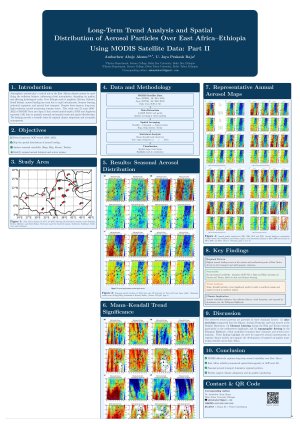
The loading of aerosol particles over East Africa–Ethiopia has increased substantially due to unprecedented growth in both natural and anthropogenic activities, exacerbated by current climatic conditions. Environmental and meteorological factors, industrial and agricultural operations, and other natural and anthropogenic influences vary significantly across ecological functional regions, leading to considerable differences in the long-term trends and spatial distributions of aerosol optical parameters. To investigate these trends and spatial distribution patterns, we extracted and analyzed Moderate Resolution Imaging Spectroradiometer (MODIS) MOD04_3K and MYD04_3K optical parameters at a 3 km spatial resolution over East Africa–Ethiopia and neighboring regions—Eritrea, Djibouti, and South Sudan—for the period 2001–2022. The results reveal that Aerosol Optical Depth (AOD) and Ångström Exponent (AE) exhibit substantial spatial variability and trend heterogeneity. Spatial distribution values are generally oriented toward the southwestern areas of the study region, with ranges of 0.00 ≤ AOD ≤ 0.45 and 0.95 ≤ AE ≤ 1.20. Seasonally, the lowest AOD and AE values occur during the Bega (December–February) and Belg (September–November) seasons, while the highest values are observed during the Kiremt (June–August) and Tseday (March–May) seasons. Interannually, AOD and AE reached their minimum in 2002–2003 and maximum in 2001, 2008, and 2015. Except for the total annual spatial distribution, the Terra instrument recorded higher AOD and AE values than Aqua. Mann–Kendall statistical forward trend tests (p < 0.05 significance level) indicate a predominantly positive (increasing) trend in the southern regions (Theil–Sen slope β = 0.004–0.012 year⁻¹), a negative (decreasing) trend in the northern regions (β = −0.005 to −0.010 year⁻¹), and no significant trend (p > 0.05) in parts of the southeast.
Keywords
Aerosol Optical Depth (AOD)
Ångström Exponent (AE)
MODIS Satellite
East Africa
Mann–Kendall Trend Test
Poster
Amba_Poster.pdf
The hypothesis of volcanogenic soot: a critical analysis and possible constructive additions
Seasonal Variability of Urban Air Pollutants in Kenitra, Morocco: Influence of Meteorological Conditions on PM2.5, Black Carbon and Gaseous Pollutants