Event submissions
Published
This submission belongs to the session S3. Aerosols of the event The 8th International Electronic Conference on Atmospheric Sciences
Published date
09 Oct, 2026
Academic Editor
'%3e%3cpath%20d='M12.6657%2010.9104C12.4185%2010.325%2012.0599%209.79327%2011.6097%209.34482C11.1609%208.89508%2010.6293%208.5365%2010.0442%208.28888C10.0389%208.28626%2010.0337%208.28495%2010.0285%208.28233C10.8446%207.69279%2011.3752%206.73249%2011.3752%205.64904C11.3752%203.8542%209.92103%202.39999%208.1262%202.39999C6.33136%202.39999%204.87715%203.8542%204.87715%205.64904C4.87715%206.73249%205.40774%207.69279%206.22393%208.28364C6.21869%208.28626%206.21345%208.28757%206.20821%208.29019C5.62129%208.5378%205.09463%208.89284%204.64265%209.34613C4.1929%209.79493%203.83432%2010.3266%203.58671%2010.9117C3.34345%2011.4845%203.21226%2012.0987%203.20023%2012.7209C3.19988%2012.7349%203.20233%2012.7488%203.20744%2012.7619C3.21255%2012.7749%203.22022%2012.7867%203.22998%2012.7968C3.23975%2012.8068%203.25142%2012.8147%203.26431%2012.8202C3.2772%2012.8256%203.29105%2012.8284%203.30504%2012.8284H4.09109C4.14874%2012.8284%204.19459%2012.7825%204.1959%2012.7262C4.2221%2011.7148%204.62823%2010.7676%205.34617%2010.0497C6.08899%209.30683%207.0755%208.89808%208.1262%208.89808C9.17689%208.89808%2010.1634%209.30683%2010.9062%2010.0497C11.6242%2010.7676%2012.0303%2011.7148%2012.0565%2012.7262C12.0578%2012.7838%2012.1037%2012.8284%2012.1613%2012.8284H12.9474C12.9613%2012.8284%2012.9752%2012.8256%2012.9881%2012.8202C13.001%2012.8147%2013.0126%2012.8068%2013.0224%2012.7968C13.0322%2012.7867%2013.0398%2012.7749%2013.0449%2012.7619C13.0501%2012.7488%2013.0525%2012.7349%2013.0522%2012.7209C13.0391%2012.0947%2012.9094%2011.4855%2012.6657%2010.9104ZM8.1262%207.9024C7.52486%207.9024%206.9589%207.6679%206.53312%207.24211C6.10733%206.81633%205.87283%206.25037%205.87283%205.64904C5.87283%205.0477%206.10733%204.48174%206.53312%204.05596C6.9589%203.63018%207.52486%203.39567%208.1262%203.39567C8.72753%203.39567%209.29349%203.63018%209.71927%204.05596C10.1451%204.48174%2010.3796%205.0477%2010.3796%205.64904C10.3796%206.25037%2010.1451%206.81633%209.71927%207.24211C9.29349%207.6679%208.72753%207.9024%208.1262%207.9024Z'%20fill='%235D1EE1'/%3e%3c/g%3e%3c/svg%3e) Dimitris Kaskaoutis
Dimitris KaskaoutisCitation
Mounia Tahri, Mustapha Zghaid, Abdelfettah Benchrif, Otmane Khalfaoui, Seasonal Variability of Urban Air Pollutants in Kenitra, Morocco: Influence of Meteorological Conditions on PM2.5, Black Carbon and Gaseous Pollutants, in Proceedings of The 8th International Electronic Conference on Atmospheric Sciences, 14 October–16 October 2026, MDPI: Basel, Switzerland
Share
Email
Facebook
Twitter
LinkedIn
Seasonal Variability of Urban Air Pollutants in Kenitra, Morocco: Influence of Meteorological Conditions on PM2.5, Black Carbon and Gaseous Pollutants
'%3e%3cpath%20d='M12.6647%2010.9104C12.4176%2010.325%2012.0589%209.7933%2011.6088%209.34485C11.16%208.89511%2010.6283%208.53653%2010.0432%208.28891C10.038%208.28629%2010.0327%208.28498%2010.0275%208.28236C10.8437%207.69282%2011.3743%206.73252%2011.3743%205.64907C11.3743%203.85423%209.92005%202.40002%208.12522%202.40002C6.33038%202.40002%204.87618%203.85423%204.87618%205.64907C4.87618%206.73252%205.40677%207.69282%206.22296%208.28367C6.21772%208.28629%206.21248%208.2876%206.20724%208.29022C5.62031%208.53783%205.09365%208.89287%204.64167%209.34616C4.19192%209.79496%203.83334%2010.3266%203.58573%2010.9117C3.34247%2011.4846%203.21128%2012.0987%203.19925%2012.721C3.1989%2012.735%203.20135%2012.7489%203.20646%2012.7619C3.21157%2012.7749%203.21924%2012.7868%203.22901%2012.7968C3.23877%2012.8068%203.25045%2012.8148%203.26334%2012.8202C3.27623%2012.8256%203.29007%2012.8284%203.30406%2012.8284H4.09012C4.14776%2012.8284%204.19362%2012.7825%204.19493%2012.7262C4.22113%2011.7148%204.62726%2010.7676%205.34519%2010.0497C6.08802%209.30686%207.07452%208.89811%208.12522%208.89811C9.17592%208.89811%2010.1624%209.30686%2010.9052%2010.0497C11.6232%2010.7676%2012.0293%2011.7148%2012.0555%2012.7262C12.0568%2012.7839%2012.1027%2012.8284%2012.1603%2012.8284H12.9464C12.9604%2012.8284%2012.9742%2012.8256%2012.9871%2012.8202C13%2012.8148%2013.0117%2012.8068%2013.0214%2012.7968C13.0312%2012.7868%2013.0389%2012.7749%2013.044%2012.7619C13.0491%2012.7489%2013.0515%2012.735%2013.0512%2012.721C13.0381%2012.0947%2012.9084%2011.4856%2012.6647%2010.9104ZM8.12522%207.90243C7.52388%207.90243%206.95792%207.66793%206.53214%207.24215C6.10636%206.81636%205.87185%206.2504%205.87185%205.64907C5.87185%205.04773%206.10636%204.48177%206.53214%204.05599C6.95792%203.63021%207.52388%203.3957%208.12522%203.3957C8.72655%203.3957%209.29252%203.63021%209.7183%204.05599C10.1441%204.48177%2010.3786%205.04773%2010.3786%205.64907C10.3786%206.2504%2010.1441%206.81636%209.7183%207.24215C9.29252%207.66793%208.72655%207.90243%208.12522%207.90243Z'%20fill='%235D1EE1'/%3e%3c/g%3e%3c/svg%3e)
Mounia Tahri 1
Mustapha Zghaid 2
Abdelfettah Benchrif 1
Otmane Khalfaoui 1
1. Earth and Environment Sciences (DSTE), Geochemistry and Chemical Pollution Unity (UGPC), National Centre for Nuclear Energy, Sciences and Technology (CNESTEN), BP 1382, BP 10001, Rabat, Zip Code: 10000, Morocco
2. Faculty of Sciences, Ibn Tofail University, B.P. 133, Kenitra, Morocco
Abstract
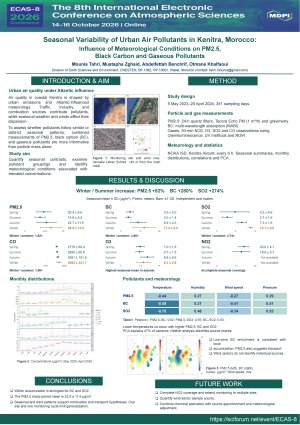
Urban air pollution is a growing environmental concern in Moroccan cities undergoing rapid urbanization and industrial development. Kenitra, located in north-western Morocco, is influenced by road traffic, industrial activities, urban expansion, and seasonal meteorological variability. This study aims to assess the temporal evolution of ambient air quality in Kenitra and to examine the influence of meteorological parameters on particulate and gaseous pollutants.
Methods
Monitoring was conducted at an urban site from May 2023 to April 2024 over 351 sampling days. Pollutant concentrations and meteorological parameters (temperature, relative humidity, pressure, wind speed, and wind direction) were analyzed at hourly, daily, monthly, and seasonal scales. Seasonal values are reported as mean ± standard deviation. Descriptive statistics, temporal analysis, correlation analysis, and principal component analysis (PCA) were applied.
Results
Seasonal means showed higher pollution during cold periods. PM2.5 increased from 15.9 ± 6.2 µg/m³ in summer to 28.9 ± 12.9 µg/m³ in winter, while BC rose from 3.0 ± 1.4 to 11.4 ± 6.0 µg/m³, indicating combustion-related emissions and reduced atmospheric mixing. SO2 increased from 2.7 ± 1.6 to 10.1 ± 0.8 µg/m³, and CO from 2779 ± 69.4 to 2984 ± 221.7 µg/m³. O₃ remained low, ranging from 6.7 ± 1.5 µg/m³ in summer to 9.8 ± 2.6 µg/m³ in autumn. NO2 averaged 18.6 ± 5.5 µg/m³ and showed traffic-related diurnal peaks. Compared with Moroccan standards, mean PM2.5, CO, SO₂, O₃, and NO₂ were below national reference values, whereas PM2.5 and NO₂ exceeded WHO annual guidelines. PCA identified two factors explaining 47% of variance, mainly related to PM2.5-BC-SO2-humidity and CO-NO2-wind speed. Correlations confirmed common behavior for PM2.5-BC (r = 0.62), PM2.5-SO2 (r = 0.55), and BC-SO2 (r = 0.63).
Conclusions
The results confirm strong seasonal control of urban air pollution in Kenitra, highlighting winter as the most critical period and supporting continuous monitoring and targeted emission-control strategies.
Keywords
PM2.5
black carbon
air quality
urban pollution
meteorology
seasonal variability
Kenitra
Morocco.
Poster
ECAS8_Poster_Tahri et al.pdf
Long-Term Trend Analysis and Spatial Distribution of Aerosol Particles Over East Africa–Ethiopia Using MODIS Satellite Data: Part II
Atmospheric Boundary Layer Dynamics over Agartala, a North-Eastern Indian Location: Insights from Ground-based Lidar Observations and Reanalysis Datasets