Event submissions
Published
This submission belongs to the session S3. Aerosols of the event The 8th International Electronic Conference on Atmospheric Sciences
Published date
09 Oct, 2026
Academic Editor
'%3e%3cpath%20d='M12.6657%2010.9104C12.4185%2010.325%2012.0599%209.79327%2011.6097%209.34482C11.1609%208.89508%2010.6293%208.5365%2010.0442%208.28888C10.0389%208.28626%2010.0337%208.28495%2010.0285%208.28233C10.8446%207.69279%2011.3752%206.73249%2011.3752%205.64904C11.3752%203.8542%209.92103%202.39999%208.1262%202.39999C6.33136%202.39999%204.87715%203.8542%204.87715%205.64904C4.87715%206.73249%205.40774%207.69279%206.22393%208.28364C6.21869%208.28626%206.21345%208.28757%206.20821%208.29019C5.62129%208.5378%205.09463%208.89284%204.64265%209.34613C4.1929%209.79493%203.83432%2010.3266%203.58671%2010.9117C3.34345%2011.4845%203.21226%2012.0987%203.20023%2012.7209C3.19988%2012.7349%203.20233%2012.7488%203.20744%2012.7619C3.21255%2012.7749%203.22022%2012.7867%203.22998%2012.7968C3.23975%2012.8068%203.25142%2012.8147%203.26431%2012.8202C3.2772%2012.8256%203.29105%2012.8284%203.30504%2012.8284H4.09109C4.14874%2012.8284%204.19459%2012.7825%204.1959%2012.7262C4.2221%2011.7148%204.62823%2010.7676%205.34617%2010.0497C6.08899%209.30683%207.0755%208.89808%208.1262%208.89808C9.17689%208.89808%2010.1634%209.30683%2010.9062%2010.0497C11.6242%2010.7676%2012.0303%2011.7148%2012.0565%2012.7262C12.0578%2012.7838%2012.1037%2012.8284%2012.1613%2012.8284H12.9474C12.9613%2012.8284%2012.9752%2012.8256%2012.9881%2012.8202C13.001%2012.8147%2013.0126%2012.8068%2013.0224%2012.7968C13.0322%2012.7867%2013.0398%2012.7749%2013.0449%2012.7619C13.0501%2012.7488%2013.0525%2012.7349%2013.0522%2012.7209C13.0391%2012.0947%2012.9094%2011.4855%2012.6657%2010.9104ZM8.1262%207.9024C7.52486%207.9024%206.9589%207.6679%206.53312%207.24211C6.10733%206.81633%205.87283%206.25037%205.87283%205.64904C5.87283%205.0477%206.10733%204.48174%206.53312%204.05596C6.9589%203.63018%207.52486%203.39567%208.1262%203.39567C8.72753%203.39567%209.29349%203.63018%209.71927%204.05596C10.1451%204.48174%2010.3796%205.0477%2010.3796%205.64904C10.3796%206.25037%2010.1451%206.81633%209.71927%207.24211C9.29349%207.6679%208.72753%207.9024%208.1262%207.9024Z'%20fill='%235D1EE1'/%3e%3c/g%3e%3c/svg%3e) Dimitris Kaskaoutis
Dimitris KaskaoutisCitation
Mamadou NDIAYE, Ibrahima DIBA, Abdou Karim DIALLO, Mamadou SARR, Massara DIAKHATE, Bouya DIOP, Abdou Karim FAROTA, Potential stratospheric aerosol injection induced changes on the variability of extreme precipitation in Senegal, West Africa, in Proceedings of The 8th International Electronic Conference on Atmospheric Sciences, 14 October–16 October 2026, MDPI: Basel, Switzerland
Share
Email
Facebook
Twitter
LinkedIn
Potential stratospheric aerosol injection induced changes on the variability of extreme precipitation in Senegal, West Africa

Mamadou NDIAYE 1
'%3e%3cpath%20d='M12.6647%2010.9104C12.4176%2010.325%2012.0589%209.7933%2011.6088%209.34485C11.16%208.89511%2010.6283%208.53653%2010.0432%208.28891C10.038%208.28629%2010.0327%208.28498%2010.0275%208.28236C10.8437%207.69282%2011.3743%206.73252%2011.3743%205.64907C11.3743%203.85423%209.92005%202.40002%208.12522%202.40002C6.33038%202.40002%204.87618%203.85423%204.87618%205.64907C4.87618%206.73252%205.40677%207.69282%206.22296%208.28367C6.21772%208.28629%206.21248%208.2876%206.20724%208.29022C5.62031%208.53783%205.09365%208.89287%204.64167%209.34616C4.19192%209.79496%203.83334%2010.3266%203.58573%2010.9117C3.34247%2011.4846%203.21128%2012.0987%203.19925%2012.721C3.1989%2012.735%203.20135%2012.7489%203.20646%2012.7619C3.21157%2012.7749%203.21924%2012.7868%203.22901%2012.7968C3.23877%2012.8068%203.25045%2012.8148%203.26334%2012.8202C3.27623%2012.8256%203.29007%2012.8284%203.30406%2012.8284H4.09012C4.14776%2012.8284%204.19362%2012.7825%204.19493%2012.7262C4.22113%2011.7148%204.62726%2010.7676%205.34519%2010.0497C6.08802%209.30686%207.07452%208.89811%208.12522%208.89811C9.17592%208.89811%2010.1624%209.30686%2010.9052%2010.0497C11.6232%2010.7676%2012.0293%2011.7148%2012.0555%2012.7262C12.0568%2012.7839%2012.1027%2012.8284%2012.1603%2012.8284H12.9464C12.9604%2012.8284%2012.9742%2012.8256%2012.9871%2012.8202C13%2012.8148%2013.0117%2012.8068%2013.0214%2012.7968C13.0312%2012.7868%2013.0389%2012.7749%2013.044%2012.7619C13.0491%2012.7489%2013.0515%2012.735%2013.0512%2012.721C13.0381%2012.0947%2012.9084%2011.4856%2012.6647%2010.9104ZM8.12522%207.90243C7.52388%207.90243%206.95792%207.66793%206.53214%207.24215C6.10636%206.81636%205.87185%206.2504%205.87185%205.64907C5.87185%205.04773%206.10636%204.48177%206.53214%204.05599C6.95792%203.63021%207.52388%203.3957%208.12522%203.3957C8.72655%203.3957%209.29252%203.63021%209.7183%204.05599C10.1441%204.48177%2010.3786%205.04773%2010.3786%205.64907C10.3786%206.2504%2010.1441%206.81636%209.7183%207.24215C9.29252%207.66793%208.72655%207.90243%208.12522%207.90243Z'%20fill='%235D1EE1'/%3e%3c/g%3e%3c/svg%3e)
Ibrahima DIBA 2
Abdou Karim DIALLO 1
Mamadou SARR 1
Massara DIAKHATE 2
Bouya DIOP 1
Abdou Karim FAROTA 1
1. Laboratory of Atmospheric and Oceans Sciences-Materials, Energy and Devices (LSAO-MED), Gaston Berger University, Saint-Louis, Senegal
2. Laboratory for Oceanography, Environmental Science and Climate (LOSEC), Assane Seck University of Ziguinchor, Saint-Louis, Senegal
Abstract
This study analyzes the potential effects of stratospheric aerosol injection on extreme precipitation in Senegal, using outputs from four CMIP6 global climate models involved in the GeoMIP G6sulfur experiment. The results were compared against the warming SSP2-4.5 and SSP5-8.5 scenarios. G6sulfur simulates stratospheric sulfur injection, with aerosol loading calibrated to keep global mean temperature close to that of the SSP2-4.5 scenario. This design allows comparison, at equivalent global warming, between G6sulfur and SSP2-4.5 to assess whether radiative compensation through stratospheric aerosols reproduces the regional dynamics of the West African monsoon. Three ETCCDI indices (PRCPTOT, R1mm, SDII) are computed during the peak rainy season (June–September, JJAS) rather than annually, following regional practice for West Africa and the Sahel, since nearly all annual precipitation occurs during this period. Model performance over the historical period (1981-2000) is assessed against CHIRPS observations both qualitatively and through bias, spatial correlation, RMSE and MAE for four climatic zones (North, Centre, East, and South), with significance tested at 5%. Future changes are analyzed over short-term (2030-2049), medium-term (2050-2069) and long-term (2070-2089) horizons relative to the reference period. The results show that the ensemble mean of the models well reproduces the spatial distribution of extreme precipitation (correlations ≥ 0.99), despite some biases, including underestimated PRCPTOT in the South and Centre and overestimated R1mm in the East. Historical trends show an increase in precipitation in the South and persistent dry conditions in the North and East. Under SSP2-4.5 and SSP5-8.5, projections show a decrease in the total precipitation and rainy days and an increase in the rainfall intensity. These changes will be significantly mitigated under G6sulfur. Policymakers should integrate geoengineering within a broader strategy combining emission reduction with climate resilience.
Keywords
Extreme precipitation
Aerosol
GeoMIP
CMIP6
Senegal
Poster
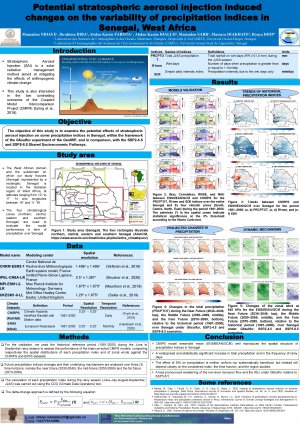
Poster_NDIAYE-Mamadou_ECAS8-2026.pdf
Atmospheric Boundary Layer Dynamics over Agartala, a North-Eastern Indian Location: Insights from Ground-based Lidar Observations and Reanalysis Datasets
Short-term variability of atmospheric aerosol optical properties over Ioannina using the CALITOO Sun Photometer