Event submissions
Published
This submission belongs to the session S3. Aerosols of the event The 8th International Electronic Conference on Atmospheric Sciences
Published date
09 Oct, 2026
Academic Editor
'%3e%3cpath%20d='M12.6657%2010.9104C12.4185%2010.325%2012.0599%209.79327%2011.6097%209.34482C11.1609%208.89508%2010.6293%208.5365%2010.0442%208.28888C10.0389%208.28626%2010.0337%208.28495%2010.0285%208.28233C10.8446%207.69279%2011.3752%206.73249%2011.3752%205.64904C11.3752%203.8542%209.92103%202.39999%208.1262%202.39999C6.33136%202.39999%204.87715%203.8542%204.87715%205.64904C4.87715%206.73249%205.40774%207.69279%206.22393%208.28364C6.21869%208.28626%206.21345%208.28757%206.20821%208.29019C5.62129%208.5378%205.09463%208.89284%204.64265%209.34613C4.1929%209.79493%203.83432%2010.3266%203.58671%2010.9117C3.34345%2011.4845%203.21226%2012.0987%203.20023%2012.7209C3.19988%2012.7349%203.20233%2012.7488%203.20744%2012.7619C3.21255%2012.7749%203.22022%2012.7867%203.22998%2012.7968C3.23975%2012.8068%203.25142%2012.8147%203.26431%2012.8202C3.2772%2012.8256%203.29105%2012.8284%203.30504%2012.8284H4.09109C4.14874%2012.8284%204.19459%2012.7825%204.1959%2012.7262C4.2221%2011.7148%204.62823%2010.7676%205.34617%2010.0497C6.08899%209.30683%207.0755%208.89808%208.1262%208.89808C9.17689%208.89808%2010.1634%209.30683%2010.9062%2010.0497C11.6242%2010.7676%2012.0303%2011.7148%2012.0565%2012.7262C12.0578%2012.7838%2012.1037%2012.8284%2012.1613%2012.8284H12.9474C12.9613%2012.8284%2012.9752%2012.8256%2012.9881%2012.8202C13.001%2012.8147%2013.0126%2012.8068%2013.0224%2012.7968C13.0322%2012.7867%2013.0398%2012.7749%2013.0449%2012.7619C13.0501%2012.7488%2013.0525%2012.7349%2013.0522%2012.7209C13.0391%2012.0947%2012.9094%2011.4855%2012.6657%2010.9104ZM8.1262%207.9024C7.52486%207.9024%206.9589%207.6679%206.53312%207.24211C6.10733%206.81633%205.87283%206.25037%205.87283%205.64904C5.87283%205.0477%206.10733%204.48174%206.53312%204.05596C6.9589%203.63018%207.52486%203.39567%208.1262%203.39567C8.72753%203.39567%209.29349%203.63018%209.71927%204.05596C10.1451%204.48174%2010.3796%205.0477%2010.3796%205.64904C10.3796%206.25037%2010.1451%206.81633%209.71927%207.24211C9.29349%207.6679%208.72753%207.9024%208.1262%207.9024Z'%20fill='%235D1EE1'/%3e%3c/g%3e%3c/svg%3e) Dimitris Kaskaoutis
Dimitris KaskaoutisCitation
Julia Salerno, Alfred Micallef, Adam Gauci, Optical properties of atmospheric aerosols over Gozo: Comparative analysis of ground-based measurements and satellite data, in Proceedings of The 8th International Electronic Conference on Atmospheric Sciences, 14 October–16 October 2026, MDPI: Basel, Switzerland
Share
Email
Facebook
Twitter
LinkedIn
Optical properties of atmospheric aerosols over Gozo: Comparative analysis of ground-based measurements and satellite data
'%3e%3cpath%20d='M12.6647%2010.9104C12.4176%2010.325%2012.0589%209.7933%2011.6088%209.34485C11.16%208.89511%2010.6283%208.53653%2010.0432%208.28891C10.038%208.28629%2010.0327%208.28498%2010.0275%208.28236C10.8437%207.69282%2011.3743%206.73252%2011.3743%205.64907C11.3743%203.85423%209.92005%202.40002%208.12522%202.40002C6.33038%202.40002%204.87618%203.85423%204.87618%205.64907C4.87618%206.73252%205.40677%207.69282%206.22296%208.28367C6.21772%208.28629%206.21248%208.2876%206.20724%208.29022C5.62031%208.53783%205.09365%208.89287%204.64167%209.34616C4.19192%209.79496%203.83334%2010.3266%203.58573%2010.9117C3.34247%2011.4846%203.21128%2012.0987%203.19925%2012.721C3.1989%2012.735%203.20135%2012.7489%203.20646%2012.7619C3.21157%2012.7749%203.21924%2012.7868%203.22901%2012.7968C3.23877%2012.8068%203.25045%2012.8148%203.26334%2012.8202C3.27623%2012.8256%203.29007%2012.8284%203.30406%2012.8284H4.09012C4.14776%2012.8284%204.19362%2012.7825%204.19493%2012.7262C4.22113%2011.7148%204.62726%2010.7676%205.34519%2010.0497C6.08802%209.30686%207.07452%208.89811%208.12522%208.89811C9.17592%208.89811%2010.1624%209.30686%2010.9052%2010.0497C11.6232%2010.7676%2012.0293%2011.7148%2012.0555%2012.7262C12.0568%2012.7839%2012.1027%2012.8284%2012.1603%2012.8284H12.9464C12.9604%2012.8284%2012.9742%2012.8256%2012.9871%2012.8202C13%2012.8148%2013.0117%2012.8068%2013.0214%2012.7968C13.0312%2012.7868%2013.0389%2012.7749%2013.044%2012.7619C13.0491%2012.7489%2013.0515%2012.735%2013.0512%2012.721C13.0381%2012.0947%2012.9084%2011.4856%2012.6647%2010.9104ZM8.12522%207.90243C7.52388%207.90243%206.95792%207.66793%206.53214%207.24215C6.10636%206.81636%205.87185%206.2504%205.87185%205.64907C5.87185%205.04773%206.10636%204.48177%206.53214%204.05599C6.95792%203.63021%207.52388%203.3957%208.12522%203.3957C8.72655%203.3957%209.29252%203.63021%209.7183%204.05599C10.1441%204.48177%2010.3786%205.04773%2010.3786%205.64907C10.3786%206.2504%2010.1441%206.81636%209.7183%207.24215C9.29252%207.66793%208.72655%207.90243%208.12522%207.90243Z'%20fill='%235D1EE1'/%3e%3c/g%3e%3c/svg%3e)
Julia Salerno 1
Alfred Micallef 1
Adam Gauci 1
1. Department of Geosciences, Faculty of Science, University of Malta, Msida MSD 2080, Malta
Abstract
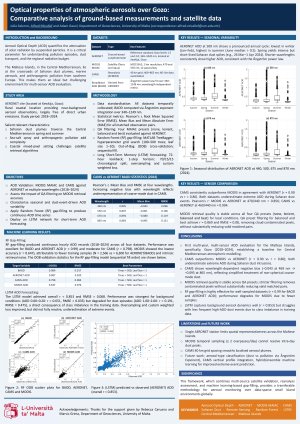
Introduction: This study presents an evaluation of Aerosol Optical Depth (AOD) over the Maltese Islands, by using a combination of data sources. The main objective was to evaluate the accuracy, spectral behaviour and temporal consistency of AOD retrieved from AERONET, MODIS-MAIAC, both TERRA and AQUA, and CAMS, as well as the Broadband AOD (BAOD), that was obtained from AERONET and calculated using the Ångström power-law fit.
Methods and Results: Satellite-derived and reanalysis AOD exhibited strong seasonal agreement with ground-based sun-photometric observations, i.e., AERONET, although specific differences in magnitude were apparent during high-intensity dust events. CAMS had the highest correlations (r ≈ 0.89–0.90) across all wavelengths that were considered, while a consistent negative bias was observed due to underrepresentation of coarse-mode dust particles, which increased at longer wavelengths. MODIS-MAIAC showed good performance under strict quality-assurance filtering, but it failed to capture the extreme values in AOD. A pronounced seasonal AOD cycle was evident, peaking in spring and summer, in good agreement with documented Saharan dust outbreaks affecting the region. In order to address the substantial temporal gaps in all datasets, a Random Forest (RF) model and a Long Short-Term Memory (LSTM) neural network/algorithm were applied. The RF model yielded highly accurate reconstructions for AERONET and BAOD (r ≈ 0.99), a moderate performance for CAMS, and a lower accuracy for MODIS-MAIAC due to sparsity in the retrievals. The LSTM model captured the general temporal behaviour successfully (r ≈ 0.85). However, it consistently underestimated the magnitude of extreme AOD events due to sparsity within the training dataset and insufficient representation of high-AOD cases.
Conclusions: This work presents the first multi-year, multi-sensor AOD evaluation for the Maltese Islands, showing that the integration of ground-based, satellite, and model data with machine-learning-based gap filling provides a very robust framework for aerosol monitoring over small islands.
Keywords
Aerosol Optical Depth
AOD
AERONET MODIS-MAIAC
CAMS
Broadband AOD
Saharan Dust
Remote Sensing
Random Forest
LSTM
Poster
Poster Salerno-Micallef-Gauci ECAS 2026 - 8th edition.pdf
Beyond Traditional Source Apportionment: A Three-Dimensional Approach to Unravel PM10 Sources, Composition, and Transport Pathways
Ten-year trends of size distributions and black carbon at the Environmental-Climate Observatory in Lecce (Italy)