Event submissions
Published
This submission belongs to the session S4. Climatology of the event The 8th International Electronic Conference on Atmospheric Sciences
Published date
09 Oct, 2026
Academic Editor
'%3e%3cpath%20d='M12.6657%2010.9104C12.4185%2010.325%2012.0599%209.79327%2011.6097%209.34482C11.1609%208.89508%2010.6293%208.5365%2010.0442%208.28888C10.0389%208.28626%2010.0337%208.28495%2010.0285%208.28233C10.8446%207.69279%2011.3752%206.73249%2011.3752%205.64904C11.3752%203.8542%209.92103%202.39999%208.1262%202.39999C6.33136%202.39999%204.87715%203.8542%204.87715%205.64904C4.87715%206.73249%205.40774%207.69279%206.22393%208.28364C6.21869%208.28626%206.21345%208.28757%206.20821%208.29019C5.62129%208.5378%205.09463%208.89284%204.64265%209.34613C4.1929%209.79493%203.83432%2010.3266%203.58671%2010.9117C3.34345%2011.4845%203.21226%2012.0987%203.20023%2012.7209C3.19988%2012.7349%203.20233%2012.7488%203.20744%2012.7619C3.21255%2012.7749%203.22022%2012.7867%203.22998%2012.7968C3.23975%2012.8068%203.25142%2012.8147%203.26431%2012.8202C3.2772%2012.8256%203.29105%2012.8284%203.30504%2012.8284H4.09109C4.14874%2012.8284%204.19459%2012.7825%204.1959%2012.7262C4.2221%2011.7148%204.62823%2010.7676%205.34617%2010.0497C6.08899%209.30683%207.0755%208.89808%208.1262%208.89808C9.17689%208.89808%2010.1634%209.30683%2010.9062%2010.0497C11.6242%2010.7676%2012.0303%2011.7148%2012.0565%2012.7262C12.0578%2012.7838%2012.1037%2012.8284%2012.1613%2012.8284H12.9474C12.9613%2012.8284%2012.9752%2012.8256%2012.9881%2012.8202C13.001%2012.8147%2013.0126%2012.8068%2013.0224%2012.7968C13.0322%2012.7867%2013.0398%2012.7749%2013.0449%2012.7619C13.0501%2012.7488%2013.0525%2012.7349%2013.0522%2012.7209C13.0391%2012.0947%2012.9094%2011.4855%2012.6657%2010.9104ZM8.1262%207.9024C7.52486%207.9024%206.9589%207.6679%206.53312%207.24211C6.10733%206.81633%205.87283%206.25037%205.87283%205.64904C5.87283%205.0477%206.10733%204.48174%206.53312%204.05596C6.9589%203.63018%207.52486%203.39567%208.1262%203.39567C8.72753%203.39567%209.29349%203.63018%209.71927%204.05596C10.1451%204.48174%2010.3796%205.0477%2010.3796%205.64904C10.3796%206.25037%2010.1451%206.81633%209.71927%207.24211C9.29349%207.6679%208.72753%207.9024%208.1262%207.9024Z'%20fill='%235D1EE1'/%3e%3c/g%3e%3c/svg%3e) Anthony R. Lupo
Anthony R. LupoCitation
Anita Drumond, Theotonio Pauliquevis, Rogert Sorí, Characterization of Compound Temperature–Precipitation Events in the Upper Paraná Basin (1991–2024), in Proceedings of The 8th International Electronic Conference on Atmospheric Sciences, 14 October–16 October 2026, MDPI: Basel, Switzerland
Share
Email
Facebook
Twitter
LinkedIn
Characterization of Compound Temperature–Precipitation Events in the Upper Paraná Basin (1991–2024)

Anita Drumond 1

Theotonio Pauliquevis 1

Rogert Sorí 2
1. Institute of Environmental, Chemical and Pharmaceutical Sciences, Federal University of Sao Paulo, Diadema, 09913-030, Brazil
2. Marine Research Center, University of Vigo, Ourense, 32004, Spain
Abstract
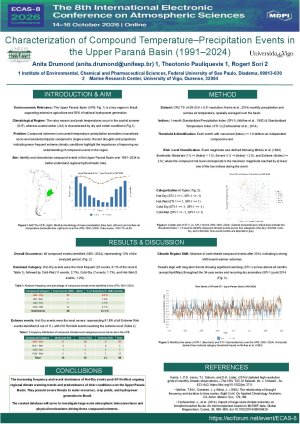
Compound temperature–precipitation events can increase environmental and socioeconomic impacts. The Upper Paraná Basin is one of the most important regions in Brazil, supporting extensive agricultural activities and nearly half of the country's hydropower generation. Recent droughts and projections indicating more frequent extreme climatic conditions highlight the importance of improving our understanding of compound events in the region. This study presents an approach to identify and characterize compound temperature–precipitation events in the Upper Paraná Basin during 1991–2024. The methodology combines the one-month Standardized Temperature Index (STI-1) and the one-month Standardized Precipitation Index (SPI-1) to identify months with concurrent temperature and precipitation anomalies. Monthly precipitation and surface air temperature from the CRU TS v4.09 dataset, with a regular spatial resolution of 0.5 degrees, were spatially averaged over the Upper Paraná Basin and used to calculate SPI-1 and STI-1. Events were defined using a threshold of 1 and classified into four categories according to the sign of the anomalies: Hot-Dry, Hot-Wet, Cold-Dry, and Cold-Wet. Each month satisfying these conditions was treated as an independent compound event occurrence. A total of 48 compound events were identified during 1991–2024, corresponding to 12% of the analyzed period. Event occurrence was not equally distributed among the categories, with Hot-Dry events being the most frequent (25 events, corresponding to 6% of the total record). The recent predominance of Hot-Dry events and the absence of cold-related compound events after 2014 are consistent with the observed climatic trends, which indicate significant warming in nearly all months (except April and May) and a significant drying trend only in the complete time series. These findings highlight increasing risks to water resources, agriculture, and hydropower generation in the Upper Paraná Basin. The event database generated in this study will support future investigations of the physical mechanisms associated with these compound extremes.
Keywords
Upper Paraná Basin
precipitation
temperature
compound events
Poster
Drumondetal_2026_ECAS8.pdf
Quantum-Enhanced Atmospheric Modeling: Variational Quantum Eigensolver Approaches for Climate System Simulation
Critical timings of the Arctic sea ice decline in three generations of CMIP models from a parametric approximation approach