Event submissions
Published
This submission belongs to the session S4. Climatology of the event The 8th International Electronic Conference on Atmospheric Sciences
Published date
09 Oct, 2026
Academic Editor
'%3e%3cpath%20d='M12.6657%2010.9104C12.4185%2010.325%2012.0599%209.79327%2011.6097%209.34482C11.1609%208.89508%2010.6293%208.5365%2010.0442%208.28888C10.0389%208.28626%2010.0337%208.28495%2010.0285%208.28233C10.8446%207.69279%2011.3752%206.73249%2011.3752%205.64904C11.3752%203.8542%209.92103%202.39999%208.1262%202.39999C6.33136%202.39999%204.87715%203.8542%204.87715%205.64904C4.87715%206.73249%205.40774%207.69279%206.22393%208.28364C6.21869%208.28626%206.21345%208.28757%206.20821%208.29019C5.62129%208.5378%205.09463%208.89284%204.64265%209.34613C4.1929%209.79493%203.83432%2010.3266%203.58671%2010.9117C3.34345%2011.4845%203.21226%2012.0987%203.20023%2012.7209C3.19988%2012.7349%203.20233%2012.7488%203.20744%2012.7619C3.21255%2012.7749%203.22022%2012.7867%203.22998%2012.7968C3.23975%2012.8068%203.25142%2012.8147%203.26431%2012.8202C3.2772%2012.8256%203.29105%2012.8284%203.30504%2012.8284H4.09109C4.14874%2012.8284%204.19459%2012.7825%204.1959%2012.7262C4.2221%2011.7148%204.62823%2010.7676%205.34617%2010.0497C6.08899%209.30683%207.0755%208.89808%208.1262%208.89808C9.17689%208.89808%2010.1634%209.30683%2010.9062%2010.0497C11.6242%2010.7676%2012.0303%2011.7148%2012.0565%2012.7262C12.0578%2012.7838%2012.1037%2012.8284%2012.1613%2012.8284H12.9474C12.9613%2012.8284%2012.9752%2012.8256%2012.9881%2012.8202C13.001%2012.8147%2013.0126%2012.8068%2013.0224%2012.7968C13.0322%2012.7867%2013.0398%2012.7749%2013.0449%2012.7619C13.0501%2012.7488%2013.0525%2012.7349%2013.0522%2012.7209C13.0391%2012.0947%2012.9094%2011.4855%2012.6657%2010.9104ZM8.1262%207.9024C7.52486%207.9024%206.9589%207.6679%206.53312%207.24211C6.10733%206.81633%205.87283%206.25037%205.87283%205.64904C5.87283%205.0477%206.10733%204.48174%206.53312%204.05596C6.9589%203.63018%207.52486%203.39567%208.1262%203.39567C8.72753%203.39567%209.29349%203.63018%209.71927%204.05596C10.1451%204.48174%2010.3796%205.0477%2010.3796%205.64904C10.3796%206.25037%2010.1451%206.81633%209.71927%207.24211C9.29349%207.6679%208.72753%207.9024%208.1262%207.9024Z'%20fill='%235D1EE1'/%3e%3c/g%3e%3c/svg%3e) Anthony R. Lupo
Anthony R. LupoCitation
Margarita Aleksandrovna Tkachenko, Eugene E Rozanov, CLIMATE RESPONSE TO A TAMBORA-SCALE ERUPTION ACROSS FIVE BACKGROUND CLIMATE STATES, in Proceedings of The 8th International Electronic Conference on Atmospheric Sciences, 14 October–16 October 2026, MDPI: Basel, Switzerland
Share
Email
Facebook
Twitter
LinkedIn
CLIMATE RESPONSE TO A TAMBORA-SCALE ERUPTION ACROSS FIVE BACKGROUND CLIMATE STATES
'%3e%3cpath%20d='M12.6647%2010.9104C12.4176%2010.325%2012.0589%209.7933%2011.6088%209.34485C11.16%208.89511%2010.6283%208.53653%2010.0432%208.28891C10.038%208.28629%2010.0327%208.28498%2010.0275%208.28236C10.8437%207.69282%2011.3743%206.73252%2011.3743%205.64907C11.3743%203.85423%209.92005%202.40002%208.12522%202.40002C6.33038%202.40002%204.87618%203.85423%204.87618%205.64907C4.87618%206.73252%205.40677%207.69282%206.22296%208.28367C6.21772%208.28629%206.21248%208.2876%206.20724%208.29022C5.62031%208.53783%205.09365%208.89287%204.64167%209.34616C4.19192%209.79496%203.83334%2010.3266%203.58573%2010.9117C3.34247%2011.4846%203.21128%2012.0987%203.19925%2012.721C3.1989%2012.735%203.20135%2012.7489%203.20646%2012.7619C3.21157%2012.7749%203.21924%2012.7868%203.22901%2012.7968C3.23877%2012.8068%203.25045%2012.8148%203.26334%2012.8202C3.27623%2012.8256%203.29007%2012.8284%203.30406%2012.8284H4.09012C4.14776%2012.8284%204.19362%2012.7825%204.19493%2012.7262C4.22113%2011.7148%204.62726%2010.7676%205.34519%2010.0497C6.08802%209.30686%207.07452%208.89811%208.12522%208.89811C9.17592%208.89811%2010.1624%209.30686%2010.9052%2010.0497C11.6232%2010.7676%2012.0293%2011.7148%2012.0555%2012.7262C12.0568%2012.7839%2012.1027%2012.8284%2012.1603%2012.8284H12.9464C12.9604%2012.8284%2012.9742%2012.8256%2012.9871%2012.8202C13%2012.8148%2013.0117%2012.8068%2013.0214%2012.7968C13.0312%2012.7868%2013.0389%2012.7749%2013.044%2012.7619C13.0491%2012.7489%2013.0515%2012.735%2013.0512%2012.721C13.0381%2012.0947%2012.9084%2011.4856%2012.6647%2010.9104ZM8.12522%207.90243C7.52388%207.90243%206.95792%207.66793%206.53214%207.24215C6.10636%206.81636%205.87185%206.2504%205.87185%205.64907C5.87185%205.04773%206.10636%204.48177%206.53214%204.05599C6.95792%203.63021%207.52388%203.3957%208.12522%203.3957C8.72655%203.3957%209.29252%203.63021%209.7183%204.05599C10.1441%204.48177%2010.3786%205.04773%2010.3786%205.64907C10.3786%206.2504%2010.1441%206.81636%209.7183%207.24215C9.29252%207.66793%208.72655%207.90243%208.12522%207.90243Z'%20fill='%235D1EE1'/%3e%3c/g%3e%3c/svg%3e)
Margarita Aleksandrovna Tkachenko 1

Eugene E Rozanov 1
1. Laboratory for Ozone Layer and Upper Atmosphere Research, Saint-Petersburg State University, Saint Petersburg, 199034, Russia
Abstract
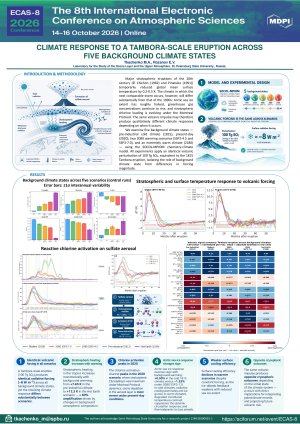
For a fixed volcanic forcing, the climate response is governed by the state of the system into which the eruption occurs. Using the coupled chemistry–climate model SOCOL-MPIOM, we ran an ensemble of 55 ten-year simulations with a 100 Tg SO₂ injection across five background states, from the pre-industrial climate of 1815 to the extremely warm climate of 2180 under the High Extension CMIP7 scenario. The aerosol radiative forcing is robust across all states (−7.9 to −8.7 W·m⁻², spread below 10%), whereas the inter-scenario spread in peak surface cooling reaches 90%. The uncertainty originates in the response of the system, not in the forcing itself.
The ozone response switches between physically distinct channels as the background halogen loading increases. At Cly ~250 pptv (1815), heterogeneous chlorine activation is negligible and the entire tropical signal is produced by enhanced meridional transport (+8.48 DU). From the present-day climate onward, a heterogeneous chlorine channel develops, scaling linearly with background Cly (r = 0.97); in the warm states it deepens the tropical ozone deficit to 12.3 DU. The dynamical and chemical mechanisms, usually treated jointly, are here separated by the background composition of the stratosphere.
The cryospheric response reverses sign under an unchanged dynamical mechanism. Strengthening of the polar vortex following the eruption is reproduced in all states, but its consequence for sea ice depends on the initial ice cover: ice area expands under cold conditions and contracts under moderate warming (SSP3-7.0). The same atmospheric signal expands or reduces the cryosphere depending on the initial state.
Concurrent results are consistent with this picture: stratospheric heating grows from +8 K (1815) to +15 K in the warm scenarios, while the winter warming of northern Eurasia through the positive phase of the Arctic Oscillation (+1.31 K) weakens as the temperature contrast declines.
The authors acknowledge Saint-Petersburg State University for a research project 124032000025-1
Keywords
volcanic forcing
chemistry-climate modelling
SOCOL-MPIOM
Tambora
stratospheric aerosol
background climate state
stratospheric ozone
climate response
Poster
ECAS2026.pdf
Multiscale determination and characterization of drought precursors in Córdoba province (Southern Spain) using machine learning models
Mapping Urban Heat Islands in Casablanca (Morocco): Spatial Analysis and Prospects for Mitigation Through Landscape Design