Event submissions
Published
This submission belongs to the session S4. Climatology of the event The 8th International Electronic Conference on Atmospheric Sciences
Published date
09 Oct, 2026
Academic Editor
'%3e%3cpath%20d='M12.6657%2010.9104C12.4185%2010.325%2012.0599%209.79327%2011.6097%209.34482C11.1609%208.89508%2010.6293%208.5365%2010.0442%208.28888C10.0389%208.28626%2010.0337%208.28495%2010.0285%208.28233C10.8446%207.69279%2011.3752%206.73249%2011.3752%205.64904C11.3752%203.8542%209.92103%202.39999%208.1262%202.39999C6.33136%202.39999%204.87715%203.8542%204.87715%205.64904C4.87715%206.73249%205.40774%207.69279%206.22393%208.28364C6.21869%208.28626%206.21345%208.28757%206.20821%208.29019C5.62129%208.5378%205.09463%208.89284%204.64265%209.34613C4.1929%209.79493%203.83432%2010.3266%203.58671%2010.9117C3.34345%2011.4845%203.21226%2012.0987%203.20023%2012.7209C3.19988%2012.7349%203.20233%2012.7488%203.20744%2012.7619C3.21255%2012.7749%203.22022%2012.7867%203.22998%2012.7968C3.23975%2012.8068%203.25142%2012.8147%203.26431%2012.8202C3.2772%2012.8256%203.29105%2012.8284%203.30504%2012.8284H4.09109C4.14874%2012.8284%204.19459%2012.7825%204.1959%2012.7262C4.2221%2011.7148%204.62823%2010.7676%205.34617%2010.0497C6.08899%209.30683%207.0755%208.89808%208.1262%208.89808C9.17689%208.89808%2010.1634%209.30683%2010.9062%2010.0497C11.6242%2010.7676%2012.0303%2011.7148%2012.0565%2012.7262C12.0578%2012.7838%2012.1037%2012.8284%2012.1613%2012.8284H12.9474C12.9613%2012.8284%2012.9752%2012.8256%2012.9881%2012.8202C13.001%2012.8147%2013.0126%2012.8068%2013.0224%2012.7968C13.0322%2012.7867%2013.0398%2012.7749%2013.0449%2012.7619C13.0501%2012.7488%2013.0525%2012.7349%2013.0522%2012.7209C13.0391%2012.0947%2012.9094%2011.4855%2012.6657%2010.9104ZM8.1262%207.9024C7.52486%207.9024%206.9589%207.6679%206.53312%207.24211C6.10733%206.81633%205.87283%206.25037%205.87283%205.64904C5.87283%205.0477%206.10733%204.48174%206.53312%204.05596C6.9589%203.63018%207.52486%203.39567%208.1262%203.39567C8.72753%203.39567%209.29349%203.63018%209.71927%204.05596C10.1451%204.48174%2010.3796%205.0477%2010.3796%205.64904C10.3796%206.25037%2010.1451%206.81633%209.71927%207.24211C9.29349%207.6679%208.72753%207.9024%208.1262%207.9024Z'%20fill='%235D1EE1'/%3e%3c/g%3e%3c/svg%3e) Eugene Rozanov
Eugene RozanovCitation
Fahim Sufi, AI-Based Ocean Climate Risk Diagnostics Using Longitudinal Ocean Health Index Data, in Proceedings of The 8th International Electronic Conference on Atmospheric Sciences, 14 October–16 October 2026, MDPI: Basel, Switzerland
Share
Email
Facebook
Twitter
LinkedIn
AI-Based Ocean Climate Risk Diagnostics Using Longitudinal Ocean Health Index Data

Fahim Sufi 1,2
1. Office of CTO, COEUS Institute, New Market, VA 22844, USA
2. CTI, University of Dhaka, Dhaka 1000, Bangladesh
Abstract
Introduction:
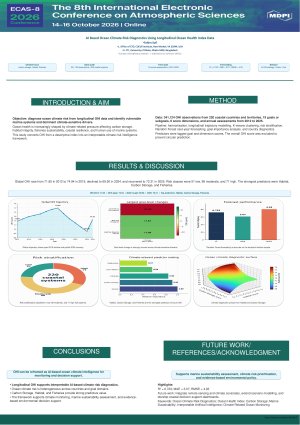
Ocean health is increasingly shaped by climate-related pressures affecting carbon storage, habitat integrity, fishery sustainability, coastal resilience, and human use of marine systems. However, many ocean assessment studies remain descriptive and do not sufficiently identify which countries are vulnerable, which goal domains drive future change, or how ocean climate risk evolves over time. This study develops an interpretable artificial intelligence framework for diagnosing ocean climate risk from longitudinal Ocean Health Index data.
Methods:
The analysis uses 341,124 Ocean Health Index score observations covering 220 coastal countries and territories, 19 goals or subgoals, six score dimensions, and annual assessments from 2012 to 2025. The framework combines data harmonisation, longitudinal trajectory modelling, K means clustering, risk stratification, Random Forest next-year forecasting, goal-level importance analysis, and country-specific policy diagnostics. Forecast predictors were constructed from lagged Ocean Health Index goal and dimension scores, while the overall Index was excluded from the predictor set to prevent circular prediction.
Results:
The global Ocean Health Index increased from 71.85 in 2012 to 74.94 in 2019, declined to 69.50 in 2024, and partially recovered to 72.31 in 2025, remaining 2.63 points below its 2019 level. Goal-level change was highly uneven, with Tourism and Recreation declining by 12.42 points, while Natural Products and Lasting Special Places increased by 7.67 and 7.38 points, respectively. Risk stratification classified 51 countries and territories as low risk, 98 as moderate risk, and 71 as high risk. The Random Forest model forecasted next-year ocean health performance with R² = 0.723, MAE = 3.07, and RMSE = 4.03, identifying Habitat, Carbon Storage, and Fisheries as the strongest predictors of future Ocean Health Index scores.
Conclusions:
This study demonstrates that longitudinal ocean health data can support AI-based climate risk diagnostics. By linking carbon storage, habitat condition, fishery pressure, forecast performance, and national risk classes, the framework provides a scalable approach for ocean climate monitoring, marine sustainability assessment, and evidence-based environmental decision support.
Keywords
Ocean Climate Risk Diagnostics
Ocean Health Index
Carbon Storage
Marine Sustainability
Interpretable Artificial Intelligence
Climate Related Ocean Monitoring
Poster
ECAS8_Ocean_Climate_Risk_Diagnostics_Poster.pdf
Hydroclimatic changes across the Himalayan region under future climate scenarios
Future changes in dry and wet sequences over West Africa under the Shared Socioeconomic Pathways (SSPs)