Event submissions
Published
This submission belongs to the session S5. Air Pollution Control of the event The 8th International Electronic Conference on Atmospheric Sciences
Published date
09 Oct, 2026
Academic Editor
'%3e%3cpath%20d='M12.6657%2010.9104C12.4185%2010.325%2012.0599%209.79327%2011.6097%209.34482C11.1609%208.89508%2010.6293%208.5365%2010.0442%208.28888C10.0389%208.28626%2010.0337%208.28495%2010.0285%208.28233C10.8446%207.69279%2011.3752%206.73249%2011.3752%205.64904C11.3752%203.8542%209.92103%202.39999%208.1262%202.39999C6.33136%202.39999%204.87715%203.8542%204.87715%205.64904C4.87715%206.73249%205.40774%207.69279%206.22393%208.28364C6.21869%208.28626%206.21345%208.28757%206.20821%208.29019C5.62129%208.5378%205.09463%208.89284%204.64265%209.34613C4.1929%209.79493%203.83432%2010.3266%203.58671%2010.9117C3.34345%2011.4845%203.21226%2012.0987%203.20023%2012.7209C3.19988%2012.7349%203.20233%2012.7488%203.20744%2012.7619C3.21255%2012.7749%203.22022%2012.7867%203.22998%2012.7968C3.23975%2012.8068%203.25142%2012.8147%203.26431%2012.8202C3.2772%2012.8256%203.29105%2012.8284%203.30504%2012.8284H4.09109C4.14874%2012.8284%204.19459%2012.7825%204.1959%2012.7262C4.2221%2011.7148%204.62823%2010.7676%205.34617%2010.0497C6.08899%209.30683%207.0755%208.89808%208.1262%208.89808C9.17689%208.89808%2010.1634%209.30683%2010.9062%2010.0497C11.6242%2010.7676%2012.0303%2011.7148%2012.0565%2012.7262C12.0578%2012.7838%2012.1037%2012.8284%2012.1613%2012.8284H12.9474C12.9613%2012.8284%2012.9752%2012.8256%2012.9881%2012.8202C13.001%2012.8147%2013.0126%2012.8068%2013.0224%2012.7968C13.0322%2012.7867%2013.0398%2012.7749%2013.0449%2012.7619C13.0501%2012.7488%2013.0525%2012.7349%2013.0522%2012.7209C13.0391%2012.0947%2012.9094%2011.4855%2012.6657%2010.9104ZM8.1262%207.9024C7.52486%207.9024%206.9589%207.6679%206.53312%207.24211C6.10733%206.81633%205.87283%206.25037%205.87283%205.64904C5.87283%205.0477%206.10733%204.48174%206.53312%204.05596C6.9589%203.63018%207.52486%203.39567%208.1262%203.39567C8.72753%203.39567%209.29349%203.63018%209.71927%204.05596C10.1451%204.48174%2010.3796%205.0477%2010.3796%205.64904C10.3796%206.25037%2010.1451%206.81633%209.71927%207.24211C9.29349%207.6679%208.72753%207.9024%208.1262%207.9024Z'%20fill='%235D1EE1'/%3e%3c/g%3e%3c/svg%3e) Pasquale Avino
Pasquale AvinoCitation
Barbara Błaszczak, Krzysztof Słaby, Magdalena Żurawka, Barbara Mathews, Monika Błaszczak, Kamila Widziewicz-Rzońca, Anna Smola-Dmochowska, Patrycja Rogula-Kopiec, Long-term measurements of atmospheric black carbon in the Polish–Czech border region, in Proceedings of The 8th International Electronic Conference on Atmospheric Sciences, 14 October–16 October 2026, MDPI: Basel, Switzerland
Share
Email
Facebook
Twitter
LinkedIn
Long-term measurements of atmospheric black carbon in the Polish–Czech border region
'%3e%3cpath%20d='M12.6647%2010.9104C12.4176%2010.325%2012.0589%209.7933%2011.6088%209.34485C11.16%208.89511%2010.6283%208.53653%2010.0432%208.28891C10.038%208.28629%2010.0327%208.28498%2010.0275%208.28236C10.8437%207.69282%2011.3743%206.73252%2011.3743%205.64907C11.3743%203.85423%209.92005%202.40002%208.12522%202.40002C6.33038%202.40002%204.87618%203.85423%204.87618%205.64907C4.87618%206.73252%205.40677%207.69282%206.22296%208.28367C6.21772%208.28629%206.21248%208.2876%206.20724%208.29022C5.62031%208.53783%205.09365%208.89287%204.64167%209.34616C4.19192%209.79496%203.83334%2010.3266%203.58573%2010.9117C3.34247%2011.4846%203.21128%2012.0987%203.19925%2012.721C3.1989%2012.735%203.20135%2012.7489%203.20646%2012.7619C3.21157%2012.7749%203.21924%2012.7868%203.22901%2012.7968C3.23877%2012.8068%203.25045%2012.8148%203.26334%2012.8202C3.27623%2012.8256%203.29007%2012.8284%203.30406%2012.8284H4.09012C4.14776%2012.8284%204.19362%2012.7825%204.19493%2012.7262C4.22113%2011.7148%204.62726%2010.7676%205.34519%2010.0497C6.08802%209.30686%207.07452%208.89811%208.12522%208.89811C9.17592%208.89811%2010.1624%209.30686%2010.9052%2010.0497C11.6232%2010.7676%2012.0293%2011.7148%2012.0555%2012.7262C12.0568%2012.7839%2012.1027%2012.8284%2012.1603%2012.8284H12.9464C12.9604%2012.8284%2012.9742%2012.8256%2012.9871%2012.8202C13%2012.8148%2013.0117%2012.8068%2013.0214%2012.7968C13.0312%2012.7868%2013.0389%2012.7749%2013.044%2012.7619C13.0491%2012.7489%2013.0515%2012.735%2013.0512%2012.721C13.0381%2012.0947%2012.9084%2011.4856%2012.6647%2010.9104ZM8.12522%207.90243C7.52388%207.90243%206.95792%207.66793%206.53214%207.24215C6.10636%206.81636%205.87185%206.2504%205.87185%205.64907C5.87185%205.04773%206.10636%204.48177%206.53214%204.05599C6.95792%203.63021%207.52388%203.3957%208.12522%203.3957C8.72655%203.3957%209.29252%203.63021%209.7183%204.05599C10.1441%204.48177%2010.3786%205.04773%2010.3786%205.64907C10.3786%206.2504%2010.1441%206.81636%209.7183%207.24215C9.29252%207.66793%208.72655%207.90243%208.12522%207.90243Z'%20fill='%235D1EE1'/%3e%3c/g%3e%3c/svg%3e)
Barbara Błaszczak 1
Krzysztof Słaby 1
Magdalena Żurawka 1
Barbara Mathews 1
Monika Błaszczak 1
Kamila Widziewicz-Rzońca 1
Anna Smola-Dmochowska 1

Patrycja Rogula-Kopiec 1
1. Institute of Environmental Engineering of the Polish Academy of Sciences, Zabrze, Poland
Abstract
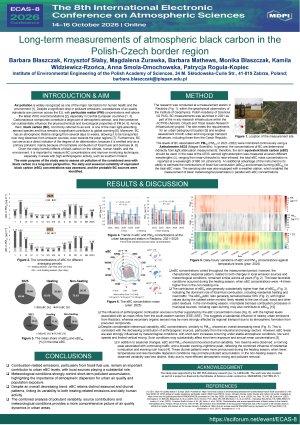
Introduction: Carbonaceous compounds are the main components of particulate matter (PM). Black carbon (BC), produced by incomplete combustion of biomass and fossil fuels, is an important air pollutant with significant impacts on climate, ecosystems, and human health. This study aimed to characterize the temporal variability of BC levels in an urban area using data from a five-year measurement campaign.
Methods: BC concentrations were continuously monitored at the IG PAS geophysical observatory in Racibórz using an Aethalometer AE33 (Magee Scientific), with eBC associated with PM2.5 (2021–2022) and with PM₁₀ (from 2023). As the method determines BC concentrations indirectly from aerosol light absorption, the measured values are reported as equivalent black carbon (eBC). The AE33 also enables the apportionment of eBC from fossil fuel combustion (eBCff) and biomass burning (eBCbb).
Results: The annual mean concentrations of eBC, eBCff, and eBCbb in 2025 were 1.65, 1.13, and 0.51 µg·m⁻³, respectively. These values were slightly higher than those observed in 2023–2024 but lower than those in 2021 (2.15, 1.61, and 0.54 µg·m⁻³, respectively). Clear seasonal variability was observed, with higher eBC concentrations during the heating season (2.64 µg·m⁻³) compared with the non-heating one (0.67 µg·m⁻³). Fossil fuel combustion was the dominant contributor throughout the year, accounting for ~69% of total eBC. The eBCbb/eBC ratio generally remained below 50%, with higher values observed mainly during the heating season.
Conclusions: Combustion processes strongly influence urban eBC levels, with fossil fuel sources remaining the dominant contributors. Despite interannual variability, the observed decreasing trend reflects the reduction in anthropogenic emissions in Poland, particularly from industrial and energy sectors.
Acknowledgements: The study was supported by IEE PAS statutory research (no. 1a-146/24-26). The work was also created as part of a project co-financed by the Minister of Science under contract no. 2024/WK/04 (“ACTRIS-PL”).
Keywords
particulate matter
black carbon
urban air quality
fossil fuel combustion
biomass burning
long-term measurements
tempotal variability
Poster
ECAS-Błaszczak et al.-2026.pdf
High spatiotemporal resolution co-estimation of PM2.5 chemical components in the western United States
Hybrid numerical–ML integrated model for hourly high spatial resolution PM2.5 forecasting up to 120 hours