Event submissions
Published
This submission belongs to the session S5. Air Pollution Control of the event The 8th International Electronic Conference on Atmospheric Sciences
Published date
09 Oct, 2026
Academic Editor
'%3e%3cpath%20d='M12.6657%2010.9104C12.4185%2010.325%2012.0599%209.79327%2011.6097%209.34482C11.1609%208.89508%2010.6293%208.5365%2010.0442%208.28888C10.0389%208.28626%2010.0337%208.28495%2010.0285%208.28233C10.8446%207.69279%2011.3752%206.73249%2011.3752%205.64904C11.3752%203.8542%209.92103%202.39999%208.1262%202.39999C6.33136%202.39999%204.87715%203.8542%204.87715%205.64904C4.87715%206.73249%205.40774%207.69279%206.22393%208.28364C6.21869%208.28626%206.21345%208.28757%206.20821%208.29019C5.62129%208.5378%205.09463%208.89284%204.64265%209.34613C4.1929%209.79493%203.83432%2010.3266%203.58671%2010.9117C3.34345%2011.4845%203.21226%2012.0987%203.20023%2012.7209C3.19988%2012.7349%203.20233%2012.7488%203.20744%2012.7619C3.21255%2012.7749%203.22022%2012.7867%203.22998%2012.7968C3.23975%2012.8068%203.25142%2012.8147%203.26431%2012.8202C3.2772%2012.8256%203.29105%2012.8284%203.30504%2012.8284H4.09109C4.14874%2012.8284%204.19459%2012.7825%204.1959%2012.7262C4.2221%2011.7148%204.62823%2010.7676%205.34617%2010.0497C6.08899%209.30683%207.0755%208.89808%208.1262%208.89808C9.17689%208.89808%2010.1634%209.30683%2010.9062%2010.0497C11.6242%2010.7676%2012.0303%2011.7148%2012.0565%2012.7262C12.0578%2012.7838%2012.1037%2012.8284%2012.1613%2012.8284H12.9474C12.9613%2012.8284%2012.9752%2012.8256%2012.9881%2012.8202C13.001%2012.8147%2013.0126%2012.8068%2013.0224%2012.7968C13.0322%2012.7867%2013.0398%2012.7749%2013.0449%2012.7619C13.0501%2012.7488%2013.0525%2012.7349%2013.0522%2012.7209C13.0391%2012.0947%2012.9094%2011.4855%2012.6657%2010.9104ZM8.1262%207.9024C7.52486%207.9024%206.9589%207.6679%206.53312%207.24211C6.10733%206.81633%205.87283%206.25037%205.87283%205.64904C5.87283%205.0477%206.10733%204.48174%206.53312%204.05596C6.9589%203.63018%207.52486%203.39567%208.1262%203.39567C8.72753%203.39567%209.29349%203.63018%209.71927%204.05596C10.1451%204.48174%2010.3796%205.0477%2010.3796%205.64904C10.3796%206.25037%2010.1451%206.81633%209.71927%207.24211C9.29349%207.6679%208.72753%207.9024%208.1262%207.9024Z'%20fill='%235D1EE1'/%3e%3c/g%3e%3c/svg%3e) Pasquale Avino
Pasquale AvinoCitation
Siti Nor Aishah Mohd Salleh, Maria Katsikogianni, Jaan Pu, Nejat Rahmanian, Chee Lok Yong, Biochar Slurry CO₂ Capture in a Rotating Bed Reactor: A Proof-of-Concept Study, in Proceedings of The 8th International Electronic Conference on Atmospheric Sciences, 14 October–16 October 2026, MDPI: Basel, Switzerland
Share
Email
Facebook
Twitter
LinkedIn
Biochar Slurry CO₂ Capture in a Rotating Bed Reactor: A Proof-of-Concept Study
'%3e%3cpath%20d='M12.6647%2010.9104C12.4176%2010.325%2012.0589%209.7933%2011.6088%209.34485C11.16%208.89511%2010.6283%208.53653%2010.0432%208.28891C10.038%208.28629%2010.0327%208.28498%2010.0275%208.28236C10.8437%207.69282%2011.3743%206.73252%2011.3743%205.64907C11.3743%203.85423%209.92005%202.40002%208.12522%202.40002C6.33038%202.40002%204.87618%203.85423%204.87618%205.64907C4.87618%206.73252%205.40677%207.69282%206.22296%208.28367C6.21772%208.28629%206.21248%208.2876%206.20724%208.29022C5.62031%208.53783%205.09365%208.89287%204.64167%209.34616C4.19192%209.79496%203.83334%2010.3266%203.58573%2010.9117C3.34247%2011.4846%203.21128%2012.0987%203.19925%2012.721C3.1989%2012.735%203.20135%2012.7489%203.20646%2012.7619C3.21157%2012.7749%203.21924%2012.7868%203.22901%2012.7968C3.23877%2012.8068%203.25045%2012.8148%203.26334%2012.8202C3.27623%2012.8256%203.29007%2012.8284%203.30406%2012.8284H4.09012C4.14776%2012.8284%204.19362%2012.7825%204.19493%2012.7262C4.22113%2011.7148%204.62726%2010.7676%205.34519%2010.0497C6.08802%209.30686%207.07452%208.89811%208.12522%208.89811C9.17592%208.89811%2010.1624%209.30686%2010.9052%2010.0497C11.6232%2010.7676%2012.0293%2011.7148%2012.0555%2012.7262C12.0568%2012.7839%2012.1027%2012.8284%2012.1603%2012.8284H12.9464C12.9604%2012.8284%2012.9742%2012.8256%2012.9871%2012.8202C13%2012.8148%2013.0117%2012.8068%2013.0214%2012.7968C13.0312%2012.7868%2013.0389%2012.7749%2013.044%2012.7619C13.0491%2012.7489%2013.0515%2012.735%2013.0512%2012.721C13.0381%2012.0947%2012.9084%2011.4856%2012.6647%2010.9104ZM8.12522%207.90243C7.52388%207.90243%206.95792%207.66793%206.53214%207.24215C6.10636%206.81636%205.87185%206.2504%205.87185%205.64907C5.87185%205.04773%206.10636%204.48177%206.53214%204.05599C6.95792%203.63021%207.52388%203.3957%208.12522%203.3957C8.72655%203.3957%209.29252%203.63021%209.7183%204.05599C10.1441%204.48177%2010.3786%205.04773%2010.3786%205.64907C10.3786%206.2504%2010.1441%206.81636%209.7183%207.24215C9.29252%207.66793%208.72655%207.90243%208.12522%207.90243Z'%20fill='%235D1EE1'/%3e%3c/g%3e%3c/svg%3e)
Siti Nor Aishah Mohd Salleh 1,2

Maria Katsikogianni 3

Jaan Pu 4
Nejat Rahmanian 1
Chee Lok Yong 1
1. Faculty of Management, Sciences and Engineering, University of Bradford, Bradford BD7 1DP, UK
2. Faculty of Integrated Life Sciences, Quest International University, Ipoh Perak, Malaysia
3. Faculty of Life Sciences, University of Bradford, Bradford BD7 1DP, UK
4. Faculty of Engineering and Digital Technologies, University of Bradford, Bradford BD7 1DP, UK
Abstract
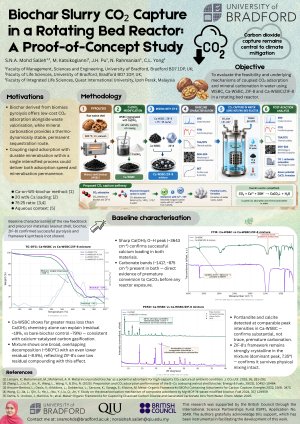
Carbon dioxide capture remains central to climate mitigation, yet conventional amine-based systems carry high energy penalties, solvent degradation, and corrosion concerns. Biochar derived from biomass pyrolysis offers low-cost CO₂ adsorption alongside waste valorisation, while mineral carbonation provides a thermo-dynamically stable, permanent sequestration route. Coupling rapid adsorption with durable mineralisation within a single intensified process could deliver both adsorption speed and mineralisation permanence. To date, fewer studies have integrated adsorption and in-pore mineralisation within a rotating bed reactor, where high centrifugal acceleration enhances gas–liquid–solid mass transfer. This work develops and evaluates such a hybrid system using a calcium-loaded biochar slurry. This work is currently at the proof-of-concept stage; therefore, the abstract describes the proposed framework and experimental approach and does not include or imply validated results.
Biochar will be produced from walnut shell via pyrolysis at a high temperature, then KOH-activated (2:1) to maximise micropore development. Calcium nitrate impregnation (0.5:1 and 1:1) followed by calcination at 450 °C deposits CaO within the pores, so CO₂ captured inside reacts permanently to form CaCO₃. The feed materials will be characterised by BET surface area analysis, XRD, FTIR, TGA, SEM-EDX. CO₂ capture experiments are planned to be conducted in a rotating bed reactor (manufactured by Spinchem, Sweden). The solvent of sodium hydroxide with an appropriate concentration will be used to capture carbon dioxide. The framework is expected to demonstrate enhanced CO₂ capture efficiency through improved gas-liquid-solid contact, provide three-dimensional spatial proof of in-pore CaCO₃ formation, and contribute toward scalable carbon capture, utilisation and storage (CCUS) and carbon-neutral technologies.
Keywords
Carbon capture
biochar
rotating bed reactor
calcium oxide impregnation
CCUS
Poster
Biochar Slurry CO₂ Capture in a Rotating Bed Reactor A Proof-of-Concept Study.pdf
Biological Air Pollution Control Using Immobilized Microalgae for CO2 Removal from Gas Streams
Can we use the phyllosphere microbiome as a nature-based solution for improving air quality in urban areas?