Event submissions
Published
This submission belongs to the session S5. Air Pollution Control of the event The 8th International Electronic Conference on Atmospheric Sciences
Published date
09 Oct, 2026
Academic Editor
'%3e%3cpath%20d='M12.6657%2010.9104C12.4185%2010.325%2012.0599%209.79327%2011.6097%209.34482C11.1609%208.89508%2010.6293%208.5365%2010.0442%208.28888C10.0389%208.28626%2010.0337%208.28495%2010.0285%208.28233C10.8446%207.69279%2011.3752%206.73249%2011.3752%205.64904C11.3752%203.8542%209.92103%202.39999%208.1262%202.39999C6.33136%202.39999%204.87715%203.8542%204.87715%205.64904C4.87715%206.73249%205.40774%207.69279%206.22393%208.28364C6.21869%208.28626%206.21345%208.28757%206.20821%208.29019C5.62129%208.5378%205.09463%208.89284%204.64265%209.34613C4.1929%209.79493%203.83432%2010.3266%203.58671%2010.9117C3.34345%2011.4845%203.21226%2012.0987%203.20023%2012.7209C3.19988%2012.7349%203.20233%2012.7488%203.20744%2012.7619C3.21255%2012.7749%203.22022%2012.7867%203.22998%2012.7968C3.23975%2012.8068%203.25142%2012.8147%203.26431%2012.8202C3.2772%2012.8256%203.29105%2012.8284%203.30504%2012.8284H4.09109C4.14874%2012.8284%204.19459%2012.7825%204.1959%2012.7262C4.2221%2011.7148%204.62823%2010.7676%205.34617%2010.0497C6.08899%209.30683%207.0755%208.89808%208.1262%208.89808C9.17689%208.89808%2010.1634%209.30683%2010.9062%2010.0497C11.6242%2010.7676%2012.0303%2011.7148%2012.0565%2012.7262C12.0578%2012.7838%2012.1037%2012.8284%2012.1613%2012.8284H12.9474C12.9613%2012.8284%2012.9752%2012.8256%2012.9881%2012.8202C13.001%2012.8147%2013.0126%2012.8068%2013.0224%2012.7968C13.0322%2012.7867%2013.0398%2012.7749%2013.0449%2012.7619C13.0501%2012.7488%2013.0525%2012.7349%2013.0522%2012.7209C13.0391%2012.0947%2012.9094%2011.4855%2012.6657%2010.9104ZM8.1262%207.9024C7.52486%207.9024%206.9589%207.6679%206.53312%207.24211C6.10733%206.81633%205.87283%206.25037%205.87283%205.64904C5.87283%205.0477%206.10733%204.48174%206.53312%204.05596C6.9589%203.63018%207.52486%203.39567%208.1262%203.39567C8.72753%203.39567%209.29349%203.63018%209.71927%204.05596C10.1451%204.48174%2010.3796%205.0477%2010.3796%205.64904C10.3796%206.25037%2010.1451%206.81633%209.71927%207.24211C9.29349%207.6679%208.72753%207.9024%208.1262%207.9024Z'%20fill='%235D1EE1'/%3e%3c/g%3e%3c/svg%3e) Pasquale Avino
Pasquale AvinoCitation
Slaveya Petrova, Bogdan Nikolov, Katya Dimitrova, Mariana Petkova, Stefan Shilev, Can we use the phyllosphere microbiome as a nature-based solution for improving air quality in urban areas?, in Proceedings of The 8th International Electronic Conference on Atmospheric Sciences, 14 October–16 October 2026, MDPI: Basel, Switzerland
Share
Email
Facebook
Twitter
LinkedIn
Can we use the phyllosphere microbiome as a nature-based solution for improving air quality in urban areas?

Slaveya Petrova 1,2
'%3e%3cpath%20d='M12.6647%2010.9104C12.4176%2010.325%2012.0589%209.7933%2011.6088%209.34485C11.16%208.89511%2010.6283%208.53653%2010.0432%208.28891C10.038%208.28629%2010.0327%208.28498%2010.0275%208.28236C10.8437%207.69282%2011.3743%206.73252%2011.3743%205.64907C11.3743%203.85423%209.92005%202.40002%208.12522%202.40002C6.33038%202.40002%204.87618%203.85423%204.87618%205.64907C4.87618%206.73252%205.40677%207.69282%206.22296%208.28367C6.21772%208.28629%206.21248%208.2876%206.20724%208.29022C5.62031%208.53783%205.09365%208.89287%204.64167%209.34616C4.19192%209.79496%203.83334%2010.3266%203.58573%2010.9117C3.34247%2011.4846%203.21128%2012.0987%203.19925%2012.721C3.1989%2012.735%203.20135%2012.7489%203.20646%2012.7619C3.21157%2012.7749%203.21924%2012.7868%203.22901%2012.7968C3.23877%2012.8068%203.25045%2012.8148%203.26334%2012.8202C3.27623%2012.8256%203.29007%2012.8284%203.30406%2012.8284H4.09012C4.14776%2012.8284%204.19362%2012.7825%204.19493%2012.7262C4.22113%2011.7148%204.62726%2010.7676%205.34519%2010.0497C6.08802%209.30686%207.07452%208.89811%208.12522%208.89811C9.17592%208.89811%2010.1624%209.30686%2010.9052%2010.0497C11.6232%2010.7676%2012.0293%2011.7148%2012.0555%2012.7262C12.0568%2012.7839%2012.1027%2012.8284%2012.1603%2012.8284H12.9464C12.9604%2012.8284%2012.9742%2012.8256%2012.9871%2012.8202C13%2012.8148%2013.0117%2012.8068%2013.0214%2012.7968C13.0312%2012.7868%2013.0389%2012.7749%2013.044%2012.7619C13.0491%2012.7489%2013.0515%2012.735%2013.0512%2012.721C13.0381%2012.0947%2012.9084%2011.4856%2012.6647%2010.9104ZM8.12522%207.90243C7.52388%207.90243%206.95792%207.66793%206.53214%207.24215C6.10636%206.81636%205.87185%206.2504%205.87185%205.64907C5.87185%205.04773%206.10636%204.48177%206.53214%204.05599C6.95792%203.63021%207.52388%203.3957%208.12522%203.3957C8.72655%203.3957%209.29252%203.63021%209.7183%204.05599C10.1441%204.48177%2010.3786%205.04773%2010.3786%205.64907C10.3786%206.2504%2010.1441%206.81636%209.7183%207.24215C9.29252%207.66793%208.72655%207.90243%208.12522%207.90243Z'%20fill='%235D1EE1'/%3e%3c/g%3e%3c/svg%3e)
Bogdan Nikolov 2
Katya Dimitrova 1
Mariana Petkova 1

Stefan Shilev 1
1. Department of Microbiology and Environmental Biotechnologies, Faculty of Plant Protection and Agroecology, Agricultural University, 12 Mendeleev Boulevard, 4000 Plovdiv, Bulgaria
2. Department of Ecology and Environmental Conservation, Faculty of Biology, Plovdiv University Paisii Hilendarski, 24 Tzar Asen Street, 4000, Plovdiv, Bulgaria
Abstract
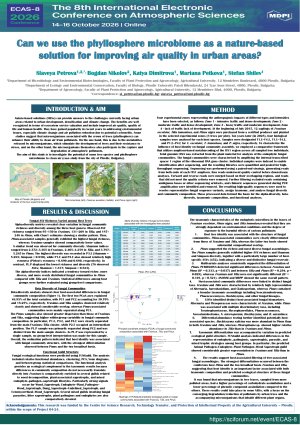
Nature-based solutions (NBSs) can provide answers to the challenges currently facing urban areas related to urban development, densification and climate change. The benefits are well recognized in terms of ecosystem service valuation and include improved air quality, quality of life and human health. They have gained popularity in recent years in addressing environmental issues, especially climate change and air pollution reduction due to potential co-benefits. Some studies suggest that microorganisms associated with the crown of trees (phyllosphere) can enhance their ability to clean air from pollutants. On the one hand, this is due to the metabolites released by microorganisms, which stimulate the development of trees and their resistance to stress, and on the other hand, the microorganisms themselves also participate in the capture and degradation of atmospheric pollutants. The aim of this study is to investigate the potential of some tree species and phyllosphere microbiome to clean air (case study from the city of Plovdiv, Bulgaria). The taxonomic characteristics of the endophytic microflora in the leaves of Fraxinus excelsior, Pinus nigra, Tilia tomentosa and Plantаnus orientalis revealed that they are strongly dependent on environmental conditions and the degree of exposure to the harmful effects of various pollutants. Actinobacteriota and Proteobacteria were the predominant type of microorganisms in all studied leaf samples. A higher abundance of Sphingobacterium, Sphingomonas, Pseudomonas was demonstrated at the genus level and they can serve as potential biomarkers for detecting the impact of various pollutants. It was found that microorganisms in tree leaves, sampled from more polluted areas, had a higher percentage of carbohydrate assimilation and a lower percentage of phenolic compounds assimilation compared to the others. These results could take place in some NBSs with a focus on the converging/degradation/reduction of pollutants by urban trees and the accompanying microorganisms that inhabited different plant organs.
Keywords
urban air pollution
green infrastructure
potential toxic elements
epiphytic microorganisms
endophytic microorganisms
degradation
ecosystem services
Poster
Poster Phyllosphere.pdf
Biochar Slurry CO₂ Capture in a Rotating Bed Reactor: A Proof-of-Concept Study
Herbaceous and Grass Roadside Vegetation as Natural Bio-Filters: Quantitative Assessment of Particulate Matter Mitigation in Urban Atmospheres