Event submissions
Published
This submission belongs to the session S6. Upper Atmosphere of the event The 8th International Electronic Conference on Atmospheric Sciences
Published date
09 Oct, 2026
Academic Editor
'%3e%3cpath%20d='M12.6657%2010.9104C12.4185%2010.325%2012.0599%209.79327%2011.6097%209.34482C11.1609%208.89508%2010.6293%208.5365%2010.0442%208.28888C10.0389%208.28626%2010.0337%208.28495%2010.0285%208.28233C10.8446%207.69279%2011.3752%206.73249%2011.3752%205.64904C11.3752%203.8542%209.92103%202.39999%208.1262%202.39999C6.33136%202.39999%204.87715%203.8542%204.87715%205.64904C4.87715%206.73249%205.40774%207.69279%206.22393%208.28364C6.21869%208.28626%206.21345%208.28757%206.20821%208.29019C5.62129%208.5378%205.09463%208.89284%204.64265%209.34613C4.1929%209.79493%203.83432%2010.3266%203.58671%2010.9117C3.34345%2011.4845%203.21226%2012.0987%203.20023%2012.7209C3.19988%2012.7349%203.20233%2012.7488%203.20744%2012.7619C3.21255%2012.7749%203.22022%2012.7867%203.22998%2012.7968C3.23975%2012.8068%203.25142%2012.8147%203.26431%2012.8202C3.2772%2012.8256%203.29105%2012.8284%203.30504%2012.8284H4.09109C4.14874%2012.8284%204.19459%2012.7825%204.1959%2012.7262C4.2221%2011.7148%204.62823%2010.7676%205.34617%2010.0497C6.08899%209.30683%207.0755%208.89808%208.1262%208.89808C9.17689%208.89808%2010.1634%209.30683%2010.9062%2010.0497C11.6242%2010.7676%2012.0303%2011.7148%2012.0565%2012.7262C12.0578%2012.7838%2012.1037%2012.8284%2012.1613%2012.8284H12.9474C12.9613%2012.8284%2012.9752%2012.8256%2012.9881%2012.8202C13.001%2012.8147%2013.0126%2012.8068%2013.0224%2012.7968C13.0322%2012.7867%2013.0398%2012.7749%2013.0449%2012.7619C13.0501%2012.7488%2013.0525%2012.7349%2013.0522%2012.7209C13.0391%2012.0947%2012.9094%2011.4855%2012.6657%2010.9104ZM8.1262%207.9024C7.52486%207.9024%206.9589%207.6679%206.53312%207.24211C6.10733%206.81633%205.87283%206.25037%205.87283%205.64904C5.87283%205.0477%206.10733%204.48174%206.53312%204.05596C6.9589%203.63018%207.52486%203.39567%208.1262%203.39567C8.72753%203.39567%209.29349%203.63018%209.71927%204.05596C10.1451%204.48174%2010.3796%205.0477%2010.3796%205.64904C10.3796%206.25037%2010.1451%206.81633%209.71927%207.24211C9.29349%207.6679%208.72753%207.9024%208.1262%207.9024Z'%20fill='%235D1EE1'/%3e%3c/g%3e%3c/svg%3e) George Balasis
George BalasisCitation
Edoardo Bucchignani, Stratospheric Wind Structure and Gravity Wave Activity over the Western Mediterranean during the Spring Transition: Radiosonde Observations from Decimomannu, Italy (May 2025), in Proceedings of The 8th International Electronic Conference on Atmospheric Sciences, 14 October–16 October 2026, MDPI: Basel, Switzerland
Share
Email
Facebook
Twitter
LinkedIn
Stratospheric Wind Structure and Gravity Wave Activity over the Western Mediterranean during the Spring Transition: Radiosonde Observations from Decimomannu, Italy (May 2025)

Edoardo Bucchignani 1
1. Laboratory of Meteorology, CIRA - Italian Aerospace Research Center, Capua CE, 81043, Italy
Abstract
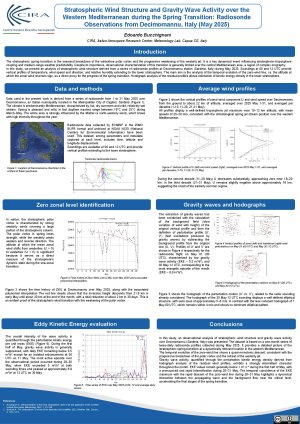
The stratospheric spring transition is the seasonal breakdown of the wintertime polar vortex and the progressive weakening of the westerly jet. It is a key dynamical event influencing stratosphere–troposphere coupling and medium-range weather predictability. Despite its importance, observational characterization of this transition is generally limited over the central Mediterranean area, a region of complex orography.
In this study, we present an analysis of stratospheric wind structure derived from a series of radiosonde profiles at Decimomannu station (Sardinia, Italy) during May 2025. Soundings at 00 and 12 UTC provide vertical profiles of temperature, wind speed and direction, and relative humidity extending to the lower stratosphere.
The main aim is the characterization of the mean zonal and meridional wind profiles in the stratosphere (15–20 km) and analysis of the temporal evolution of the zero-wind line, i.e. the altitude at which the zonal wind reverses sign, as a direct proxy for the progress of the spring transition. Then, we constructed time–height sections of the zonal wind component to identify the dominant temporal structures during the transition. Finally, inertia-gravity wave activity was investigated by isolating wind perturbations from a slowly varying background estimated via a vertical running mean. Hodograph analysis of the residual profiles allows estimation of kinetic energy density and the orientation of dominant wave packets in the lower stratosphere.
The Decimomannu dataset provides an observational perspective on the spring transition over the western Mediterranean, where orographic forcing from the Sardinian highlands and mesoscale marine circulation may locally modulate stratospheric wave activity. Results are expected to contribute to the observational characterization of this transitional regime and to serve as a reference for the validation of high-resolution Numerical Weather Prediction simulations with ICON (Icosahedral Non-Hydrostatic) model at the regional scale.
Keywords
stratospheric wind
spring transition
radiosonde
Poster
poster.pdf
Investigation of the Effects of extreme geomagnetic storms of Solar Cycle 25 on the African Equatorial Ionization Anomaly (EIA)
Anomalous Dawn Enhancement of Atomic Oxygen in the Martian Upper Atmosphere During Type C Dust Storms