Event submissions
Published
This submission belongs to the session S7. Atmospheric Techniques, Instruments and Modeling of the event The 8th International Electronic Conference on Atmospheric Sciences
Published date
09 Oct, 2026
Academic Editor
'%3e%3cpath%20d='M12.6657%2010.9104C12.4185%2010.325%2012.0599%209.79327%2011.6097%209.34482C11.1609%208.89508%2010.6293%208.5365%2010.0442%208.28888C10.0389%208.28626%2010.0337%208.28495%2010.0285%208.28233C10.8446%207.69279%2011.3752%206.73249%2011.3752%205.64904C11.3752%203.8542%209.92103%202.39999%208.1262%202.39999C6.33136%202.39999%204.87715%203.8542%204.87715%205.64904C4.87715%206.73249%205.40774%207.69279%206.22393%208.28364C6.21869%208.28626%206.21345%208.28757%206.20821%208.29019C5.62129%208.5378%205.09463%208.89284%204.64265%209.34613C4.1929%209.79493%203.83432%2010.3266%203.58671%2010.9117C3.34345%2011.4845%203.21226%2012.0987%203.20023%2012.7209C3.19988%2012.7349%203.20233%2012.7488%203.20744%2012.7619C3.21255%2012.7749%203.22022%2012.7867%203.22998%2012.7968C3.23975%2012.8068%203.25142%2012.8147%203.26431%2012.8202C3.2772%2012.8256%203.29105%2012.8284%203.30504%2012.8284H4.09109C4.14874%2012.8284%204.19459%2012.7825%204.1959%2012.7262C4.2221%2011.7148%204.62823%2010.7676%205.34617%2010.0497C6.08899%209.30683%207.0755%208.89808%208.1262%208.89808C9.17689%208.89808%2010.1634%209.30683%2010.9062%2010.0497C11.6242%2010.7676%2012.0303%2011.7148%2012.0565%2012.7262C12.0578%2012.7838%2012.1037%2012.8284%2012.1613%2012.8284H12.9474C12.9613%2012.8284%2012.9752%2012.8256%2012.9881%2012.8202C13.001%2012.8147%2013.0126%2012.8068%2013.0224%2012.7968C13.0322%2012.7867%2013.0398%2012.7749%2013.0449%2012.7619C13.0501%2012.7488%2013.0525%2012.7349%2013.0522%2012.7209C13.0391%2012.0947%2012.9094%2011.4855%2012.6657%2010.9104ZM8.1262%207.9024C7.52486%207.9024%206.9589%207.6679%206.53312%207.24211C6.10733%206.81633%205.87283%206.25037%205.87283%205.64904C5.87283%205.0477%206.10733%204.48174%206.53312%204.05596C6.9589%203.63018%207.52486%203.39567%208.1262%203.39567C8.72753%203.39567%209.29349%203.63018%209.71927%204.05596C10.1451%204.48174%2010.3796%205.0477%2010.3796%205.64904C10.3796%206.25037%2010.1451%206.81633%209.71927%207.24211C9.29349%207.6679%208.72753%207.9024%208.1262%207.9024Z'%20fill='%235D1EE1'/%3e%3c/g%3e%3c/svg%3e) Chun Ho Liu
Chun Ho LiuCitation
René Parra, Defining the Startup Time for Forecasting the PM2.5 Levels Due to the New Year Combustion Activities in an Urban Andean City of Southern Ecuador, in Proceedings of The 8th International Electronic Conference on Atmospheric Sciences, 14 October–16 October 2026, MDPI: Basel, Switzerland
Share
Email
Facebook
Twitter
LinkedIn
Defining the Startup Time for Forecasting the PM2.5 Levels Due to the New Year Combustion Activities in an Urban Andean City of Southern Ecuador

René Parra 1
1. Environmental Engineering Department, College of Science and Engineering, Campus Cumbaya, University San Francisco de Quito, Quito, 170901, Ecuador
Abstract
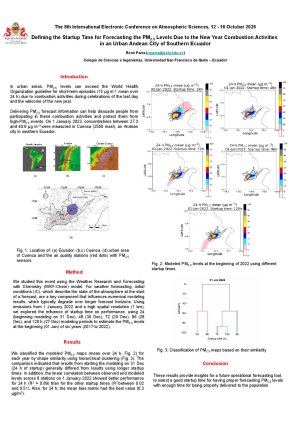
In urban areas, PM2.5 levels can exceed the World Health Organization guideline for short-term episodes (15 µg m-3, mean over 24 h) due to combustion activities during celebrations of the last day and the welcome of the new year. Delivering PM2.5 forecast information can help dissuade people from participating in these combustion activities and protect them from high-PM2.5 events. On 1 January 2022, concentrations between 27.3 and 40.6 µg m−3 were measured in Cuenca (2550 masl), an Andean city in south-ern Ecuador, an event that was studied using the Weather Research and Forecasting with Chemistry (WRF-Chem) model. For weather forecasting, initial conditions (IC), which describe the state of the atmosphere at the start of a forecast, are a key compo-nent that influences numerical modeling results, which typically degrade over longer forecast horizons. Using emissions from 1 January 2022 and a high spatial resolution (1 km), we explored the influence of startup time on performance, using 24 (beginning modeling on 31 Dec), 48 (30 Dec), 72 (29 Dec), 96 (28 Dec), and 120 h (27 Dec) model-ing periods to estimate the PM2.5 levels at the beginning (01 Jan) of six years (2017 to 2022). The modeled PM2.5 maps (mean over 24 h) for each year were classified based on shape similarity using a hierarchical clustering approach. The comparison indicated that the results provided when beginning the modeling on 31 Dec (24 h of startup) were in general, different to the results using the larger startup times. In addition, the linear correlation of the comparison between observed in 6 stations and modeled levels on 1 January 2022, showed better performance (R2 = 0.89) for 24 h compared to the other startup times (R2 between 0.02 to 0.51). Also, for 24 h, the mean bias metric got the best value (0.3 µg/m3). These results provide insights for a future operational fore-casting tool, to select a good startup time for having proper forecasting PM2.5 levels with enough time for being properly delivered to the population.
Keywords
WRF-Chem
Initial conditions
Modeling performance
short-term exposition
Poster
Ecas2026_PM25_new_year_Cuenca_Ecu_poster.pdf
Data‑Driven Inverse Modelling of Urban Pollutant Emissions Using a ConvLSTM3D Spatiotemporal Network
Spatiotemporal Dynamics of Land Use and Land Cover in the Brazilian Cerrado (1985–2023): Climatic and Anthropogenic Pressures, Water Impacts, and Implications for Conservation