Event submissions
Published
This submission belongs to the session S7. Atmospheric Techniques, Instruments and Modeling of the event The 8th International Electronic Conference on Atmospheric Sciences
Published date
09 Oct, 2026
Academic Editor
'%3e%3cpath%20d='M12.6657%2010.9104C12.4185%2010.325%2012.0599%209.79327%2011.6097%209.34482C11.1609%208.89508%2010.6293%208.5365%2010.0442%208.28888C10.0389%208.28626%2010.0337%208.28495%2010.0285%208.28233C10.8446%207.69279%2011.3752%206.73249%2011.3752%205.64904C11.3752%203.8542%209.92103%202.39999%208.1262%202.39999C6.33136%202.39999%204.87715%203.8542%204.87715%205.64904C4.87715%206.73249%205.40774%207.69279%206.22393%208.28364C6.21869%208.28626%206.21345%208.28757%206.20821%208.29019C5.62129%208.5378%205.09463%208.89284%204.64265%209.34613C4.1929%209.79493%203.83432%2010.3266%203.58671%2010.9117C3.34345%2011.4845%203.21226%2012.0987%203.20023%2012.7209C3.19988%2012.7349%203.20233%2012.7488%203.20744%2012.7619C3.21255%2012.7749%203.22022%2012.7867%203.22998%2012.7968C3.23975%2012.8068%203.25142%2012.8147%203.26431%2012.8202C3.2772%2012.8256%203.29105%2012.8284%203.30504%2012.8284H4.09109C4.14874%2012.8284%204.19459%2012.7825%204.1959%2012.7262C4.2221%2011.7148%204.62823%2010.7676%205.34617%2010.0497C6.08899%209.30683%207.0755%208.89808%208.1262%208.89808C9.17689%208.89808%2010.1634%209.30683%2010.9062%2010.0497C11.6242%2010.7676%2012.0303%2011.7148%2012.0565%2012.7262C12.0578%2012.7838%2012.1037%2012.8284%2012.1613%2012.8284H12.9474C12.9613%2012.8284%2012.9752%2012.8256%2012.9881%2012.8202C13.001%2012.8147%2013.0126%2012.8068%2013.0224%2012.7968C13.0322%2012.7867%2013.0398%2012.7749%2013.0449%2012.7619C13.0501%2012.7488%2013.0525%2012.7349%2013.0522%2012.7209C13.0391%2012.0947%2012.9094%2011.4855%2012.6657%2010.9104ZM8.1262%207.9024C7.52486%207.9024%206.9589%207.6679%206.53312%207.24211C6.10733%206.81633%205.87283%206.25037%205.87283%205.64904C5.87283%205.0477%206.10733%204.48174%206.53312%204.05596C6.9589%203.63018%207.52486%203.39567%208.1262%203.39567C8.72753%203.39567%209.29349%203.63018%209.71927%204.05596C10.1451%204.48174%2010.3796%205.0477%2010.3796%205.64904C10.3796%206.25037%2010.1451%206.81633%209.71927%207.24211C9.29349%207.6679%208.72753%207.9024%208.1262%207.9024Z'%20fill='%235D1EE1'/%3e%3c/g%3e%3c/svg%3e) Chun-Ho Liu
Chun-Ho LiuCitation
Ankita Mall, A Nationwide Multi-Site Time-Series Forecasting Framework Using SARIMAX with Exogenous Atmospheric Drivers over India: A Retrospective Analysis and Forecast Evaluation, in Proceedings of The 8th International Electronic Conference on Atmospheric Sciences, 14 October–16 October 2026, MDPI: Basel, Switzerland
Share
Email
Facebook
Twitter
LinkedIn
A Nationwide Multi-Site Time-Series Forecasting Framework Using SARIMAX with Exogenous Atmospheric Drivers over India: A Retrospective Analysis and Forecast Evaluation
'%3e%3cpath%20d='M12.6647%2010.9104C12.4176%2010.325%2012.0589%209.7933%2011.6088%209.34485C11.16%208.89511%2010.6283%208.53653%2010.0432%208.28891C10.038%208.28629%2010.0327%208.28498%2010.0275%208.28236C10.8437%207.69282%2011.3743%206.73252%2011.3743%205.64907C11.3743%203.85423%209.92005%202.40002%208.12522%202.40002C6.33038%202.40002%204.87618%203.85423%204.87618%205.64907C4.87618%206.73252%205.40677%207.69282%206.22296%208.28367C6.21772%208.28629%206.21248%208.2876%206.20724%208.29022C5.62031%208.53783%205.09365%208.89287%204.64167%209.34616C4.19192%209.79496%203.83334%2010.3266%203.58573%2010.9117C3.34247%2011.4846%203.21128%2012.0987%203.19925%2012.721C3.1989%2012.735%203.20135%2012.7489%203.20646%2012.7619C3.21157%2012.7749%203.21924%2012.7868%203.22901%2012.7968C3.23877%2012.8068%203.25045%2012.8148%203.26334%2012.8202C3.27623%2012.8256%203.29007%2012.8284%203.30406%2012.8284H4.09012C4.14776%2012.8284%204.19362%2012.7825%204.19493%2012.7262C4.22113%2011.7148%204.62726%2010.7676%205.34519%2010.0497C6.08802%209.30686%207.07452%208.89811%208.12522%208.89811C9.17592%208.89811%2010.1624%209.30686%2010.9052%2010.0497C11.6232%2010.7676%2012.0293%2011.7148%2012.0555%2012.7262C12.0568%2012.7839%2012.1027%2012.8284%2012.1603%2012.8284H12.9464C12.9604%2012.8284%2012.9742%2012.8256%2012.9871%2012.8202C13%2012.8148%2013.0117%2012.8068%2013.0214%2012.7968C13.0312%2012.7868%2013.0389%2012.7749%2013.044%2012.7619C13.0491%2012.7489%2013.0515%2012.735%2013.0512%2012.721C13.0381%2012.0947%2012.9084%2011.4856%2012.6647%2010.9104ZM8.12522%207.90243C7.52388%207.90243%206.95792%207.66793%206.53214%207.24215C6.10636%206.81636%205.87185%206.2504%205.87185%205.64907C5.87185%205.04773%206.10636%204.48177%206.53214%204.05599C6.95792%203.63021%207.52388%203.3957%208.12522%203.3957C8.72655%203.3957%209.29252%203.63021%209.7183%204.05599C10.1441%204.48177%2010.3786%205.04773%2010.3786%205.64907C10.3786%206.2504%2010.1441%206.81636%209.7183%207.24215C9.29252%207.66793%208.72655%207.90243%208.12522%207.90243Z'%20fill='%235D1EE1'/%3e%3c/g%3e%3c/svg%3e)
Ankita Mall 1
1. India Meteorological Department, Ministry of Earth Sciences (MoES), Delhi, 110003, India
Abstract
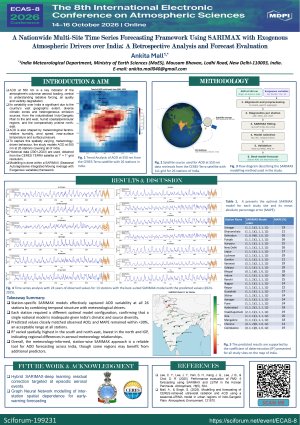
Accurate forecasting of atmospheric and environmental parameters is crucial for understanding long-term variability and improving predictive assessment of changing climatic conditions over geographically diverse regions. In this study, a comprehensive time-series forecasting framework of aerosol optical depth (AOD) at 550 nm based on the Seasonal Auto-Regressive Integrated Moving Average with Exogenous Variables (SARIMAX) model has been developed and applied across 26 observational stations across India to predict aerosol variability using long-term historical datasets from 2001–2023. The forecasting performance was further evaluated through predictions generated for 2024–2025 and subsequently compared against recently observed datasets for validation. Prior to model development, the temporal characteristics of each station were examined through stationarity diagnostics, including the Augmented Dickey–Fuller (ADF) test, and determined the differencing order required for stable time-series modelling. To improve predictive capability, multiple atmospheric drivers as exogenous predictors are relative humidity, surface albedo, near-surface temperature, and total column ozone, owing to their known influence on atmospheric variability. Several SARIMAX model configurations with varying autoregressive, differencing, moving average, and seasonal parameters have been tested, and the optimal model for each station was selected based on minimum Akaike Information Criterion (AIC) and residual diagnostic analysis. The best-suited SARIMAX models have been used to generate forecasts from 2024–2025 at each station. Model performance and predictive accuracy were quantitatively evaluated by comparing forecasted and observed values using the coefficient of determination (R²), Root Mean Square Error (RMSE), and Mean Absolute Percentage Error (MAPE). In addition to forecasting analysis, long-term monotonic trends within the historical datasets were investigated using the non-parametric Mann–Kendall (MK) trend significance test, while the Sen’s Slope estimator was used to identify statistically significant increasing or decreasing trends across the selected stations. The integrated modelling framework demonstrates large-scale atmospheric prediction over India and provides an effective approach for understanding spatiotemporal variability, trend behaviour, and forecast reliability in environmental time-series analysis.
Keywords
Aerosol Optical Depth
SARIMAX
Exogeneous variables
Time series modelling
Forecasting
Poster
Ankita_Poster_ECAS_8.pdf
An Explainable Transfer Learning Framework for PM2.5 Forecasting in Data-Scarce Urban Environments Using Cross-Regional Atmospheric Knowledge Transfer
Forecasting Aviation Turbulence in Tropical Airspace: A Comparative Evaluation of Machine Learning and Deep Learning Models in Jakarta FIR