Event submissions
Published
This submission belongs to the session S7. Atmospheric Techniques, Instruments and Modeling of the event The 8th International Electronic Conference on Atmospheric Sciences
Published date
09 Oct, 2026
Academic Editor
'%3e%3cpath%20d='M12.6657%2010.9104C12.4185%2010.325%2012.0599%209.79327%2011.6097%209.34482C11.1609%208.89508%2010.6293%208.5365%2010.0442%208.28888C10.0389%208.28626%2010.0337%208.28495%2010.0285%208.28233C10.8446%207.69279%2011.3752%206.73249%2011.3752%205.64904C11.3752%203.8542%209.92103%202.39999%208.1262%202.39999C6.33136%202.39999%204.87715%203.8542%204.87715%205.64904C4.87715%206.73249%205.40774%207.69279%206.22393%208.28364C6.21869%208.28626%206.21345%208.28757%206.20821%208.29019C5.62129%208.5378%205.09463%208.89284%204.64265%209.34613C4.1929%209.79493%203.83432%2010.3266%203.58671%2010.9117C3.34345%2011.4845%203.21226%2012.0987%203.20023%2012.7209C3.19988%2012.7349%203.20233%2012.7488%203.20744%2012.7619C3.21255%2012.7749%203.22022%2012.7867%203.22998%2012.7968C3.23975%2012.8068%203.25142%2012.8147%203.26431%2012.8202C3.2772%2012.8256%203.29105%2012.8284%203.30504%2012.8284H4.09109C4.14874%2012.8284%204.19459%2012.7825%204.1959%2012.7262C4.2221%2011.7148%204.62823%2010.7676%205.34617%2010.0497C6.08899%209.30683%207.0755%208.89808%208.1262%208.89808C9.17689%208.89808%2010.1634%209.30683%2010.9062%2010.0497C11.6242%2010.7676%2012.0303%2011.7148%2012.0565%2012.7262C12.0578%2012.7838%2012.1037%2012.8284%2012.1613%2012.8284H12.9474C12.9613%2012.8284%2012.9752%2012.8256%2012.9881%2012.8202C13.001%2012.8147%2013.0126%2012.8068%2013.0224%2012.7968C13.0322%2012.7867%2013.0398%2012.7749%2013.0449%2012.7619C13.0501%2012.7488%2013.0525%2012.7349%2013.0522%2012.7209C13.0391%2012.0947%2012.9094%2011.4855%2012.6657%2010.9104ZM8.1262%207.9024C7.52486%207.9024%206.9589%207.6679%206.53312%207.24211C6.10733%206.81633%205.87283%206.25037%205.87283%205.64904C5.87283%205.0477%206.10733%204.48174%206.53312%204.05596C6.9589%203.63018%207.52486%203.39567%208.1262%203.39567C8.72753%203.39567%209.29349%203.63018%209.71927%204.05596C10.1451%204.48174%2010.3796%205.0477%2010.3796%205.64904C10.3796%206.25037%2010.1451%206.81633%209.71927%207.24211C9.29349%207.6679%208.72753%207.9024%208.1262%207.9024Z'%20fill='%235D1EE1'/%3e%3c/g%3e%3c/svg%3e) Chun-Ho Liu
Chun-Ho LiuCitation
Muhammad Ikko Safrilda Maulana, Yesi Ratnasari, Finkan Danitasari, Forecasting Aviation Turbulence in Tropical Airspace: A Comparative Evaluation of Machine Learning and Deep Learning Models in Jakarta FIR, in Proceedings of The 8th International Electronic Conference on Atmospheric Sciences, 14 October–16 October 2026, MDPI: Basel, Switzerland
Share
Email
Facebook
Twitter
LinkedIn
Forecasting Aviation Turbulence in Tropical Airspace: A Comparative Evaluation of Machine Learning and Deep Learning Models in Jakarta FIR
'%3e%3cpath%20d='M12.6647%2010.9104C12.4176%2010.325%2012.0589%209.7933%2011.6088%209.34485C11.16%208.89511%2010.6283%208.53653%2010.0432%208.28891C10.038%208.28629%2010.0327%208.28498%2010.0275%208.28236C10.8437%207.69282%2011.3743%206.73252%2011.3743%205.64907C11.3743%203.85423%209.92005%202.40002%208.12522%202.40002C6.33038%202.40002%204.87618%203.85423%204.87618%205.64907C4.87618%206.73252%205.40677%207.69282%206.22296%208.28367C6.21772%208.28629%206.21248%208.2876%206.20724%208.29022C5.62031%208.53783%205.09365%208.89287%204.64167%209.34616C4.19192%209.79496%203.83334%2010.3266%203.58573%2010.9117C3.34247%2011.4846%203.21128%2012.0987%203.19925%2012.721C3.1989%2012.735%203.20135%2012.7489%203.20646%2012.7619C3.21157%2012.7749%203.21924%2012.7868%203.22901%2012.7968C3.23877%2012.8068%203.25045%2012.8148%203.26334%2012.8202C3.27623%2012.8256%203.29007%2012.8284%203.30406%2012.8284H4.09012C4.14776%2012.8284%204.19362%2012.7825%204.19493%2012.7262C4.22113%2011.7148%204.62726%2010.7676%205.34519%2010.0497C6.08802%209.30686%207.07452%208.89811%208.12522%208.89811C9.17592%208.89811%2010.1624%209.30686%2010.9052%2010.0497C11.6232%2010.7676%2012.0293%2011.7148%2012.0555%2012.7262C12.0568%2012.7839%2012.1027%2012.8284%2012.1603%2012.8284H12.9464C12.9604%2012.8284%2012.9742%2012.8256%2012.9871%2012.8202C13%2012.8148%2013.0117%2012.8068%2013.0214%2012.7968C13.0312%2012.7868%2013.0389%2012.7749%2013.044%2012.7619C13.0491%2012.7489%2013.0515%2012.735%2013.0512%2012.721C13.0381%2012.0947%2012.9084%2011.4856%2012.6647%2010.9104ZM8.12522%207.90243C7.52388%207.90243%206.95792%207.66793%206.53214%207.24215C6.10636%206.81636%205.87185%206.2504%205.87185%205.64907C5.87185%205.04773%206.10636%204.48177%206.53214%204.05599C6.95792%203.63021%207.52388%203.3957%208.12522%203.3957C8.72655%203.3957%209.29252%203.63021%209.7183%204.05599C10.1441%204.48177%2010.3786%205.04773%2010.3786%205.64907C10.3786%206.2504%2010.1441%206.81636%209.7183%207.24215C9.29252%207.66793%208.72655%207.90243%208.12522%207.90243Z'%20fill='%235D1EE1'/%3e%3c/g%3e%3c/svg%3e)
Muhammad Ikko Safrilda Maulana 1
Yesi Ratnasari 1
Finkan Danitasari 1
1. Soekarno-Hatta Meteorological Station, Meteorology, Climatology, and Geophysics Agency (BMKG), Tangerang 15126, Indonesia
Abstract
Atmospheric turbulence, particularly Convectively Induced Turbulence (CIT), poses a significant hazard to aviation safety within the Jakarta Flight Information Region (FIR), a region characterized by persistent deep convection over the Indonesian Maritime Continent. While machine learning models exhibit high proficiency in forecasting clear air turbulence (CAT) in mid-latitude regions, their predictive capability for CIT in tropical maritime environments remains underexplored. In this study, we evaluated four AI architectures for forecasting tropical turbulence, which are eXtreme Gradient Boosting (XGBoost), Artificial Neural Networks (ANNs), Bidirectional Long Short-Term Memory (Bi-LSTM), and Gated Recurrent Units (GRUs). Models were trained using fifteen dynamic and thermodynamic atmospheric predictors derived from ECMWF ERA5 reanalysis data and validated against operationally verified Pilot Reports (PIREPs) from January 2024 to April 2026. Model performance was evaluated using the Area Under the Receiver Operating Characteristic Curve (AUC), while operational performance was assessed through threshold optimization (Default, Youden Index, F1-score) using the Probability of Detection (POD) and the Matthews Correlation Coefficient (MCC). XGBoost demonstrated superior discrimination capability (AUC = 0.65), outperforming ANN (0.60), GRU (0.60), and Bi-LSTM (0.59). These relatively modest metrics underscore the inherent challenge of resolving microscale, rapidly evolving CIT using coarse resolution reanalysis datasets. Nevertheless, threshold optimization via the Youden Index significantly enhanced detection accuracy; XGBoost achieved the most balanced operational efficacy (MCC ≈ 0.26, False Alarm Ratio ≈ 0.52, POD ≈ 0.62), while both XGBoost and Bi-LSTM optimized the detection of moderate-to-severe events. These findings elucidate the fundamental differences in turbulence predictability between tropical convective environments and CAT-dominated regimes, substantiating the necessity for region specific, AI-driven meteorological frameworks to advance next-generation aviation warning systems.
Keywords
aviation turbulence
Convectively Induced Turbulence (CIT)
tropical convection
ERA5 reanalysis
machine learning
deep learning
XGBoost
aviation safety
Poster
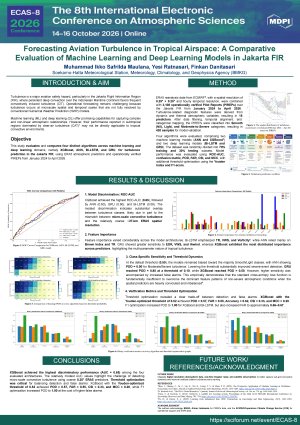
Poster ECAS-8_Muhammad Ikko et al.pdf
A Nationwide Multi-Site Time-Series Forecasting Framework Using SARIMAX with Exogenous Atmospheric Drivers over India: A Retrospective Analysis and Forecast Evaluation
Thunderstorm-Induced Muon Events at the GRAPES-3 Experiment: Recent Advances and Future Perspectives