Event submissions
Published
This submission belongs to the session S7. Atmospheric Techniques, Instruments and Modeling of the event The 8th International Electronic Conference on Atmospheric Sciences
Published date
09 Oct, 2026
Academic Editor
'%3e%3cpath%20d='M12.6657%2010.9104C12.4185%2010.325%2012.0599%209.79327%2011.6097%209.34482C11.1609%208.89508%2010.6293%208.5365%2010.0442%208.28888C10.0389%208.28626%2010.0337%208.28495%2010.0285%208.28233C10.8446%207.69279%2011.3752%206.73249%2011.3752%205.64904C11.3752%203.8542%209.92103%202.39999%208.1262%202.39999C6.33136%202.39999%204.87715%203.8542%204.87715%205.64904C4.87715%206.73249%205.40774%207.69279%206.22393%208.28364C6.21869%208.28626%206.21345%208.28757%206.20821%208.29019C5.62129%208.5378%205.09463%208.89284%204.64265%209.34613C4.1929%209.79493%203.83432%2010.3266%203.58671%2010.9117C3.34345%2011.4845%203.21226%2012.0987%203.20023%2012.7209C3.19988%2012.7349%203.20233%2012.7488%203.20744%2012.7619C3.21255%2012.7749%203.22022%2012.7867%203.22998%2012.7968C3.23975%2012.8068%203.25142%2012.8147%203.26431%2012.8202C3.2772%2012.8256%203.29105%2012.8284%203.30504%2012.8284H4.09109C4.14874%2012.8284%204.19459%2012.7825%204.1959%2012.7262C4.2221%2011.7148%204.62823%2010.7676%205.34617%2010.0497C6.08899%209.30683%207.0755%208.89808%208.1262%208.89808C9.17689%208.89808%2010.1634%209.30683%2010.9062%2010.0497C11.6242%2010.7676%2012.0303%2011.7148%2012.0565%2012.7262C12.0578%2012.7838%2012.1037%2012.8284%2012.1613%2012.8284H12.9474C12.9613%2012.8284%2012.9752%2012.8256%2012.9881%2012.8202C13.001%2012.8147%2013.0126%2012.8068%2013.0224%2012.7968C13.0322%2012.7867%2013.0398%2012.7749%2013.0449%2012.7619C13.0501%2012.7488%2013.0525%2012.7349%2013.0522%2012.7209C13.0391%2012.0947%2012.9094%2011.4855%2012.6657%2010.9104ZM8.1262%207.9024C7.52486%207.9024%206.9589%207.6679%206.53312%207.24211C6.10733%206.81633%205.87283%206.25037%205.87283%205.64904C5.87283%205.0477%206.10733%204.48174%206.53312%204.05596C6.9589%203.63018%207.52486%203.39567%208.1262%203.39567C8.72753%203.39567%209.29349%203.63018%209.71927%204.05596C10.1451%204.48174%2010.3796%205.0477%2010.3796%205.64904C10.3796%206.25037%2010.1451%206.81633%209.71927%207.24211C9.29349%207.6679%208.72753%207.9024%208.1262%207.9024Z'%20fill='%235D1EE1'/%3e%3c/g%3e%3c/svg%3e) Chun-Ho Liu
Chun-Ho LiuCitation
Pranaba K Nayak, S R Dugad, S K Gupta, B Hariharan, Y Hayashi, P Jagadeesan, A Jain, S Kawakami, P K Mohanty, A Oshima, M Rameez, K Ramesh, Thunderstorm-Induced Muon Events at the GRAPES-3 Experiment: Recent Advances and Future Perspectives, in Proceedings of The 8th International Electronic Conference on Atmospheric Sciences, 14 October–16 October 2026, MDPI: Basel, Switzerland
Share
Email
Facebook
Twitter
LinkedIn
Thunderstorm-Induced Muon Events at the GRAPES-3 Experiment: Recent Advances and Future Perspectives
'%3e%3cpath%20d='M12.6647%2010.9104C12.4176%2010.325%2012.0589%209.7933%2011.6088%209.34485C11.16%208.89511%2010.6283%208.53653%2010.0432%208.28891C10.038%208.28629%2010.0327%208.28498%2010.0275%208.28236C10.8437%207.69282%2011.3743%206.73252%2011.3743%205.64907C11.3743%203.85423%209.92005%202.40002%208.12522%202.40002C6.33038%202.40002%204.87618%203.85423%204.87618%205.64907C4.87618%206.73252%205.40677%207.69282%206.22296%208.28367C6.21772%208.28629%206.21248%208.2876%206.20724%208.29022C5.62031%208.53783%205.09365%208.89287%204.64167%209.34616C4.19192%209.79496%203.83334%2010.3266%203.58573%2010.9117C3.34247%2011.4846%203.21128%2012.0987%203.19925%2012.721C3.1989%2012.735%203.20135%2012.7489%203.20646%2012.7619C3.21157%2012.7749%203.21924%2012.7868%203.22901%2012.7968C3.23877%2012.8068%203.25045%2012.8148%203.26334%2012.8202C3.27623%2012.8256%203.29007%2012.8284%203.30406%2012.8284H4.09012C4.14776%2012.8284%204.19362%2012.7825%204.19493%2012.7262C4.22113%2011.7148%204.62726%2010.7676%205.34519%2010.0497C6.08802%209.30686%207.07452%208.89811%208.12522%208.89811C9.17592%208.89811%2010.1624%209.30686%2010.9052%2010.0497C11.6232%2010.7676%2012.0293%2011.7148%2012.0555%2012.7262C12.0568%2012.7839%2012.1027%2012.8284%2012.1603%2012.8284H12.9464C12.9604%2012.8284%2012.9742%2012.8256%2012.9871%2012.8202C13%2012.8148%2013.0117%2012.8068%2013.0214%2012.7968C13.0312%2012.7868%2013.0389%2012.7749%2013.044%2012.7619C13.0491%2012.7489%2013.0515%2012.735%2013.0512%2012.721C13.0381%2012.0947%2012.9084%2011.4856%2012.6647%2010.9104ZM8.12522%207.90243C7.52388%207.90243%206.95792%207.66793%206.53214%207.24215C6.10636%206.81636%205.87185%206.2504%205.87185%205.64907C5.87185%205.04773%206.10636%204.48177%206.53214%204.05599C6.95792%203.63021%207.52388%203.3957%208.12522%203.3957C8.72655%203.3957%209.29252%203.63021%209.7183%204.05599C10.1441%204.48177%2010.3786%205.04773%2010.3786%205.64907C10.3786%206.2504%2010.1441%206.81636%209.7183%207.24215C9.29252%207.66793%208.72655%207.90243%208.12522%207.90243Z'%20fill='%235D1EE1'/%3e%3c/g%3e%3c/svg%3e)
Pranaba K Nayak 1
S R Dugad 1
S K Gupta 1
B Hariharan 1
Y Hayashi 2
P Jagadeesan 1
A Jain 1
S Kawakami 2
P K Mohanty 1
A Oshima 3
M Rameez 1
K Ramesh 1
1. Tata Institute of Fundamental Research, Mumbai 400005, India
2. Graduate School of Science, Osaka Metropolitan University, Osaka 558 8585, Japan
3. College of Engineering, Chubu University, Kasugai, Aichi, 487 8501, Japan
Abstract
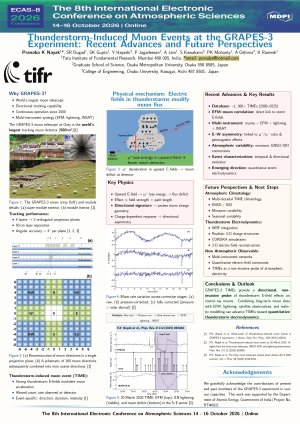
Thunderstorm-induced muon events (TIMEs) are variations in secondary cosmic-ray muon intensity produced by electric fields within thunderclouds, providing a unique probe of atmospheric electrification [1]. Over the past two decades, the GRAPES-3 muon telescope at Ooty, India, has recorded numerous TIMEs associated with intense convective storms, demonstrating the potential of muon observations as a novel atmospheric diagnostic.
This contribution summarizes recent advances in the study of TIMEs using a multi-instrument framework that combines directional muon measurements with electric field mill observations, lightning detections, and geostationary satellite data [2]. These analyses show that TIMEs are consistently associated with electrically active thunderstorms, while the amplitude and directional characteristics of the muon response vary substantially between events. The observed anisotropies indicate sensitivity to the spatial distribution and temporal evolution of thunderstorm charge structures, providing insights that complement conventional meteorological and electrical measurements.
Future directions include long-term climatological investigations of TIMEs, assessment of their relationships with large-scale climate modes such as ENSO [3] and the Indian Ocean Dipole, integration with numerical weather models, and the development of coordinated multi-instrument observational networks. As an emerging atmospheric observable, TIMEs offer a promising pathway for advancing studies of thunderstorm electrification, atmospheric electricity, and climate-driven variability in convective activity.
References
- PK Nayak et al., Observation of thunderstorm-induced muon events in GRAPES-3 experiment, J. Atmos. Sol.–Terr. Phys. 258 (2024) 106231.
- P.K. Nayak et al., Thunderstorm-induced muon event on 20 March 2020: Insights from the Ooty muon telescope, INSAT-3DR, and lightning observations, Physical Review D 112 (2025) 083046
- P.K. Nayak et al., The Ooty muon telescope reveals what climate did in 2022 summer, Ind. J. Phys. 98 (2024) 4239.
Keywords
Thunderstorm-induced muon events
Muon telescope observations
Atmospheric electrification
Electric field measurements
Lightning observations
Geostationary satellite observations
Multi-instrument atmospheric monitoring
Poster
Sciforum-199223.pdf
Forecasting Aviation Turbulence in Tropical Airspace: A Comparative Evaluation of Machine Learning and Deep Learning Models in Jakarta FIR
Measuring an Atmospheric Methane Column Based on Outgoing Thermal IR Radiation Spectra