Event submissions
Published
This submission belongs to the session S7. Atmospheric Techniques, Instruments and Modeling of the event The 8th International Electronic Conference on Atmospheric Sciences
Published date
09 Oct, 2026
Academic Editor
'%3e%3cpath%20d='M12.6657%2010.9104C12.4185%2010.325%2012.0599%209.79327%2011.6097%209.34482C11.1609%208.89508%2010.6293%208.5365%2010.0442%208.28888C10.0389%208.28626%2010.0337%208.28495%2010.0285%208.28233C10.8446%207.69279%2011.3752%206.73249%2011.3752%205.64904C11.3752%203.8542%209.92103%202.39999%208.1262%202.39999C6.33136%202.39999%204.87715%203.8542%204.87715%205.64904C4.87715%206.73249%205.40774%207.69279%206.22393%208.28364C6.21869%208.28626%206.21345%208.28757%206.20821%208.29019C5.62129%208.5378%205.09463%208.89284%204.64265%209.34613C4.1929%209.79493%203.83432%2010.3266%203.58671%2010.9117C3.34345%2011.4845%203.21226%2012.0987%203.20023%2012.7209C3.19988%2012.7349%203.20233%2012.7488%203.20744%2012.7619C3.21255%2012.7749%203.22022%2012.7867%203.22998%2012.7968C3.23975%2012.8068%203.25142%2012.8147%203.26431%2012.8202C3.2772%2012.8256%203.29105%2012.8284%203.30504%2012.8284H4.09109C4.14874%2012.8284%204.19459%2012.7825%204.1959%2012.7262C4.2221%2011.7148%204.62823%2010.7676%205.34617%2010.0497C6.08899%209.30683%207.0755%208.89808%208.1262%208.89808C9.17689%208.89808%2010.1634%209.30683%2010.9062%2010.0497C11.6242%2010.7676%2012.0303%2011.7148%2012.0565%2012.7262C12.0578%2012.7838%2012.1037%2012.8284%2012.1613%2012.8284H12.9474C12.9613%2012.8284%2012.9752%2012.8256%2012.9881%2012.8202C13.001%2012.8147%2013.0126%2012.8068%2013.0224%2012.7968C13.0322%2012.7867%2013.0398%2012.7749%2013.0449%2012.7619C13.0501%2012.7488%2013.0525%2012.7349%2013.0522%2012.7209C13.0391%2012.0947%2012.9094%2011.4855%2012.6657%2010.9104ZM8.1262%207.9024C7.52486%207.9024%206.9589%207.6679%206.53312%207.24211C6.10733%206.81633%205.87283%206.25037%205.87283%205.64904C5.87283%205.0477%206.10733%204.48174%206.53312%204.05596C6.9589%203.63018%207.52486%203.39567%208.1262%203.39567C8.72753%203.39567%209.29349%203.63018%209.71927%204.05596C10.1451%204.48174%2010.3796%205.0477%2010.3796%205.64904C10.3796%206.25037%2010.1451%206.81633%209.71927%207.24211C9.29349%207.6679%208.72753%207.9024%208.1262%207.9024Z'%20fill='%235D1EE1'/%3e%3c/g%3e%3c/svg%3e) Chun Ho Liu
Chun Ho LiuCitation
Mark Mesyatsev, Vladimir Toporovsky, Oleg Kolesnikov, Ilya Galaktionov, Instrumentation and Modeling for Adaptive Wavefront Restoration in Atmospheric Turbulence Using Deformable Mirror Feedback Control, in Proceedings of The 8th International Electronic Conference on Atmospheric Sciences, 14 October–16 October 2026, MDPI: Basel, Switzerland
Share
Email
Facebook
Twitter
LinkedIn
Instrumentation and Modeling for Adaptive Wavefront Restoration in Atmospheric Turbulence Using Deformable Mirror Feedback Control
'%3e%3cpath%20d='M12.6647%2010.9104C12.4176%2010.325%2012.0589%209.7933%2011.6088%209.34485C11.16%208.89511%2010.6283%208.53653%2010.0432%208.28891C10.038%208.28629%2010.0327%208.28498%2010.0275%208.28236C10.8437%207.69282%2011.3743%206.73252%2011.3743%205.64907C11.3743%203.85423%209.92005%202.40002%208.12522%202.40002C6.33038%202.40002%204.87618%203.85423%204.87618%205.64907C4.87618%206.73252%205.40677%207.69282%206.22296%208.28367C6.21772%208.28629%206.21248%208.2876%206.20724%208.29022C5.62031%208.53783%205.09365%208.89287%204.64167%209.34616C4.19192%209.79496%203.83334%2010.3266%203.58573%2010.9117C3.34247%2011.4846%203.21128%2012.0987%203.19925%2012.721C3.1989%2012.735%203.20135%2012.7489%203.20646%2012.7619C3.21157%2012.7749%203.21924%2012.7868%203.22901%2012.7968C3.23877%2012.8068%203.25045%2012.8148%203.26334%2012.8202C3.27623%2012.8256%203.29007%2012.8284%203.30406%2012.8284H4.09012C4.14776%2012.8284%204.19362%2012.7825%204.19493%2012.7262C4.22113%2011.7148%204.62726%2010.7676%205.34519%2010.0497C6.08802%209.30686%207.07452%208.89811%208.12522%208.89811C9.17592%208.89811%2010.1624%209.30686%2010.9052%2010.0497C11.6232%2010.7676%2012.0293%2011.7148%2012.0555%2012.7262C12.0568%2012.7839%2012.1027%2012.8284%2012.1603%2012.8284H12.9464C12.9604%2012.8284%2012.9742%2012.8256%2012.9871%2012.8202C13%2012.8148%2013.0117%2012.8068%2013.0214%2012.7968C13.0312%2012.7868%2013.0389%2012.7749%2013.044%2012.7619C13.0491%2012.7489%2013.0515%2012.735%2013.0512%2012.721C13.0381%2012.0947%2012.9084%2011.4856%2012.6647%2010.9104ZM8.12522%207.90243C7.52388%207.90243%206.95792%207.66793%206.53214%207.24215C6.10636%206.81636%205.87185%206.2504%205.87185%205.64907C5.87185%205.04773%206.10636%204.48177%206.53214%204.05599C6.95792%203.63021%207.52388%203.3957%208.12522%203.3957C8.72655%203.3957%209.29252%203.63021%209.7183%204.05599C10.1441%204.48177%2010.3786%205.04773%2010.3786%205.64907C10.3786%206.2504%2010.1441%206.81636%209.7183%207.24215C9.29252%207.66793%208.72655%207.90243%208.12522%207.90243Z'%20fill='%235D1EE1'/%3e%3c/g%3e%3c/svg%3e)
Mark Mesyatsev 1

Vladimir Toporovsky 2
Oleg Kolesnikov 2
Ilya Galaktionov 2,3
1. Optical and quantum communications department, Moscow Technical University of Communications and Informatics, Moscow 111024, Russia
2. Quantum Center, Moscow Technical University of Communications and Informatics, Moscow, 111024, Russia
3. Physics Department, Moscow Polytechnic University, Moscow, 107023, Russia
Abstract
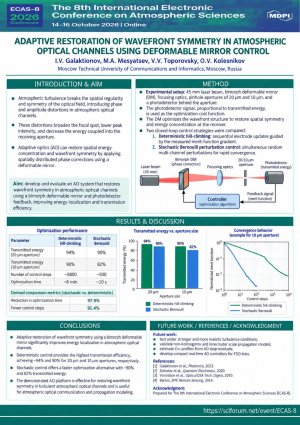
Atmospheric optical channels suffer from phase and amplitude distortions induced by refractive-index turbulence, which degrade focal-spot quality and reduce energy coupling into finite receiving apertures. This work presents an experimental adaptive optics (AO) instrument—combining a 45 mm laser beam, a bimorph deformable mirror (DM), and photodetector-coupled pinholes of 20 μm and 10 μm—designed to both correct wavefront aberrations and serve as a diagnostic platform for atmospheric propagation modeling. The photodetector signal, proportional to transmitted energy through the aperture, is defined as the optimization cost function, with aperture sizes selected to probe spatial scales relevant to the atmospheric coherence length r0.
Two closed-loop control strategies are compared. A deterministic hill-climbing algorithm sequentially adjusts DM electrodes based on the measured cost-function gradient, achieving maximum correction efficiency: 94% transmitted energy for the 20 μm aperture and 90% for the 10 μm aperture, effectively compensating quasi-static turbulence-induced aberrations. Alternatively, a stochastic algorithm applying Bernoulli-distributed multi-channel perturbations reaches a slightly lower peak but reduces optimization time from ~8 minutes to ~10 seconds (≈500 steps), enabling real-time tracking of dynamic turbulence with typical Greenwood frequencies.
The results quantify the inherent trade-off between spatial correction accuracy and temporal bandwidth. Deterministic approaches maximize energy localization under slowly varying conditions, whereas stochastic methods are superior for rapidly evolving refractive-index fields. Beyond correction performance, the instrument's response provides a direct metric for validating wave-optical turbulence models—including non-Kolmogorov spectra and inner/outer scale effects. This integrated experimental and modeling framework offers a robust testbed for designing next-generation atmospheric optical systems and for inferring real-time turbulence parameters (Cn2 profiles) from AO control-loop residuals, thereby directly supporting the development of advanced atmospheric sensing techniques and adaptive instrumentation.
Keywords
wavefront symmetry
applied optics
deformable mirror
adaptive optics
atmospheric optical channel
spatial energy localization
Poster
Mesyatsev - poster.pdf
High-Resolution Assessment of Surface Urban Heat Island Dynamics across Apulian Cities Using ECOSTRESS and Urban Atlas Data
Bias Correction of the CAMx Air Quality Model Using Deep Learning: A Comparative Evaluation of Station-Specific and Multi-Station Training Approaches