Event submissions
Published
This submission belongs to the session S3. Advanced Data Analysis and Integration in Metabolomics of the event The 5th International Electronic Conference on Metabolomics
Published date
09 Oct, 2026
Academic Editor
'%3e%3cpath%20d='M12.6657%2010.9104C12.4185%2010.325%2012.0599%209.79327%2011.6097%209.34482C11.1609%208.89508%2010.6293%208.5365%2010.0442%208.28888C10.0389%208.28626%2010.0337%208.28495%2010.0285%208.28233C10.8446%207.69279%2011.3752%206.73249%2011.3752%205.64904C11.3752%203.8542%209.92103%202.39999%208.1262%202.39999C6.33136%202.39999%204.87715%203.8542%204.87715%205.64904C4.87715%206.73249%205.40774%207.69279%206.22393%208.28364C6.21869%208.28626%206.21345%208.28757%206.20821%208.29019C5.62129%208.5378%205.09463%208.89284%204.64265%209.34613C4.1929%209.79493%203.83432%2010.3266%203.58671%2010.9117C3.34345%2011.4845%203.21226%2012.0987%203.20023%2012.7209C3.19988%2012.7349%203.20233%2012.7488%203.20744%2012.7619C3.21255%2012.7749%203.22022%2012.7867%203.22998%2012.7968C3.23975%2012.8068%203.25142%2012.8147%203.26431%2012.8202C3.2772%2012.8256%203.29105%2012.8284%203.30504%2012.8284H4.09109C4.14874%2012.8284%204.19459%2012.7825%204.1959%2012.7262C4.2221%2011.7148%204.62823%2010.7676%205.34617%2010.0497C6.08899%209.30683%207.0755%208.89808%208.1262%208.89808C9.17689%208.89808%2010.1634%209.30683%2010.9062%2010.0497C11.6242%2010.7676%2012.0303%2011.7148%2012.0565%2012.7262C12.0578%2012.7838%2012.1037%2012.8284%2012.1613%2012.8284H12.9474C12.9613%2012.8284%2012.9752%2012.8256%2012.9881%2012.8202C13.001%2012.8147%2013.0126%2012.8068%2013.0224%2012.7968C13.0322%2012.7867%2013.0398%2012.7749%2013.0449%2012.7619C13.0501%2012.7488%2013.0525%2012.7349%2013.0522%2012.7209C13.0391%2012.0947%2012.9094%2011.4855%2012.6657%2010.9104ZM8.1262%207.9024C7.52486%207.9024%206.9589%207.6679%206.53312%207.24211C6.10733%206.81633%205.87283%206.25037%205.87283%205.64904C5.87283%205.0477%206.10733%204.48174%206.53312%204.05596C6.9589%203.63018%207.52486%203.39567%208.1262%203.39567C8.72753%203.39567%209.29349%203.63018%209.71927%204.05596C10.1451%204.48174%2010.3796%205.0477%2010.3796%205.64904C10.3796%206.25037%2010.1451%206.81633%209.71927%207.24211C9.29349%207.6679%208.72753%207.9024%208.1262%207.9024Z'%20fill='%235D1EE1'/%3e%3c/g%3e%3c/svg%3e) Reza Salek
Reza SalekCitation
Ali Khan, Ujjaini Dasgupta, Alterations in Plasma Lipidomics Signatures During Progression of Metabolic Dysfunction-associated Steatotic Liver Disease Towards Hepatocellular Carcinoma, in Proceedings of The 5th International Electronic Conference on Metabolomics, 14 October–16 October 2026, MDPI: Basel, Switzerland
Share
Email
Facebook
Twitter
LinkedIn
Alterations in Plasma Lipidomics Signatures During Progression of Metabolic Dysfunction-associated Steatotic Liver Disease Towards Hepatocellular Carcinoma
'%3e%3cpath%20d='M12.6647%2010.9104C12.4176%2010.325%2012.0589%209.7933%2011.6088%209.34485C11.16%208.89511%2010.6283%208.53653%2010.0432%208.28891C10.038%208.28629%2010.0327%208.28498%2010.0275%208.28236C10.8437%207.69282%2011.3743%206.73252%2011.3743%205.64907C11.3743%203.85423%209.92005%202.40002%208.12522%202.40002C6.33038%202.40002%204.87618%203.85423%204.87618%205.64907C4.87618%206.73252%205.40677%207.69282%206.22296%208.28367C6.21772%208.28629%206.21248%208.2876%206.20724%208.29022C5.62031%208.53783%205.09365%208.89287%204.64167%209.34616C4.19192%209.79496%203.83334%2010.3266%203.58573%2010.9117C3.34247%2011.4846%203.21128%2012.0987%203.19925%2012.721C3.1989%2012.735%203.20135%2012.7489%203.20646%2012.7619C3.21157%2012.7749%203.21924%2012.7868%203.22901%2012.7968C3.23877%2012.8068%203.25045%2012.8148%203.26334%2012.8202C3.27623%2012.8256%203.29007%2012.8284%203.30406%2012.8284H4.09012C4.14776%2012.8284%204.19362%2012.7825%204.19493%2012.7262C4.22113%2011.7148%204.62726%2010.7676%205.34519%2010.0497C6.08802%209.30686%207.07452%208.89811%208.12522%208.89811C9.17592%208.89811%2010.1624%209.30686%2010.9052%2010.0497C11.6232%2010.7676%2012.0293%2011.7148%2012.0555%2012.7262C12.0568%2012.7839%2012.1027%2012.8284%2012.1603%2012.8284H12.9464C12.9604%2012.8284%2012.9742%2012.8256%2012.9871%2012.8202C13%2012.8148%2013.0117%2012.8068%2013.0214%2012.7968C13.0312%2012.7868%2013.0389%2012.7749%2013.044%2012.7619C13.0491%2012.7489%2013.0515%2012.735%2013.0512%2012.721C13.0381%2012.0947%2012.9084%2011.4856%2012.6647%2010.9104ZM8.12522%207.90243C7.52388%207.90243%206.95792%207.66793%206.53214%207.24215C6.10636%206.81636%205.87185%206.2504%205.87185%205.64907C5.87185%205.04773%206.10636%204.48177%206.53214%204.05599C6.95792%203.63021%207.52388%203.3957%208.12522%203.3957C8.72655%203.3957%209.29252%203.63021%209.7183%204.05599C10.1441%204.48177%2010.3786%205.04773%2010.3786%205.64907C10.3786%206.2504%2010.1441%206.81636%209.7183%207.24215C9.29252%207.66793%208.72655%207.90243%208.12522%207.90243Z'%20fill='%235D1EE1'/%3e%3c/g%3e%3c/svg%3e)
Ali Khan 1
Ujjaini Dasgupta 2
1. Amity University Haryana, Amity Education Valley, Gurugram (Manesar), Haryana 122-413, India
2. Department of Biology, Koita Centre for Digital Health-Ashoka, Trivedi School of Biosciences, Ashoka University, Haryana, Sonipat-131029, India
Abstract
Metabolically Dysfunctional-associated Steatotic Liver Disease (MASLD) is a spectrum of diseases that starts with the accumulation of excessive fat within the hepatocytes of healthy individuals, leading to liver inflammation and can progress to advanced scarring (cirrhosis), Hepatocellular Carcinoma (HCC), and liver failure. Common radiologic tests and serum-based surrogate markers are used; however, operator dependence, radiological exposure, and affordability are major limitations. Furthermore, while liver biopsy is the gold standard for MASLD staging, it is significantly limited by its invasiveness, sampling variability, and potential interobserver variability. Thus, finding novel non-invasive markers for diagnosis and prognosis is necessary.
Lipids and metabolites play a significant role in the remodelling of MASL to its more severe forms. In this study, we performed comprehensive global plasma lipidomics profiling of non-MASLD healthy individuals, MASLD, and HCC patients. Plasma samples were subjected to liquid-liquid extraction using a cold methanol and dichloromethane (MeOH/DCM) protocol developed in laboratory with previous modifications. Profiling was performed utilising a Vanquish UHPLC system coupled to an Orbitrap mass spectrometer with an HSST3 column. The platform operated in positive and negative polarity with an Orbitrap resolution of 120,000 and a scan range of 70–1500. Analytical stability was monitored by injecting a quality control (QC) sample at the beginning of the batch and after every 10 experimental samples. Data processing and lipid identification were conducted using Compound Discoverer by employing strict screening criteria, including QC, high mass accuracy and MS2 scores.
We performed systematic comparisons of MASLD, Cirrhosis and HCC patients from healthy individuals to observe substantial alterations in lipid classes, such as Sphingolipids, glycerolipids and phospholipids, which were strongly associated with MASLD stage and disease severity to hold significant promise for development as non-invasive diagnostic and prognostic markers for predicting disease severity and establishing clinico-pathological correlations.
Keywords
Metabolomics
LCMS
Fatty Liver
MASLD
MASH
Liver
HCC
Poster
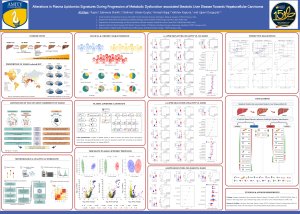
Ali Poster for 5th Electronics Metabolomics Conference.pdf
Development and Validation of a Comprehensive LC-MS/MS Targeted Assay for Uremic Solute Profiling in Chronic Kidney Disease