Event submissions
Published
This submission belongs to the session S1. Lipid and Nutrition Metabolomics of the event The 5th International Electronic Conference on Metabolomics
Published date
09 Oct, 2026
Academic Editor
'%3e%3cpath%20d='M12.6657%2010.9104C12.4185%2010.325%2012.0599%209.79327%2011.6097%209.34482C11.1609%208.89508%2010.6293%208.5365%2010.0442%208.28888C10.0389%208.28626%2010.0337%208.28495%2010.0285%208.28233C10.8446%207.69279%2011.3752%206.73249%2011.3752%205.64904C11.3752%203.8542%209.92103%202.39999%208.1262%202.39999C6.33136%202.39999%204.87715%203.8542%204.87715%205.64904C4.87715%206.73249%205.40774%207.69279%206.22393%208.28364C6.21869%208.28626%206.21345%208.28757%206.20821%208.29019C5.62129%208.5378%205.09463%208.89284%204.64265%209.34613C4.1929%209.79493%203.83432%2010.3266%203.58671%2010.9117C3.34345%2011.4845%203.21226%2012.0987%203.20023%2012.7209C3.19988%2012.7349%203.20233%2012.7488%203.20744%2012.7619C3.21255%2012.7749%203.22022%2012.7867%203.22998%2012.7968C3.23975%2012.8068%203.25142%2012.8147%203.26431%2012.8202C3.2772%2012.8256%203.29105%2012.8284%203.30504%2012.8284H4.09109C4.14874%2012.8284%204.19459%2012.7825%204.1959%2012.7262C4.2221%2011.7148%204.62823%2010.7676%205.34617%2010.0497C6.08899%209.30683%207.0755%208.89808%208.1262%208.89808C9.17689%208.89808%2010.1634%209.30683%2010.9062%2010.0497C11.6242%2010.7676%2012.0303%2011.7148%2012.0565%2012.7262C12.0578%2012.7838%2012.1037%2012.8284%2012.1613%2012.8284H12.9474C12.9613%2012.8284%2012.9752%2012.8256%2012.9881%2012.8202C13.001%2012.8147%2013.0126%2012.8068%2013.0224%2012.7968C13.0322%2012.7867%2013.0398%2012.7749%2013.0449%2012.7619C13.0501%2012.7488%2013.0525%2012.7349%2013.0522%2012.7209C13.0391%2012.0947%2012.9094%2011.4855%2012.6657%2010.9104ZM8.1262%207.9024C7.52486%207.9024%206.9589%207.6679%206.53312%207.24211C6.10733%206.81633%205.87283%206.25037%205.87283%205.64904C5.87283%205.0477%206.10733%204.48174%206.53312%204.05596C6.9589%203.63018%207.52486%203.39567%208.1262%203.39567C8.72753%203.39567%209.29349%203.63018%209.71927%204.05596C10.1451%204.48174%2010.3796%205.0477%2010.3796%205.64904C10.3796%206.25037%2010.1451%206.81633%209.71927%207.24211C9.29349%207.6679%208.72753%207.9024%208.1262%207.9024Z'%20fill='%235D1EE1'/%3e%3c/g%3e%3c/svg%3e) Giuseppe Paglia
Giuseppe PagliaCitation
Marina Santana, Amanda Guimarães de Araújo, Eder H. A. Pinto, Artur Fernando A.M. Oliveira, Jackson Monteiro, Vanessa Vendramini, NUTRACEUTICAL EFFECT OF AÇAÍ ON SPERM FUNCTION IN THE D-GALACTOSE-INDUCED AGING MODEL IS NOT LINKED WITH GLYCOLYSIS PATHWAY METABOLOMICS, in Proceedings of The 5th International Electronic Conference on Metabolomics, 14 October–16 October 2026, MDPI: Basel, Switzerland
Share
Email
Facebook
Twitter
LinkedIn
NUTRACEUTICAL EFFECT OF AÇAÍ ON SPERM FUNCTION IN THE D-GALACTOSE-INDUCED AGING MODEL IS NOT LINKED WITH GLYCOLYSIS PATHWAY METABOLOMICS
'%3e%3cpath%20d='M12.6647%2010.9104C12.4176%2010.325%2012.0589%209.7933%2011.6088%209.34485C11.16%208.89511%2010.6283%208.53653%2010.0432%208.28891C10.038%208.28629%2010.0327%208.28498%2010.0275%208.28236C10.8437%207.69282%2011.3743%206.73252%2011.3743%205.64907C11.3743%203.85423%209.92005%202.40002%208.12522%202.40002C6.33038%202.40002%204.87618%203.85423%204.87618%205.64907C4.87618%206.73252%205.40677%207.69282%206.22296%208.28367C6.21772%208.28629%206.21248%208.2876%206.20724%208.29022C5.62031%208.53783%205.09365%208.89287%204.64167%209.34616C4.19192%209.79496%203.83334%2010.3266%203.58573%2010.9117C3.34247%2011.4846%203.21128%2012.0987%203.19925%2012.721C3.1989%2012.735%203.20135%2012.7489%203.20646%2012.7619C3.21157%2012.7749%203.21924%2012.7868%203.22901%2012.7968C3.23877%2012.8068%203.25045%2012.8148%203.26334%2012.8202C3.27623%2012.8256%203.29007%2012.8284%203.30406%2012.8284H4.09012C4.14776%2012.8284%204.19362%2012.7825%204.19493%2012.7262C4.22113%2011.7148%204.62726%2010.7676%205.34519%2010.0497C6.08802%209.30686%207.07452%208.89811%208.12522%208.89811C9.17592%208.89811%2010.1624%209.30686%2010.9052%2010.0497C11.6232%2010.7676%2012.0293%2011.7148%2012.0555%2012.7262C12.0568%2012.7839%2012.1027%2012.8284%2012.1603%2012.8284H12.9464C12.9604%2012.8284%2012.9742%2012.8256%2012.9871%2012.8202C13%2012.8148%2013.0117%2012.8068%2013.0214%2012.7968C13.0312%2012.7868%2013.0389%2012.7749%2013.044%2012.7619C13.0491%2012.7489%2013.0515%2012.735%2013.0512%2012.721C13.0381%2012.0947%2012.9084%2011.4856%2012.6647%2010.9104ZM8.12522%207.90243C7.52388%207.90243%206.95792%207.66793%206.53214%207.24215C6.10636%206.81636%205.87185%206.2504%205.87185%205.64907C5.87185%205.04773%206.10636%204.48177%206.53214%204.05599C6.95792%203.63021%207.52388%203.3957%208.12522%203.3957C8.72655%203.3957%209.29252%203.63021%209.7183%204.05599C10.1441%204.48177%2010.3786%205.04773%2010.3786%205.64907C10.3786%206.2504%2010.1441%206.81636%209.7183%207.24215C9.29252%207.66793%208.72655%207.90243%208.12522%207.90243Z'%20fill='%235D1EE1'/%3e%3c/g%3e%3c/svg%3e)
Marina Santana 1
Amanda Guimarães de Araújo 2
Eder H. A. Pinto 2
Artur Fernando A.M. Oliveira 3

Jackson Monteiro 4
Vanessa Vendramini 2
1. Faculty of Public Health, University of São Paulo, São Paulo, 01246-904, Brazil
2. Department of Morphology and Genetics, Laboratory of Reproductive and Developmental Biology (LABReD), Paulista School of Medicine, Federal University of Sao Paulo - EPM/UNIFESP, São Paulo, 04023-062, Brazil
3. Cruzeiro do Sul University, São Paulo, 03071-000, Brazil
4. Laboratory of Pharmacognosy and Pharmaceutical Chemistry, Department of Pharmaceutical Sciences (DCF), Institute of Environmental, Chemical and Pharmaceutical Sciences (ICAQF), Universidade Federal de São Paulo, Diadema, São Paulo, 09972-270, Brazil
Abstract
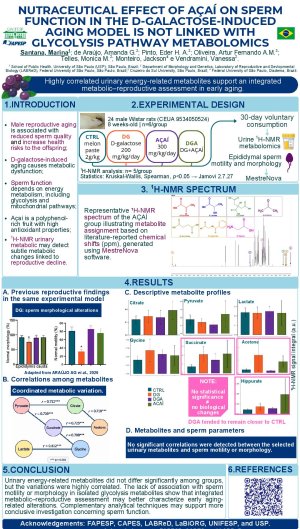
Açaí (Euterpe olaracea Mart.) is a Brazilian “super” fruit rich in polyphenols with antioxidant and anti-inflammatory properties. Aging is associated with increased oxidative stress and chronic low-grade inflammation—impairing the male reproductive system. Overconsumption of D-galactose (DG) reproduces some of the hallmarks of aging, including oxidative damage, DNA damage, and innate immune system and circulatory dysregulation. Therefore, this preliminary study aimed to evaluate whether freeze-dried açaí supplementation attenuates metabolic alterations and reproductive dysfunction in a rat model of accelerated aging.
Twenty-four male Wistar rats (8 weeks old) were randomly distributed into four experimental groups (n=6/group): Control, DG (200 mg/kg/day), Açaí (300 mg/kg/day), and DG + Açaí (DGA). After four weeks of voluntary consumption, sperm concentration, motility, and morphology were evaluated. Urinary metabolomic (pyruvate, lactate, citrate, acetone, succinate, hippurate) was assessed through proton nuclear magnetic resonance (1H-NMR) spectroscopy. Data were analyzed using parametric and non-parametric ANOVA tests, and Spearman’s correlation matrix, with significance set at p < 0.05.
Metabolomic analysis revealed no significant differences in urinary metabolics (Kruskal–Wallis, p > 0.05). Descriptively, the highest mean normalized glycine and lactate levels were observed in the DG group, while the lowest mean normalized pyruvate level was observed in the DGA group. Spearman correlation analysis did not demonstrate significant associations between metabolites and sperm motility. As expected, positive correlations were observed among pyruvate, succinate, citrate, glycine, lactate, and acetone.
Our results indicate that the coordinated pattern observed among metabolites supports coherent metabolic changes during the initial stage of reproductive dysfunction. Metabolites involved in glycolysis analysed by RMN neither mirrored the energetic dysfunction caused by D-galactose-induced aging in a short protocol nor the biological benefits of açaí seen in sperm function. Further studies should address whether longer exposure to D-galactose and more sensitive techniques would reveal metabolic modulation provided by açaí.
Keywords
Motility
Aging
Energy metabolism
Urinary metabolomics
Açaí supplementation.
Poster
Banner IECM- Marina Santana - NUTRACEUTICAL EFFECT OF AÇAÍ ON SPERM FUNCTION IN THE D-GALACTOSE-INDUCED AGING MODEL IS NOT LINKED WITH GLYCOLYSIS PATHWAY METABOLOMICS.pdf
Comparative Analysis of Sample Preservation Techniques for Plant Ecometabolomic Studies
Volumetric Absorptive Microsampling in Biomarker Analysis: Insights from Targeted and Rapid Microbore Metabolic Profiling Approaches