Event submissions
Published
This submission belongs to the session S6. Plant and Animal Metabolism and Metabolic Modeling of the event The 5th International Electronic Conference on Metabolomics
Published date
09 Oct, 2026
Academic Editor
'%3e%3cpath%20d='M12.6657%2010.9104C12.4185%2010.325%2012.0599%209.79327%2011.6097%209.34482C11.1609%208.89508%2010.6293%208.5365%2010.0442%208.28888C10.0389%208.28626%2010.0337%208.28495%2010.0285%208.28233C10.8446%207.69279%2011.3752%206.73249%2011.3752%205.64904C11.3752%203.8542%209.92103%202.39999%208.1262%202.39999C6.33136%202.39999%204.87715%203.8542%204.87715%205.64904C4.87715%206.73249%205.40774%207.69279%206.22393%208.28364C6.21869%208.28626%206.21345%208.28757%206.20821%208.29019C5.62129%208.5378%205.09463%208.89284%204.64265%209.34613C4.1929%209.79493%203.83432%2010.3266%203.58671%2010.9117C3.34345%2011.4845%203.21226%2012.0987%203.20023%2012.7209C3.19988%2012.7349%203.20233%2012.7488%203.20744%2012.7619C3.21255%2012.7749%203.22022%2012.7867%203.22998%2012.7968C3.23975%2012.8068%203.25142%2012.8147%203.26431%2012.8202C3.2772%2012.8256%203.29105%2012.8284%203.30504%2012.8284H4.09109C4.14874%2012.8284%204.19459%2012.7825%204.1959%2012.7262C4.2221%2011.7148%204.62823%2010.7676%205.34617%2010.0497C6.08899%209.30683%207.0755%208.89808%208.1262%208.89808C9.17689%208.89808%2010.1634%209.30683%2010.9062%2010.0497C11.6242%2010.7676%2012.0303%2011.7148%2012.0565%2012.7262C12.0578%2012.7838%2012.1037%2012.8284%2012.1613%2012.8284H12.9474C12.9613%2012.8284%2012.9752%2012.8256%2012.9881%2012.8202C13.001%2012.8147%2013.0126%2012.8068%2013.0224%2012.7968C13.0322%2012.7867%2013.0398%2012.7749%2013.0449%2012.7619C13.0501%2012.7488%2013.0525%2012.7349%2013.0522%2012.7209C13.0391%2012.0947%2012.9094%2011.4855%2012.6657%2010.9104ZM8.1262%207.9024C7.52486%207.9024%206.9589%207.6679%206.53312%207.24211C6.10733%206.81633%205.87283%206.25037%205.87283%205.64904C5.87283%205.0477%206.10733%204.48174%206.53312%204.05596C6.9589%203.63018%207.52486%203.39567%208.1262%203.39567C8.72753%203.39567%209.29349%203.63018%209.71927%204.05596C10.1451%204.48174%2010.3796%205.0477%2010.3796%205.64904C10.3796%206.25037%2010.1451%206.81633%209.71927%207.24211C9.29349%207.6679%208.72753%207.9024%208.1262%207.9024Z'%20fill='%235D1EE1'/%3e%3c/g%3e%3c/svg%3e) Hunter N.B. Moseley
Hunter N.B. MoseleyCitation
Manuela Ayala Duarte, Jessica Rodrigues Pereira de Oliveira Borlot, Rodrigo de Almeida Romagna, Rodrigo Rezende Kitagawa, Ximena Londoño, Juliet Angélica Prieto-Rodríguez, Ian Castro-Gamboa, Geison Modesti Costa, Luis Carlos Chitiva, Metabolomic correlation analysis of chemical profiles and anti-inflammatory activity of different species of the genus Guadua, in Proceedings of The 5th International Electronic Conference on Metabolomics, 14 October–16 October 2026, MDPI: Basel, Switzerland
Share
Email
Facebook
Twitter
LinkedIn
Metabolomic correlation analysis of chemical profiles and anti-inflammatory activity of different species of the genus Guadua
'%3e%3cpath%20d='M12.6647%2010.9104C12.4176%2010.325%2012.0589%209.7933%2011.6088%209.34485C11.16%208.89511%2010.6283%208.53653%2010.0432%208.28891C10.038%208.28629%2010.0327%208.28498%2010.0275%208.28236C10.8437%207.69282%2011.3743%206.73252%2011.3743%205.64907C11.3743%203.85423%209.92005%202.40002%208.12522%202.40002C6.33038%202.40002%204.87618%203.85423%204.87618%205.64907C4.87618%206.73252%205.40677%207.69282%206.22296%208.28367C6.21772%208.28629%206.21248%208.2876%206.20724%208.29022C5.62031%208.53783%205.09365%208.89287%204.64167%209.34616C4.19192%209.79496%203.83334%2010.3266%203.58573%2010.9117C3.34247%2011.4846%203.21128%2012.0987%203.19925%2012.721C3.1989%2012.735%203.20135%2012.7489%203.20646%2012.7619C3.21157%2012.7749%203.21924%2012.7868%203.22901%2012.7968C3.23877%2012.8068%203.25045%2012.8148%203.26334%2012.8202C3.27623%2012.8256%203.29007%2012.8284%203.30406%2012.8284H4.09012C4.14776%2012.8284%204.19362%2012.7825%204.19493%2012.7262C4.22113%2011.7148%204.62726%2010.7676%205.34519%2010.0497C6.08802%209.30686%207.07452%208.89811%208.12522%208.89811C9.17592%208.89811%2010.1624%209.30686%2010.9052%2010.0497C11.6232%2010.7676%2012.0293%2011.7148%2012.0555%2012.7262C12.0568%2012.7839%2012.1027%2012.8284%2012.1603%2012.8284H12.9464C12.9604%2012.8284%2012.9742%2012.8256%2012.9871%2012.8202C13%2012.8148%2013.0117%2012.8068%2013.0214%2012.7968C13.0312%2012.7868%2013.0389%2012.7749%2013.044%2012.7619C13.0491%2012.7489%2013.0515%2012.735%2013.0512%2012.721C13.0381%2012.0947%2012.9084%2011.4856%2012.6647%2010.9104ZM8.12522%207.90243C7.52388%207.90243%206.95792%207.66793%206.53214%207.24215C6.10636%206.81636%205.87185%206.2504%205.87185%205.64907C5.87185%205.04773%206.10636%204.48177%206.53214%204.05599C6.95792%203.63021%207.52388%203.3957%208.12522%203.3957C8.72655%203.3957%209.29252%203.63021%209.7183%204.05599C10.1441%204.48177%2010.3786%205.04773%2010.3786%205.64907C10.3786%206.2504%2010.1441%206.81636%209.7183%207.24215C9.29252%207.66793%208.72655%207.90243%208.12522%207.90243Z'%20fill='%235D1EE1'/%3e%3c/g%3e%3c/svg%3e)
Manuela Ayala Duarte 1
Jessica Rodrigues Pereira de Oliveira Borlot 2
Rodrigo de Almeida Romagna 2
Rodrigo Rezende Kitagawa 2
Ximena Londoño 3

Juliet Angélica Prieto-Rodríguez 4
Ian Castro-Gamboa 5

Geison Modesti Costa 4
Luis Carlos Chitiva 1,4
1. Facultad de Ciencias Exactas y Naturales, Fundación Universitaria Salesiana, Bogotá, 111071, Colombia
2. Department of Pharmaceutical Sciences, Federal University of Espírito Santo, Vitoria, 29047-105, Brazil
3. Facultad de Ciencias Agropecuarias, Universidad Nacional de Colombia, Palmira, 763533, Colombia
4. Departamento de Química, Pontificia Universidad Javeriana, Bogotá, 110231, Colombia
5. Institute of Chemistry, São Paulo State University, SP, Araraquara, SP 14800-901, Brazil
Abstract
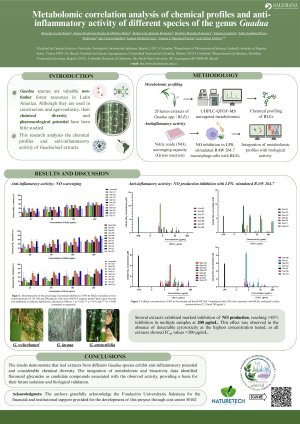
Species of bamboo belonging to the genus Guadua represent one of the most important non-timber forest resources in Latin America due to their ecological, economic, and social significance. Beyond their traditional applications in construction and agro-industry, however, their chemical diversity and pharmacological potential remain largely unexplored. Although previous studies have demonstrated that Guadua leaves are rich in polyphenolic compounds exhibiting promising biological activities, the chemical composition associated with their anti-inflammatory activity remain largely unknown. Therefore, this study aimed to identify metabolites and chemical families associated with anti-inflammatory activity by correlating the metabolomic profiles of leaf extracts from different Guadua species using an untargeted metabolomics approach. Twenty-nine leaf extracts were chemically profiled by ultra-high-performance liquid chromatography coupled with quadrupole time-of-flight mass spectrometry (UHPLC-QTOF-MS). Anti-inflammatory activity was evaluated using two complementary assays: 1) nitric oxide (NO) scavenging capacity determined by the Griess reaction and 2) inhibition of NO production in lipopolysaccharide (LPS)-stimulated RAW 264.7 macrophages. Metabolomic profiles were integrated with biological activity data using multivariate chemometric approaches to identify metabolites and chemical families putatively associated with anti-inflammatory activity. The untargeted metabolomic analysis revealed high chemical diversity among the species evaluated, characterized mainly by flavonoid glycosides, hydroxycinnamic acid derivatives, and other polyphenolic compounds. Biological evaluation demonstrated that several extracts, particularly selected extracts from G. angustifolia, G. incana, and G. weberbaueri, markedly inhibited NO production in LPS-stimulated RAW 264.7 macrophages without exhibiting cytotoxicity at the tested concentrations. Integration of metabolomic and bioactivity datasets through chemometric analysis identified flavonoid glycosides as the metabolite class showing the strongest positive association with the observed anti-inflammatory activity, highlighting these metabolites as promising candidates for future isolation and biological validation. These findings provide new insights into the valorization of Guadua leaves as a sustainable source of bioactive compounds.
Keywords
Metabolomics
Guadua
Bamboo
Metabolomic profiling
anti-inflammatory activity
RAW 264.7 cells
Poster
Poster IECM 2026.pdf
Metabolic Signatures of Pancreatic Drain Fluid and Serum in Severe Acute Pancreatitis Revealed by High-Resolution 1H NMR Metabolomics
Lyophilization-based protocol for human plasma and serum metabolomics by benchtop NMR spectroscopy: optimization and validation