Event submissions
Published
This submission belongs to the session S4. Clinical Metabolomics and Drug Metabolism of the event The 5th International Electronic Conference on Metabolomics
Published date
09 Oct, 2026
Academic Editor
'%3e%3cpath%20d='M12.6657%2010.9104C12.4185%2010.325%2012.0599%209.79327%2011.6097%209.34482C11.1609%208.89508%2010.6293%208.5365%2010.0442%208.28888C10.0389%208.28626%2010.0337%208.28495%2010.0285%208.28233C10.8446%207.69279%2011.3752%206.73249%2011.3752%205.64904C11.3752%203.8542%209.92103%202.39999%208.1262%202.39999C6.33136%202.39999%204.87715%203.8542%204.87715%205.64904C4.87715%206.73249%205.40774%207.69279%206.22393%208.28364C6.21869%208.28626%206.21345%208.28757%206.20821%208.29019C5.62129%208.5378%205.09463%208.89284%204.64265%209.34613C4.1929%209.79493%203.83432%2010.3266%203.58671%2010.9117C3.34345%2011.4845%203.21226%2012.0987%203.20023%2012.7209C3.19988%2012.7349%203.20233%2012.7488%203.20744%2012.7619C3.21255%2012.7749%203.22022%2012.7867%203.22998%2012.7968C3.23975%2012.8068%203.25142%2012.8147%203.26431%2012.8202C3.2772%2012.8256%203.29105%2012.8284%203.30504%2012.8284H4.09109C4.14874%2012.8284%204.19459%2012.7825%204.1959%2012.7262C4.2221%2011.7148%204.62823%2010.7676%205.34617%2010.0497C6.08899%209.30683%207.0755%208.89808%208.1262%208.89808C9.17689%208.89808%2010.1634%209.30683%2010.9062%2010.0497C11.6242%2010.7676%2012.0303%2011.7148%2012.0565%2012.7262C12.0578%2012.7838%2012.1037%2012.8284%2012.1613%2012.8284H12.9474C12.9613%2012.8284%2012.9752%2012.8256%2012.9881%2012.8202C13.001%2012.8147%2013.0126%2012.8068%2013.0224%2012.7968C13.0322%2012.7867%2013.0398%2012.7749%2013.0449%2012.7619C13.0501%2012.7488%2013.0525%2012.7349%2013.0522%2012.7209C13.0391%2012.0947%2012.9094%2011.4855%2012.6657%2010.9104ZM8.1262%207.9024C7.52486%207.9024%206.9589%207.6679%206.53312%207.24211C6.10733%206.81633%205.87283%206.25037%205.87283%205.64904C5.87283%205.0477%206.10733%204.48174%206.53312%204.05596C6.9589%203.63018%207.52486%203.39567%208.1262%203.39567C8.72753%203.39567%209.29349%203.63018%209.71927%204.05596C10.1451%204.48174%2010.3796%205.0477%2010.3796%205.64904C10.3796%206.25037%2010.1451%206.81633%209.71927%207.24211C9.29349%207.6679%208.72753%207.9024%208.1262%207.9024Z'%20fill='%235D1EE1'/%3e%3c/g%3e%3c/svg%3e) Hunter N.B. Moseley
Hunter N.B. MoseleyCitation
Mariana I. R. Duarte, Bárbara Ferreira, Tiago A.H. Fonseca, Cristiana P. Von Rekowski, Isabel Doutor, Ana Fernandes-Platzgummer, Cecília R. C. Calado, Early Prediction of Donor-Dependent Expansion Capacity in NK Cells Using FTIR Spectroscopy and Machine Learning, in Proceedings of The 5th International Electronic Conference on Metabolomics, 14 October–16 October 2026, MDPI: Basel, Switzerland
Share
Email
Facebook
Twitter
LinkedIn
Early Prediction of Donor-Dependent Expansion Capacity in NK Cells Using FTIR Spectroscopy and Machine Learning
'%3e%3cpath%20d='M12.6647%2010.9104C12.4176%2010.325%2012.0589%209.7933%2011.6088%209.34485C11.16%208.89511%2010.6283%208.53653%2010.0432%208.28891C10.038%208.28629%2010.0327%208.28498%2010.0275%208.28236C10.8437%207.69282%2011.3743%206.73252%2011.3743%205.64907C11.3743%203.85423%209.92005%202.40002%208.12522%202.40002C6.33038%202.40002%204.87618%203.85423%204.87618%205.64907C4.87618%206.73252%205.40677%207.69282%206.22296%208.28367C6.21772%208.28629%206.21248%208.2876%206.20724%208.29022C5.62031%208.53783%205.09365%208.89287%204.64167%209.34616C4.19192%209.79496%203.83334%2010.3266%203.58573%2010.9117C3.34247%2011.4846%203.21128%2012.0987%203.19925%2012.721C3.1989%2012.735%203.20135%2012.7489%203.20646%2012.7619C3.21157%2012.7749%203.21924%2012.7868%203.22901%2012.7968C3.23877%2012.8068%203.25045%2012.8148%203.26334%2012.8202C3.27623%2012.8256%203.29007%2012.8284%203.30406%2012.8284H4.09012C4.14776%2012.8284%204.19362%2012.7825%204.19493%2012.7262C4.22113%2011.7148%204.62726%2010.7676%205.34519%2010.0497C6.08802%209.30686%207.07452%208.89811%208.12522%208.89811C9.17592%208.89811%2010.1624%209.30686%2010.9052%2010.0497C11.6232%2010.7676%2012.0293%2011.7148%2012.0555%2012.7262C12.0568%2012.7839%2012.1027%2012.8284%2012.1603%2012.8284H12.9464C12.9604%2012.8284%2012.9742%2012.8256%2012.9871%2012.8202C13%2012.8148%2013.0117%2012.8068%2013.0214%2012.7968C13.0312%2012.7868%2013.0389%2012.7749%2013.044%2012.7619C13.0491%2012.7489%2013.0515%2012.735%2013.0512%2012.721C13.0381%2012.0947%2012.9084%2011.4856%2012.6647%2010.9104ZM8.12522%207.90243C7.52388%207.90243%206.95792%207.66793%206.53214%207.24215C6.10636%206.81636%205.87185%206.2504%205.87185%205.64907C5.87185%205.04773%206.10636%204.48177%206.53214%204.05599C6.95792%203.63021%207.52388%203.3957%208.12522%203.3957C8.72655%203.3957%209.29252%203.63021%209.7183%204.05599C10.1441%204.48177%2010.3786%205.04773%2010.3786%205.64907C10.3786%206.2504%2010.1441%206.81636%209.7183%207.24215C9.29252%207.66793%208.72655%207.90243%208.12522%207.90243Z'%20fill='%235D1EE1'/%3e%3c/g%3e%3c/svg%3e)
Mariana I. R. Duarte 1
Bárbara Ferreira 1
Tiago A.H. Fonseca 1
Cristiana P. Von Rekowski 1
Isabel Doutor 2,3
Ana Fernandes-Platzgummer 2,3

Cecília R. C. Calado 1,2
1. ISEL – Instituto Superior de Engenharia de Lisboa, Instituto Politécnico de Lisboa, Lisbon, Portugal
2. IBB – Institute for Bioengineering and Biosciences, Instituto Superior Técnico, University of Lisbon, Lisbon, Portugal
3. i4HB - Associate Laboratory Institute for Health and Bioeconomy at Instituto Superior Técnico, University of Lisbon, Lisbon, Portugal
Abstract
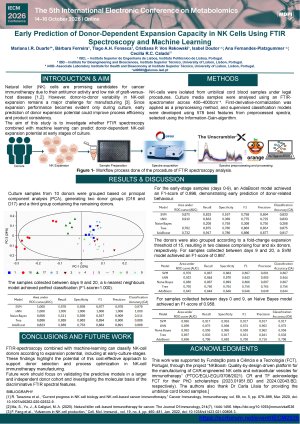
Introduction:Natural killer(NK) cells are candidates for cancer immunotherapy due to their antitumor-activity and lower risk of graft-versus-host disease than T-cell therapies. However, NK-cell manufacturing is constrained by donor-to-donor variability in expansion capacity, evident after culture days. This limitation reduces opportunities for early-process adjustment, making identification of high-performing donors crucial for improving process efficiency and product consistency.
Objectives:This study combines Fourier-transform infrared(FTIR) spectroscopy and machine-learning to identify molecular signatures in culture media associated with NK-cell expansion potential. The goal is to predict donor-dependent expansion performance at early culture stages, before significant cell-proliferation occurs.
Methods:NK-cells were isolated from umbilical cord blood samples under legal procedures. Culture media samples were analysed using an FTIR-spectrometer across 400–4000cm⁻¹. First-derivative-normalization was applied as a preprocessing method, and supervised classification models were developed using 578 best features from preprocessed spectra, selected using the Information-Gain-algorithm.
Results:Culture samples from ten donors were grouped based on principal component analysis(PCA), generating two donor groups and a third group containing the remaining donors. Using samples collected between days 9 and 20, a k-nearest neighbours model achieved perfect classification (F1-score=1.000). Using early-stage samples (days 0-9), an AdaBoost model achieved an F1-score of 0.896, demonstrating early prediction of donor-related behaviour. Donors were grouped according to a fold-change expansion threshold of 15, generating classes of four and six donors, respectively. For samples collected between days 9 and 20, a Naïve Bayes model achieved an F1-score of 0.958, while an SVM model trained on samples from the first nine culture days achieved an F1-score of 0.867.
Conclusions:FTIR-spectroscopy combined with machine-learning can classify NK-cell donors according to expansion potential, including at early-culture-stages. These findings highlight the potential of this cost-effective approach to support donor selection and process optimization in NK-cell immunotherapy manufacturing.
Keywords
Key-words: FTIR spetroscopy
donor variability
NK cell expansion
Poster
Early Prediction of Donor-Dependent Expansion Capacity in NK Cells Using FTIR Spectroscopy and Machine Learning- poster IECM 2026.pdf
Lyophilization-based protocol for human plasma and serum metabolomics by benchtop NMR spectroscopy: optimization and validation
Lipidomic Profiling of Egg Yolk to Evaluate Alternative Protein Sources in the Mediterranean Diet