Event submissions
Published
This submission belongs to the session S1. Lipid and Nutrition Metabolomics of the event The 5th International Electronic Conference on Metabolomics
Published date
09 Oct, 2026
Academic Editor
'%3e%3cpath%20d='M12.6657%2010.9104C12.4185%2010.325%2012.0599%209.79327%2011.6097%209.34482C11.1609%208.89508%2010.6293%208.5365%2010.0442%208.28888C10.0389%208.28626%2010.0337%208.28495%2010.0285%208.28233C10.8446%207.69279%2011.3752%206.73249%2011.3752%205.64904C11.3752%203.8542%209.92103%202.39999%208.1262%202.39999C6.33136%202.39999%204.87715%203.8542%204.87715%205.64904C4.87715%206.73249%205.40774%207.69279%206.22393%208.28364C6.21869%208.28626%206.21345%208.28757%206.20821%208.29019C5.62129%208.5378%205.09463%208.89284%204.64265%209.34613C4.1929%209.79493%203.83432%2010.3266%203.58671%2010.9117C3.34345%2011.4845%203.21226%2012.0987%203.20023%2012.7209C3.19988%2012.7349%203.20233%2012.7488%203.20744%2012.7619C3.21255%2012.7749%203.22022%2012.7867%203.22998%2012.7968C3.23975%2012.8068%203.25142%2012.8147%203.26431%2012.8202C3.2772%2012.8256%203.29105%2012.8284%203.30504%2012.8284H4.09109C4.14874%2012.8284%204.19459%2012.7825%204.1959%2012.7262C4.2221%2011.7148%204.62823%2010.7676%205.34617%2010.0497C6.08899%209.30683%207.0755%208.89808%208.1262%208.89808C9.17689%208.89808%2010.1634%209.30683%2010.9062%2010.0497C11.6242%2010.7676%2012.0303%2011.7148%2012.0565%2012.7262C12.0578%2012.7838%2012.1037%2012.8284%2012.1613%2012.8284H12.9474C12.9613%2012.8284%2012.9752%2012.8256%2012.9881%2012.8202C13.001%2012.8147%2013.0126%2012.8068%2013.0224%2012.7968C13.0322%2012.7867%2013.0398%2012.7749%2013.0449%2012.7619C13.0501%2012.7488%2013.0525%2012.7349%2013.0522%2012.7209C13.0391%2012.0947%2012.9094%2011.4855%2012.6657%2010.9104ZM8.1262%207.9024C7.52486%207.9024%206.9589%207.6679%206.53312%207.24211C6.10733%206.81633%205.87283%206.25037%205.87283%205.64904C5.87283%205.0477%206.10733%204.48174%206.53312%204.05596C6.9589%203.63018%207.52486%203.39567%208.1262%203.39567C8.72753%203.39567%209.29349%203.63018%209.71927%204.05596C10.1451%204.48174%2010.3796%205.0477%2010.3796%205.64904C10.3796%206.25037%2010.1451%206.81633%209.71927%207.24211C9.29349%207.6679%208.72753%207.9024%208.1262%207.9024Z'%20fill='%235D1EE1'/%3e%3c/g%3e%3c/svg%3e) Giuseppe Paglia
Giuseppe PagliaCitation
Georgios Theodoridis, Theano Rizou, Pol Giménez Gil, Artemis Vasileiou, Christina Virgiliou, Lipidomic Profiling of Egg Yolk to Evaluate Alternative Protein Sources in the Mediterranean Diet, in Proceedings of The 5th International Electronic Conference on Metabolomics, 14 October–16 October 2026, MDPI: Basel, Switzerland
Share
Email
Facebook
Twitter
LinkedIn
Lipidomic Profiling of Egg Yolk to Evaluate Alternative Protein Sources in the Mediterranean Diet

Georgios Theodoridis 1,2
'%3e%3cpath%20d='M12.6647%2010.9104C12.4176%2010.325%2012.0589%209.7933%2011.6088%209.34485C11.16%208.89511%2010.6283%208.53653%2010.0432%208.28891C10.038%208.28629%2010.0327%208.28498%2010.0275%208.28236C10.8437%207.69282%2011.3743%206.73252%2011.3743%205.64907C11.3743%203.85423%209.92005%202.40002%208.12522%202.40002C6.33038%202.40002%204.87618%203.85423%204.87618%205.64907C4.87618%206.73252%205.40677%207.69282%206.22296%208.28367C6.21772%208.28629%206.21248%208.2876%206.20724%208.29022C5.62031%208.53783%205.09365%208.89287%204.64167%209.34616C4.19192%209.79496%203.83334%2010.3266%203.58573%2010.9117C3.34247%2011.4846%203.21128%2012.0987%203.19925%2012.721C3.1989%2012.735%203.20135%2012.7489%203.20646%2012.7619C3.21157%2012.7749%203.21924%2012.7868%203.22901%2012.7968C3.23877%2012.8068%203.25045%2012.8148%203.26334%2012.8202C3.27623%2012.8256%203.29007%2012.8284%203.30406%2012.8284H4.09012C4.14776%2012.8284%204.19362%2012.7825%204.19493%2012.7262C4.22113%2011.7148%204.62726%2010.7676%205.34519%2010.0497C6.08802%209.30686%207.07452%208.89811%208.12522%208.89811C9.17592%208.89811%2010.1624%209.30686%2010.9052%2010.0497C11.6232%2010.7676%2012.0293%2011.7148%2012.0555%2012.7262C12.0568%2012.7839%2012.1027%2012.8284%2012.1603%2012.8284H12.9464C12.9604%2012.8284%2012.9742%2012.8256%2012.9871%2012.8202C13%2012.8148%2013.0117%2012.8068%2013.0214%2012.7968C13.0312%2012.7868%2013.0389%2012.7749%2013.044%2012.7619C13.0491%2012.7489%2013.0515%2012.735%2013.0512%2012.721C13.0381%2012.0947%2012.9084%2011.4856%2012.6647%2010.9104ZM8.12522%207.90243C7.52388%207.90243%206.95792%207.66793%206.53214%207.24215C6.10636%206.81636%205.87185%206.2504%205.87185%205.64907C5.87185%205.04773%206.10636%204.48177%206.53214%204.05599C6.95792%203.63021%207.52388%203.3957%208.12522%203.3957C8.72655%203.3957%209.29252%203.63021%209.7183%204.05599C10.1441%204.48177%2010.3786%205.04773%2010.3786%205.64907C10.3786%206.2504%2010.1441%206.81636%209.7183%207.24215C9.29252%207.66793%208.72655%207.90243%208.12522%207.90243Z'%20fill='%235D1EE1'/%3e%3c/g%3e%3c/svg%3e)
Theano Rizou 2,3

Pol Giménez Gil 2
Artemis Vasileiou 3
Christina Virgiliou 2,3
1. Laboratory of Analytical Chemistry, School of Chemistry, Aristotle University of Thessaloniki, Thessaloniki, 54124, Greece
2. Biomic AUTh, Center for Interdisciplinary Research and Innovation (CIRI-AUTH), Thessaloniki, 57001, Greece
3. School of Chemical Engineering, Aristotle University of Thessaloniki, Thessaloniki, 54636, Greece
Abstract
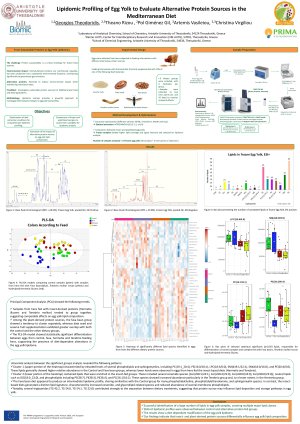
Alternative protein sources, such as plant-based, microbial and novel foods, offer promising solutions to meet the growing population’s nutritional needs while reducing environmental impact. The ProxIMed project aims to integrate sustainable proteins into Mediterranean food systems. Eggs from hens (6 groups, 6 replicates per group) were collected after 21 and 42 days of feeding intervention with the basal diet supplemented with 10% of one of the following feed materials: sesame hulls, date seeds, fava beans, Tenebrio molitor larvae, or hydrolyzed Hermetia illucens. All experimental diets were designed to be isoenergetic and isoproteic, ensuring comparable levels of metabolizable energy (approximately 11.4 MJ/kg) and crude protein (17.5%) across all treatments. Different extraction solvents (MTBE, chloroform, MeOH and H2O) in different ratios were evaluated for lipid extraction. After optimization, frozen and lyophilized egg yolks were compared to assess their lipidomic content. The optimal extraction condition was MTBE:MeOH:H₂O 2:1:1 (v/v/v). Comparative analysis revealed that frozen samples yielded higher lipid coverage and signal intensity. A total of 72 frozen egg yolk samples were analyzed using a UHPLC-timsTOF Pro 2 analytical platform in PASEF mode, allowing high-throughput profiling and lipid annotation using collision cross section (CCS) measurements. Lipid identification was performed using PASEF fragmentation data and available lipid libraries (MS-DIAL, LIPID ATLAS, and an in-house NIST database). Almost 400 lipids were identified, covering major lipid subclasses, including CE, CER, DG, HexCer, PE, PE-O/PE-P, PC-O/PC-P, LPC, LPE, PI, SM, PC, TG and FA. Multivariate analysis revealed diet-related differences in egg yolk lipidomic profiles, particularly among control, fava bean, Tenebrio molitor and hydrolyzed Hermetia illucens groups. These findings demonstrate the potential of lipidomics to evaluate the effects of alternative protein ingredients on egg yolk lipid composition.
Keywords
egg yolk
lipidomics
alternative proteins
UHPLC
Poster
Egg Yolk Lipidomics Poster.pdf
Early Prediction of Donor-Dependent Expansion Capacity in NK Cells Using FTIR Spectroscopy and Machine Learning
Quality control of the culture media during early stages of NK-cell expansion process