Event submissions
Published
This submission belongs to the session S4. Clinical Metabolomics and Drug Metabolism of the event The 5th International Electronic Conference on Metabolomics
Published date
09 Oct, 2026
Academic Editor
'%3e%3cpath%20d='M12.6657%2010.9104C12.4185%2010.325%2012.0599%209.79327%2011.6097%209.34482C11.1609%208.89508%2010.6293%208.5365%2010.0442%208.28888C10.0389%208.28626%2010.0337%208.28495%2010.0285%208.28233C10.8446%207.69279%2011.3752%206.73249%2011.3752%205.64904C11.3752%203.8542%209.92103%202.39999%208.1262%202.39999C6.33136%202.39999%204.87715%203.8542%204.87715%205.64904C4.87715%206.73249%205.40774%207.69279%206.22393%208.28364C6.21869%208.28626%206.21345%208.28757%206.20821%208.29019C5.62129%208.5378%205.09463%208.89284%204.64265%209.34613C4.1929%209.79493%203.83432%2010.3266%203.58671%2010.9117C3.34345%2011.4845%203.21226%2012.0987%203.20023%2012.7209C3.19988%2012.7349%203.20233%2012.7488%203.20744%2012.7619C3.21255%2012.7749%203.22022%2012.7867%203.22998%2012.7968C3.23975%2012.8068%203.25142%2012.8147%203.26431%2012.8202C3.2772%2012.8256%203.29105%2012.8284%203.30504%2012.8284H4.09109C4.14874%2012.8284%204.19459%2012.7825%204.1959%2012.7262C4.2221%2011.7148%204.62823%2010.7676%205.34617%2010.0497C6.08899%209.30683%207.0755%208.89808%208.1262%208.89808C9.17689%208.89808%2010.1634%209.30683%2010.9062%2010.0497C11.6242%2010.7676%2012.0303%2011.7148%2012.0565%2012.7262C12.0578%2012.7838%2012.1037%2012.8284%2012.1613%2012.8284H12.9474C12.9613%2012.8284%2012.9752%2012.8256%2012.9881%2012.8202C13.001%2012.8147%2013.0126%2012.8068%2013.0224%2012.7968C13.0322%2012.7867%2013.0398%2012.7749%2013.0449%2012.7619C13.0501%2012.7488%2013.0525%2012.7349%2013.0522%2012.7209C13.0391%2012.0947%2012.9094%2011.4855%2012.6657%2010.9104ZM8.1262%207.9024C7.52486%207.9024%206.9589%207.6679%206.53312%207.24211C6.10733%206.81633%205.87283%206.25037%205.87283%205.64904C5.87283%205.0477%206.10733%204.48174%206.53312%204.05596C6.9589%203.63018%207.52486%203.39567%208.1262%203.39567C8.72753%203.39567%209.29349%203.63018%209.71927%204.05596C10.1451%204.48174%2010.3796%205.0477%2010.3796%205.64904C10.3796%206.25037%2010.1451%206.81633%209.71927%207.24211C9.29349%207.6679%208.72753%207.9024%208.1262%207.9024Z'%20fill='%235D1EE1'/%3e%3c/g%3e%3c/svg%3e) Yunping Qiu
Yunping QiuCitation
Jiya Mishra, Shreya Pandey, NEERAJ SINHA, Integrated NMR-Based Metabolomics and Clinical Profiling for Differential Diagnosis of Gallbladder Cancer and Gallstone Disease., in Proceedings of The 5th International Electronic Conference on Metabolomics, 14 October–16 October 2026, MDPI: Basel, Switzerland
Share
Email
Facebook
Twitter
LinkedIn
Integrated NMR-Based Metabolomics and Clinical Profiling for Differential Diagnosis of Gallbladder Cancer and Gallstone Disease.
'%3e%3cpath%20d='M12.6647%2010.9104C12.4176%2010.325%2012.0589%209.7933%2011.6088%209.34485C11.16%208.89511%2010.6283%208.53653%2010.0432%208.28891C10.038%208.28629%2010.0327%208.28498%2010.0275%208.28236C10.8437%207.69282%2011.3743%206.73252%2011.3743%205.64907C11.3743%203.85423%209.92005%202.40002%208.12522%202.40002C6.33038%202.40002%204.87618%203.85423%204.87618%205.64907C4.87618%206.73252%205.40677%207.69282%206.22296%208.28367C6.21772%208.28629%206.21248%208.2876%206.20724%208.29022C5.62031%208.53783%205.09365%208.89287%204.64167%209.34616C4.19192%209.79496%203.83334%2010.3266%203.58573%2010.9117C3.34247%2011.4846%203.21128%2012.0987%203.19925%2012.721C3.1989%2012.735%203.20135%2012.7489%203.20646%2012.7619C3.21157%2012.7749%203.21924%2012.7868%203.22901%2012.7968C3.23877%2012.8068%203.25045%2012.8148%203.26334%2012.8202C3.27623%2012.8256%203.29007%2012.8284%203.30406%2012.8284H4.09012C4.14776%2012.8284%204.19362%2012.7825%204.19493%2012.7262C4.22113%2011.7148%204.62726%2010.7676%205.34519%2010.0497C6.08802%209.30686%207.07452%208.89811%208.12522%208.89811C9.17592%208.89811%2010.1624%209.30686%2010.9052%2010.0497C11.6232%2010.7676%2012.0293%2011.7148%2012.0555%2012.7262C12.0568%2012.7839%2012.1027%2012.8284%2012.1603%2012.8284H12.9464C12.9604%2012.8284%2012.9742%2012.8256%2012.9871%2012.8202C13%2012.8148%2013.0117%2012.8068%2013.0214%2012.7968C13.0312%2012.7868%2013.0389%2012.7749%2013.044%2012.7619C13.0491%2012.7489%2013.0515%2012.735%2013.0512%2012.721C13.0381%2012.0947%2012.9084%2011.4856%2012.6647%2010.9104ZM8.12522%207.90243C7.52388%207.90243%206.95792%207.66793%206.53214%207.24215C6.10636%206.81636%205.87185%206.2504%205.87185%205.64907C5.87185%205.04773%206.10636%204.48177%206.53214%204.05599C6.95792%203.63021%207.52388%203.3957%208.12522%203.3957C8.72655%203.3957%209.29252%203.63021%209.7183%204.05599C10.1441%204.48177%2010.3786%205.04773%2010.3786%205.64907C10.3786%206.2504%2010.1441%206.81636%209.7183%207.24215C9.29252%207.66793%208.72655%207.90243%208.12522%207.90243Z'%20fill='%235D1EE1'/%3e%3c/g%3e%3c/svg%3e)
Jiya Mishra 1,2
Shreya Pandey 1,2
NEERAJ SINHA 1,2
1. Department of Advanced Spectroscopy, Centre of Biomedical Research, SGPGIMS Campus, Raebareli Road, Lucknow, 226014, India
2. Academy of Scientific and Innovative Research, Ghaziabad, Uttar Pradesh, 201002, India
Abstract
Background:
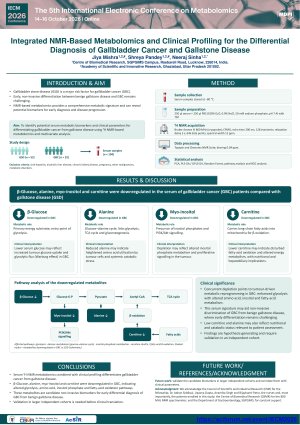
Differentiating gallbladder cancer (GBC) from gallstone disease (GSD) remains a significant clinical challenge due to overlapping clinical manifestations and the limited diagnostic accuracy of conventional clinical parameters. This study aimed to evaluate the diagnostic utility of serum ¹H NMR-based metabolomics integrated with clinical profiling for improved differentiation between GBC and GSD.
Methods:
Serum samples were collected from 50 patients with GBC, 50 patients with GSD, and 20 healthy controls. Metabolic profiling was performed using ¹H Nuclear Magnetic Resonance (NMR) spectroscopy. Differential metabolites were identified by comparing GBC and GSD metabolic profiles. Metabolomic and clinical datasets were subsequently integrated using Multi-Omics Factor Analysis (MOFA) to assess their relative contribution to disease classification and diagnostic performance.
Results:
Comparative metabolomic analysis revealed significant downregulation of β-glucose, alanine, and carnitine in GBC compared with GSD. MOFA-based integration demonstrated that the metabolomic dataset contributed more strongly to disease discrimination than clinical parameters alone, indicating superior diagnostic performance of NMR-derived metabolic signatures for differentiating GBC from GSD.
Conclusion:
Integrated analysis of ¹H NMR-based metabolomics and clinical profiling highlights the superior diagnostic potential of metabolomic biomarkers over conventional clinical parameters for distinguishing GBC from GSD. These findings support the application of NMR-based metabolomics as a promising complementary tool for the early and accurate differential diagnosis of gallbladder diseases.
Keywords
Gallbladder cancer
Gallstone disease
¹H NMR metabolomics
MOFA
Clinical profiling
Biomarkers.
Poster
PPT_CONF_IECM2026.pdf
PRESERVATION FLUID FTIR FINGERPRINTING AS A PRE-IMPLANT READOUT OF EARLY KIDNEY GRAFT FUNCTION
Integrative Clinical Lipid Metabolomics Analysis of Metabolic Characteristics Underlying Hypertrophic Scar Formation After Plastic Surgery