Event submissions
Published
This submission belongs to the session S3. Advanced Data Analysis and Integration in Metabolomics of the event The 5th International Electronic Conference on Metabolomics
Published date
09 Oct, 2026
Academic Editor
'%3e%3cpath%20d='M12.6657%2010.9104C12.4185%2010.325%2012.0599%209.79327%2011.6097%209.34482C11.1609%208.89508%2010.6293%208.5365%2010.0442%208.28888C10.0389%208.28626%2010.0337%208.28495%2010.0285%208.28233C10.8446%207.69279%2011.3752%206.73249%2011.3752%205.64904C11.3752%203.8542%209.92103%202.39999%208.1262%202.39999C6.33136%202.39999%204.87715%203.8542%204.87715%205.64904C4.87715%206.73249%205.40774%207.69279%206.22393%208.28364C6.21869%208.28626%206.21345%208.28757%206.20821%208.29019C5.62129%208.5378%205.09463%208.89284%204.64265%209.34613C4.1929%209.79493%203.83432%2010.3266%203.58671%2010.9117C3.34345%2011.4845%203.21226%2012.0987%203.20023%2012.7209C3.19988%2012.7349%203.20233%2012.7488%203.20744%2012.7619C3.21255%2012.7749%203.22022%2012.7867%203.22998%2012.7968C3.23975%2012.8068%203.25142%2012.8147%203.26431%2012.8202C3.2772%2012.8256%203.29105%2012.8284%203.30504%2012.8284H4.09109C4.14874%2012.8284%204.19459%2012.7825%204.1959%2012.7262C4.2221%2011.7148%204.62823%2010.7676%205.34617%2010.0497C6.08899%209.30683%207.0755%208.89808%208.1262%208.89808C9.17689%208.89808%2010.1634%209.30683%2010.9062%2010.0497C11.6242%2010.7676%2012.0303%2011.7148%2012.0565%2012.7262C12.0578%2012.7838%2012.1037%2012.8284%2012.1613%2012.8284H12.9474C12.9613%2012.8284%2012.9752%2012.8256%2012.9881%2012.8202C13.001%2012.8147%2013.0126%2012.8068%2013.0224%2012.7968C13.0322%2012.7867%2013.0398%2012.7749%2013.0449%2012.7619C13.0501%2012.7488%2013.0525%2012.7349%2013.0522%2012.7209C13.0391%2012.0947%2012.9094%2011.4855%2012.6657%2010.9104ZM8.1262%207.9024C7.52486%207.9024%206.9589%207.6679%206.53312%207.24211C6.10733%206.81633%205.87283%206.25037%205.87283%205.64904C5.87283%205.0477%206.10733%204.48174%206.53312%204.05596C6.9589%203.63018%207.52486%203.39567%208.1262%203.39567C8.72753%203.39567%209.29349%203.63018%209.71927%204.05596C10.1451%204.48174%2010.3796%205.0477%2010.3796%205.64904C10.3796%206.25037%2010.1451%206.81633%209.71927%207.24211C9.29349%207.6679%208.72753%207.9024%208.1262%207.9024Z'%20fill='%235D1EE1'/%3e%3c/g%3e%3c/svg%3e) Reza Salek
Reza SalekCitation
UPASNA GUPTA, Amrita Sahu, Anupma Kaul, Jiya Mishra, Subash Yadav, Manas Behera, Bikash Baishya, Neeraj Sinha, NMR-Based Metabolomics Reveals Diabetes-Associated Metabolic Dysregulation in Early-Stage Chronic Kidney Disease, in Proceedings of The 5th International Electronic Conference on Metabolomics, 14 October–16 October 2026, MDPI: Basel, Switzerland
Share
Email
Facebook
Twitter
LinkedIn
NMR-Based Metabolomics Reveals Diabetes-Associated Metabolic Dysregulation in Early-Stage Chronic Kidney Disease
'%3e%3cpath%20d='M12.6647%2010.9104C12.4176%2010.325%2012.0589%209.7933%2011.6088%209.34485C11.16%208.89511%2010.6283%208.53653%2010.0432%208.28891C10.038%208.28629%2010.0327%208.28498%2010.0275%208.28236C10.8437%207.69282%2011.3743%206.73252%2011.3743%205.64907C11.3743%203.85423%209.92005%202.40002%208.12522%202.40002C6.33038%202.40002%204.87618%203.85423%204.87618%205.64907C4.87618%206.73252%205.40677%207.69282%206.22296%208.28367C6.21772%208.28629%206.21248%208.2876%206.20724%208.29022C5.62031%208.53783%205.09365%208.89287%204.64167%209.34616C4.19192%209.79496%203.83334%2010.3266%203.58573%2010.9117C3.34247%2011.4846%203.21128%2012.0987%203.19925%2012.721C3.1989%2012.735%203.20135%2012.7489%203.20646%2012.7619C3.21157%2012.7749%203.21924%2012.7868%203.22901%2012.7968C3.23877%2012.8068%203.25045%2012.8148%203.26334%2012.8202C3.27623%2012.8256%203.29007%2012.8284%203.30406%2012.8284H4.09012C4.14776%2012.8284%204.19362%2012.7825%204.19493%2012.7262C4.22113%2011.7148%204.62726%2010.7676%205.34519%2010.0497C6.08802%209.30686%207.07452%208.89811%208.12522%208.89811C9.17592%208.89811%2010.1624%209.30686%2010.9052%2010.0497C11.6232%2010.7676%2012.0293%2011.7148%2012.0555%2012.7262C12.0568%2012.7839%2012.1027%2012.8284%2012.1603%2012.8284H12.9464C12.9604%2012.8284%2012.9742%2012.8256%2012.9871%2012.8202C13%2012.8148%2013.0117%2012.8068%2013.0214%2012.7968C13.0312%2012.7868%2013.0389%2012.7749%2013.044%2012.7619C13.0491%2012.7489%2013.0515%2012.735%2013.0512%2012.721C13.0381%2012.0947%2012.9084%2011.4856%2012.6647%2010.9104ZM8.12522%207.90243C7.52388%207.90243%206.95792%207.66793%206.53214%207.24215C6.10636%206.81636%205.87185%206.2504%205.87185%205.64907C5.87185%205.04773%206.10636%204.48177%206.53214%204.05599C6.95792%203.63021%207.52388%203.3957%208.12522%203.3957C8.72655%203.3957%209.29252%203.63021%209.7183%204.05599C10.1441%204.48177%2010.3786%205.04773%2010.3786%205.64907C10.3786%206.2504%2010.1441%206.81636%209.7183%207.24215C9.29252%207.66793%208.72655%207.90243%208.12522%207.90243Z'%20fill='%235D1EE1'/%3e%3c/g%3e%3c/svg%3e)
UPASNA GUPTA 1,2
Amrita Sahu 1,2
Anupma Kaul 3
Jiya Mishra 1,2
Subash Yadav 4
Manas Behera 3
Bikash Baishya 1,2
Neeraj Sinha 1,2
1. Department of Advanced Spectroscopy and Imaging, Centre of Biomedical Research, Lucknow, Uttar Pradesh, India
2. Academy of Scientific and Innovative Research (AcSIR), Kamla Nehru Nagar, Ghaziabad, Uttar Pradesh, 201002, India
3. Department of Nephrology and Renal Transplantation, Sanjay Gandhi Postgraduate Institute of Medical Sciences, Lucknow, Uttar Pradesh, India
4. Department of Endocrinology, Sanjay Gandhi Postgraduate Institute of Medical Sciences, Lucknow, India
Abstract
Impact:
This study identifies important metabolic pathways and potential biomarkers for early diagnosis and disease monitoring by revealing diabetes-associated metabolic dysregulation in early-stage chronic kidney disease (CKD). In order to delay the progression of chronic kidney disease (CKD) and lessen complications related to diabetes, these findings promote precision medicine approaches, tailored treatment interventions, and better risk assessment.
Motivation:
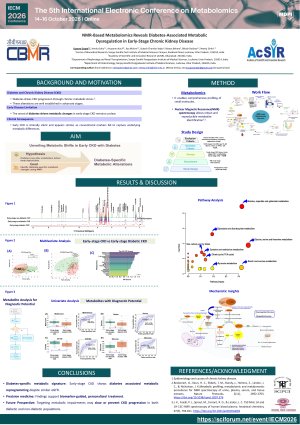
Type 2 diabetes mellitus (T2DM) is a primary cause of chronic kidney disease (CKD), accelerating disease development via oxidative stress and complex metabolic disruptions. However, the metabolic mechanism underlying diabetes-associated renal damage in the early stages of CKD are poorly understood.
Aim:
This study used serum ¹H NMR-based metabolomics to assess metabolic changes in early-stage CKD patients with and without type 2 diabetes. It also sought to discover possible biomarkers and disrupted metabolic pathways linked to diabetic CKD.
Method:
¹H NMR spectroscopy was used to assess serum samples from 100 people with early-stage CKD, including patients with and without T2DM. Metabolic pathway analysis was used to discover impacted biochemical pathways after multivariate and univariate statistical approaches were used to find significantly changed metabolites.
Results:
Patients with diabetic and non-diabetic chronic kidney disease (CKD) showed different metabolic profiles; lower levels of citrate, serine, and methionine suggested problems with energy metabolism and one-carbon metabolism; pathway analysis showed notable changes in the tricarboxylic acid (TCA) cycle and amino acid metabolism, indicating the metabolic impact of diabetes in early CKD.
Conclusion:
The three metabolites that were identified—methionine, citrate, and serine—may be useful biomarkers for the early identification and description of diabetic chronic kidney disease (CKD), assisting with better risk assessment and individualized treatment plans.
Keywords
Chronic Kidney Disease(CKD)
Diabetes
Metabolomics
Multivariate
Precision Medicine
Poster
IECM 2026_Upasna_Gupta.pdf
Integrative Clinical Lipid Metabolomics Analysis of Metabolic Characteristics Underlying Hypertrophic Scar Formation After Plastic Surgery
Investigation of Metabolic Dysregulation in Advanced-Stage Chronic Kidney Disease Using NMR-Based Urinary Metabolomics.