Event submissions
Published
This submission belongs to the session S1. Lipid and Nutrition Metabolomics of the event The 5th International Electronic Conference on Metabolomics
Published date
09 Oct, 2026
Academic Editor
'%3e%3cpath%20d='M12.6657%2010.9104C12.4185%2010.325%2012.0599%209.79327%2011.6097%209.34482C11.1609%208.89508%2010.6293%208.5365%2010.0442%208.28888C10.0389%208.28626%2010.0337%208.28495%2010.0285%208.28233C10.8446%207.69279%2011.3752%206.73249%2011.3752%205.64904C11.3752%203.8542%209.92103%202.39999%208.1262%202.39999C6.33136%202.39999%204.87715%203.8542%204.87715%205.64904C4.87715%206.73249%205.40774%207.69279%206.22393%208.28364C6.21869%208.28626%206.21345%208.28757%206.20821%208.29019C5.62129%208.5378%205.09463%208.89284%204.64265%209.34613C4.1929%209.79493%203.83432%2010.3266%203.58671%2010.9117C3.34345%2011.4845%203.21226%2012.0987%203.20023%2012.7209C3.19988%2012.7349%203.20233%2012.7488%203.20744%2012.7619C3.21255%2012.7749%203.22022%2012.7867%203.22998%2012.7968C3.23975%2012.8068%203.25142%2012.8147%203.26431%2012.8202C3.2772%2012.8256%203.29105%2012.8284%203.30504%2012.8284H4.09109C4.14874%2012.8284%204.19459%2012.7825%204.1959%2012.7262C4.2221%2011.7148%204.62823%2010.7676%205.34617%2010.0497C6.08899%209.30683%207.0755%208.89808%208.1262%208.89808C9.17689%208.89808%2010.1634%209.30683%2010.9062%2010.0497C11.6242%2010.7676%2012.0303%2011.7148%2012.0565%2012.7262C12.0578%2012.7838%2012.1037%2012.8284%2012.1613%2012.8284H12.9474C12.9613%2012.8284%2012.9752%2012.8256%2012.9881%2012.8202C13.001%2012.8147%2013.0126%2012.8068%2013.0224%2012.7968C13.0322%2012.7867%2013.0398%2012.7749%2013.0449%2012.7619C13.0501%2012.7488%2013.0525%2012.7349%2013.0522%2012.7209C13.0391%2012.0947%2012.9094%2011.4855%2012.6657%2010.9104ZM8.1262%207.9024C7.52486%207.9024%206.9589%207.6679%206.53312%207.24211C6.10733%206.81633%205.87283%206.25037%205.87283%205.64904C5.87283%205.0477%206.10733%204.48174%206.53312%204.05596C6.9589%203.63018%207.52486%203.39567%208.1262%203.39567C8.72753%203.39567%209.29349%203.63018%209.71927%204.05596C10.1451%204.48174%2010.3796%205.0477%2010.3796%205.64904C10.3796%206.25037%2010.1451%206.81633%209.71927%207.24211C9.29349%207.6679%208.72753%207.9024%208.1262%207.9024Z'%20fill='%235D1EE1'/%3e%3c/g%3e%3c/svg%3e) Giuseppe Paglia
Giuseppe PagliaCitation
Boda Damodar, Vishal Verma, Vishal Gill, Avinash Kumar, Shailendra Pratap Singh, Nutrient-Dense Wheatgrass Ladoo Formulations for Athlete Nutrition: A Biochemical Profiling of Sunflower and Pumpkin Seed Variants, in Proceedings of The 5th International Electronic Conference on Metabolomics, 14 October–16 October 2026, MDPI: Basel, Switzerland
Share
Email
Facebook
Twitter
LinkedIn
Nutrient-Dense Wheatgrass Ladoo Formulations for Athlete Nutrition: A Biochemical Profiling of Sunflower and Pumpkin Seed Variants
'%3e%3cpath%20d='M12.6647%2010.9104C12.4176%2010.325%2012.0589%209.7933%2011.6088%209.34485C11.16%208.89511%2010.6283%208.53653%2010.0432%208.28891C10.038%208.28629%2010.0327%208.28498%2010.0275%208.28236C10.8437%207.69282%2011.3743%206.73252%2011.3743%205.64907C11.3743%203.85423%209.92005%202.40002%208.12522%202.40002C6.33038%202.40002%204.87618%203.85423%204.87618%205.64907C4.87618%206.73252%205.40677%207.69282%206.22296%208.28367C6.21772%208.28629%206.21248%208.2876%206.20724%208.29022C5.62031%208.53783%205.09365%208.89287%204.64167%209.34616C4.19192%209.79496%203.83334%2010.3266%203.58573%2010.9117C3.34247%2011.4846%203.21128%2012.0987%203.19925%2012.721C3.1989%2012.735%203.20135%2012.7489%203.20646%2012.7619C3.21157%2012.7749%203.21924%2012.7868%203.22901%2012.7968C3.23877%2012.8068%203.25045%2012.8148%203.26334%2012.8202C3.27623%2012.8256%203.29007%2012.8284%203.30406%2012.8284H4.09012C4.14776%2012.8284%204.19362%2012.7825%204.19493%2012.7262C4.22113%2011.7148%204.62726%2010.7676%205.34519%2010.0497C6.08802%209.30686%207.07452%208.89811%208.12522%208.89811C9.17592%208.89811%2010.1624%209.30686%2010.9052%2010.0497C11.6232%2010.7676%2012.0293%2011.7148%2012.0555%2012.7262C12.0568%2012.7839%2012.1027%2012.8284%2012.1603%2012.8284H12.9464C12.9604%2012.8284%2012.9742%2012.8256%2012.9871%2012.8202C13%2012.8148%2013.0117%2012.8068%2013.0214%2012.7968C13.0312%2012.7868%2013.0389%2012.7749%2013.044%2012.7619C13.0491%2012.7489%2013.0515%2012.735%2013.0512%2012.721C13.0381%2012.0947%2012.9084%2011.4856%2012.6647%2010.9104ZM8.12522%207.90243C7.52388%207.90243%206.95792%207.66793%206.53214%207.24215C6.10636%206.81636%205.87185%206.2504%205.87185%205.64907C5.87185%205.04773%206.10636%204.48177%206.53214%204.05599C6.95792%203.63021%207.52388%203.3957%208.12522%203.3957C8.72655%203.3957%209.29252%203.63021%209.7183%204.05599C10.1441%204.48177%2010.3786%205.04773%2010.3786%205.64907C10.3786%206.2504%2010.1441%206.81636%209.7183%207.24215C9.29252%207.66793%208.72655%207.90243%208.12522%207.90243Z'%20fill='%235D1EE1'/%3e%3c/g%3e%3c/svg%3e)
Boda Damodar 1

Vishal Verma 1
Vishal Gill 1
Avinash Kumar 1
Shailendra Pratap Singh 1
1. Department of Sports Biosciences, Central University of Rajasthan, Bandar Sindri, Dist. Ajmer, Rajasthan, 305817, India
Abstract
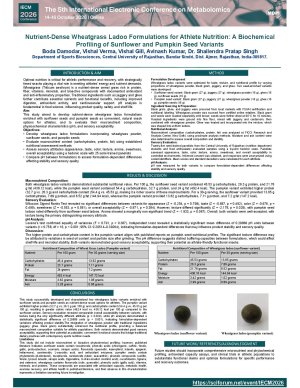
Nutrition-focused metabolite and food composition analyses are increasingly relevant for designing functional foods for athletic populations. This study developed nutrient-dense wheatgrass ladoo formulations enriched with sunflower seeds and pumpkin seeds, evaluating their nutritional and physicochemical characteristics as potential snack options for athletes. Ingredients were procured from licensed vendors and processed through roasting, grinding, mixing, and shaping. Samples were analyzed at the FICCI laboratory, with sensory evaluation by 25 semi-trained panelists assessing appearance, taste, color, texture, aroma, sweetness, and overall acceptability; pH analysis compared the two variants.
Nutritional analysis showed the sunflower seed variant contained 45.53 g carbohydrates, 26.3 g protein, and 21.76 g fat per 100 g, while the pumpkin seed variant contained 54.4 g carbohydrates, 32.7 g protein, and 24 g fat per 100 g, indicating notable variation in nutrient density. A statistically significant mean difference of 0.29889 pH units was observed between variants (p < 0.001), suggesting formulation-dependent differences potentially influencing stability and sensory quality.
This study did not include micronutrient or bioactive phytochemical profiling; however, published literature indicates sunflower seeds contain tocopherols, phenolic acids (chlorogenic, caffeic, ferulic, gallic, protocatechuic, coumaric, sinapic acids), flavonoids (quercetin, kaempferol, luteolin, apigenin, heliannone), carotenoids, L-ascorbic acid, and antioxidant enzymes; pumpkin seeds contain phytosterols (β-sitosterol), tocopherols, carotenoids (lutein, zeaxanthin), phenolic compounds (vanillic, ferulic, tyrosol, luteolin, sinapic acids, trigonelline, D-chiro-inositol, nicotinic acid), cucurbitacins, lignans, and selenium; wheatgrass contains flavonoids (rutin, quercetin), phenolic acids (gallic acid), vitamins, minerals, and proteins. These compounds are associated with antioxidant capacity, metabolic health, exercise recovery, and athlete health in published literature, and their absence in this characterization represents a limitation warranting future investigation.
Wheatgrass ladoos enriched with sunflower and pumpkin seeds may serve as practical, natural, nutrient-rich snack alternatives for athletes, supporting functional food development aligned with sports nutrition
Keywords
Wheatgrass ladoo
Nutrition metabolomics
Sports nutrition
Functional foods
Athlete diet
Poster
metabolomics conference poster.pdf
Metabolomic Profiling of Botanical Ingredients by ¹H NMR for Quality Evaluation ofNatural Health Products
Himalayan Geography Imprints the Metabolome of Traditional Yak Milk Churupi: A Multi-Region Comparative Study