Event submissions
Published
This submission belongs to the session S1. Lipid and Nutrition Metabolomics of the event The 5th International Electronic Conference on Metabolomics
Published date
09 Oct, 2026
Academic Editor
'%3e%3cpath%20d='M12.6657%2010.9104C12.4185%2010.325%2012.0599%209.79327%2011.6097%209.34482C11.1609%208.89508%2010.6293%208.5365%2010.0442%208.28888C10.0389%208.28626%2010.0337%208.28495%2010.0285%208.28233C10.8446%207.69279%2011.3752%206.73249%2011.3752%205.64904C11.3752%203.8542%209.92103%202.39999%208.1262%202.39999C6.33136%202.39999%204.87715%203.8542%204.87715%205.64904C4.87715%206.73249%205.40774%207.69279%206.22393%208.28364C6.21869%208.28626%206.21345%208.28757%206.20821%208.29019C5.62129%208.5378%205.09463%208.89284%204.64265%209.34613C4.1929%209.79493%203.83432%2010.3266%203.58671%2010.9117C3.34345%2011.4845%203.21226%2012.0987%203.20023%2012.7209C3.19988%2012.7349%203.20233%2012.7488%203.20744%2012.7619C3.21255%2012.7749%203.22022%2012.7867%203.22998%2012.7968C3.23975%2012.8068%203.25142%2012.8147%203.26431%2012.8202C3.2772%2012.8256%203.29105%2012.8284%203.30504%2012.8284H4.09109C4.14874%2012.8284%204.19459%2012.7825%204.1959%2012.7262C4.2221%2011.7148%204.62823%2010.7676%205.34617%2010.0497C6.08899%209.30683%207.0755%208.89808%208.1262%208.89808C9.17689%208.89808%2010.1634%209.30683%2010.9062%2010.0497C11.6242%2010.7676%2012.0303%2011.7148%2012.0565%2012.7262C12.0578%2012.7838%2012.1037%2012.8284%2012.1613%2012.8284H12.9474C12.9613%2012.8284%2012.9752%2012.8256%2012.9881%2012.8202C13.001%2012.8147%2013.0126%2012.8068%2013.0224%2012.7968C13.0322%2012.7867%2013.0398%2012.7749%2013.0449%2012.7619C13.0501%2012.7488%2013.0525%2012.7349%2013.0522%2012.7209C13.0391%2012.0947%2012.9094%2011.4855%2012.6657%2010.9104ZM8.1262%207.9024C7.52486%207.9024%206.9589%207.6679%206.53312%207.24211C6.10733%206.81633%205.87283%206.25037%205.87283%205.64904C5.87283%205.0477%206.10733%204.48174%206.53312%204.05596C6.9589%203.63018%207.52486%203.39567%208.1262%203.39567C8.72753%203.39567%209.29349%203.63018%209.71927%204.05596C10.1451%204.48174%2010.3796%205.0477%2010.3796%205.64904C10.3796%206.25037%2010.1451%206.81633%209.71927%207.24211C9.29349%207.6679%208.72753%207.9024%208.1262%207.9024Z'%20fill='%235D1EE1'/%3e%3c/g%3e%3c/svg%3e) Beate Fuchs
Beate FuchsCitation
Richa NATIONAL DAIRY RESEARCH Singh, Sarnamai Hansda, Rajan Sharma, Sumit Arora, Himalayan Geography Imprints the Metabolome of Traditional Yak Milk Churupi: A Multi-Region Comparative Study, in Proceedings of The 5th International Electronic Conference on Metabolomics, 14 October–16 October 2026, MDPI: Basel, Switzerland
Share
Email
Facebook
Twitter
LinkedIn
Himalayan Geography Imprints the Metabolome of Traditional Yak Milk Churupi: A Multi-Region Comparative Study
'%3e%3cpath%20d='M12.6647%2010.9104C12.4176%2010.325%2012.0589%209.7933%2011.6088%209.34485C11.16%208.89511%2010.6283%208.53653%2010.0432%208.28891C10.038%208.28629%2010.0327%208.28498%2010.0275%208.28236C10.8437%207.69282%2011.3743%206.73252%2011.3743%205.64907C11.3743%203.85423%209.92005%202.40002%208.12522%202.40002C6.33038%202.40002%204.87618%203.85423%204.87618%205.64907C4.87618%206.73252%205.40677%207.69282%206.22296%208.28367C6.21772%208.28629%206.21248%208.2876%206.20724%208.29022C5.62031%208.53783%205.09365%208.89287%204.64167%209.34616C4.19192%209.79496%203.83334%2010.3266%203.58573%2010.9117C3.34247%2011.4846%203.21128%2012.0987%203.19925%2012.721C3.1989%2012.735%203.20135%2012.7489%203.20646%2012.7619C3.21157%2012.7749%203.21924%2012.7868%203.22901%2012.7968C3.23877%2012.8068%203.25045%2012.8148%203.26334%2012.8202C3.27623%2012.8256%203.29007%2012.8284%203.30406%2012.8284H4.09012C4.14776%2012.8284%204.19362%2012.7825%204.19493%2012.7262C4.22113%2011.7148%204.62726%2010.7676%205.34519%2010.0497C6.08802%209.30686%207.07452%208.89811%208.12522%208.89811C9.17592%208.89811%2010.1624%209.30686%2010.9052%2010.0497C11.6232%2010.7676%2012.0293%2011.7148%2012.0555%2012.7262C12.0568%2012.7839%2012.1027%2012.8284%2012.1603%2012.8284H12.9464C12.9604%2012.8284%2012.9742%2012.8256%2012.9871%2012.8202C13%2012.8148%2013.0117%2012.8068%2013.0214%2012.7968C13.0312%2012.7868%2013.0389%2012.7749%2013.044%2012.7619C13.0491%2012.7489%2013.0515%2012.735%2013.0512%2012.721C13.0381%2012.0947%2012.9084%2011.4856%2012.6647%2010.9104ZM8.12522%207.90243C7.52388%207.90243%206.95792%207.66793%206.53214%207.24215C6.10636%206.81636%205.87185%206.2504%205.87185%205.64907C5.87185%205.04773%206.10636%204.48177%206.53214%204.05599C6.95792%203.63021%207.52388%203.3957%208.12522%203.3957C8.72655%203.3957%209.29252%203.63021%209.7183%204.05599C10.1441%204.48177%2010.3786%205.04773%2010.3786%205.64907C10.3786%206.2504%2010.1441%206.81636%209.7183%207.24215C9.29252%207.66793%208.72655%207.90243%208.12522%207.90243Z'%20fill='%235D1EE1'/%3e%3c/g%3e%3c/svg%3e)
Richa NATIONAL DAIRY RESEARCH Singh 1
Sarnamai Hansda 1
Rajan Sharma 1
Sumit Arora 1
1. Dairy Chemistry Division, ICAR-National Dairy Research Institute, Karnal, Haryana, 132001, India
Abstract
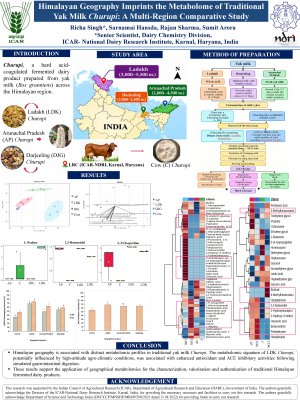
Churupi, a hard acid-coagulated fermented yak milk (Bos grunniens) product, is produced under widely contrasting agro-climatic conditions across the Himalayas, from the cold, arid, hypoxic Ladakh (3,000–5,500 m a.s.l.) to the temperate, humid highlands of Arunachal Pradesh and Darjeeling (2,000–4,500 m a.s.l.). While compositional studies on Churupi exist, untargeted metabolomics linking geographical origin to stress-adaptive metabolic signatures and biofunctional potential remains unexplored. Three independent Yak milk Churupi from each geographical region,Ladakh (LDK), Arunachal Pradesh (AP), and Darjeeling (DJ), with cow milk Churupi as control, were subjected to untargeted GC-MS metabolite profiling. A total of 80 metabolites were identified, of which 28 were statistically significant. Multivariate analysis including PCA and hierarchical clustering were performed using MetaboAnalyst 6.0. Biofunctional assessment included in vitro gastrointestinal digestion, DPPH radical scavenging, and ACE inhibitory activity. PCA clearly separated LDK from eastern Himalayan samples, with all yak Churupi distinct from cow milk control. LDK Churupi had greater abundance of gluconic acid, D-galactopyranose, proline, 5-oxoproline and N-acetyl-D-glucosamine metabolites consistent with metabolic adaptation to cold, high-altitude environments.AP and DJ Churupi were enriched in 2,3-butanediol, 2-hydroxy-3-methylbutyric acid, 2-hydroxyisocaproic acid and hexanoic acid consistent with enhanced pyruvate fermentation, branched-chain amino acid metabolism and flavour-associated microbial activity.After simulated GI digestion, LDK Churupi had the highest DPPH scavenging (73.27%) and ACE inhibition (68.12%) which were substantially higher than AP, DJ and control (p < 0.05). The findings suggest that Himalayan geography is associated with distinct metabolomic profiles in traditional yak milk Churupi. The metabolomic signature of LDK Churupi, potentially influenced by high-altitude agro-climatic conditions, was associated with enhanced antioxidant and ACE inhibitory activities following simulated gastrointestinal digestion. These results support the application of geographical metabolomics for the characterization, valorisation and authentication of traditional Himalayan fermented dairy products.
Keywords
Churupi
yak milk
geographical metabolomics
GC-MS
amino acid profiling
fatty acid profiling
ACE inhibitory peptides
antioxidant activity
Himalayan fermented dairy
traditional food metabolomics
Poster
Electronic conference poster EDITED 23rd sept, 2026.pdf
Nutrient-Dense Wheatgrass Ladoo Formulations for Athlete Nutrition: A Biochemical Profiling of Sunflower and Pumpkin Seed Variants
Metabolite Profiling of Selected Mauritian Endemic Fruits