Event submissions
Published
This submission belongs to the session S1. Lipid and Nutrition Metabolomics of the event The 5th International Electronic Conference on Metabolomics
Published date
09 Oct, 2026
Academic Editor
'%3e%3cpath%20d='M12.6657%2010.9104C12.4185%2010.325%2012.0599%209.79327%2011.6097%209.34482C11.1609%208.89508%2010.6293%208.5365%2010.0442%208.28888C10.0389%208.28626%2010.0337%208.28495%2010.0285%208.28233C10.8446%207.69279%2011.3752%206.73249%2011.3752%205.64904C11.3752%203.8542%209.92103%202.39999%208.1262%202.39999C6.33136%202.39999%204.87715%203.8542%204.87715%205.64904C4.87715%206.73249%205.40774%207.69279%206.22393%208.28364C6.21869%208.28626%206.21345%208.28757%206.20821%208.29019C5.62129%208.5378%205.09463%208.89284%204.64265%209.34613C4.1929%209.79493%203.83432%2010.3266%203.58671%2010.9117C3.34345%2011.4845%203.21226%2012.0987%203.20023%2012.7209C3.19988%2012.7349%203.20233%2012.7488%203.20744%2012.7619C3.21255%2012.7749%203.22022%2012.7867%203.22998%2012.7968C3.23975%2012.8068%203.25142%2012.8147%203.26431%2012.8202C3.2772%2012.8256%203.29105%2012.8284%203.30504%2012.8284H4.09109C4.14874%2012.8284%204.19459%2012.7825%204.1959%2012.7262C4.2221%2011.7148%204.62823%2010.7676%205.34617%2010.0497C6.08899%209.30683%207.0755%208.89808%208.1262%208.89808C9.17689%208.89808%2010.1634%209.30683%2010.9062%2010.0497C11.6242%2010.7676%2012.0303%2011.7148%2012.0565%2012.7262C12.0578%2012.7838%2012.1037%2012.8284%2012.1613%2012.8284H12.9474C12.9613%2012.8284%2012.9752%2012.8256%2012.9881%2012.8202C13.001%2012.8147%2013.0126%2012.8068%2013.0224%2012.7968C13.0322%2012.7867%2013.0398%2012.7749%2013.0449%2012.7619C13.0501%2012.7488%2013.0525%2012.7349%2013.0522%2012.7209C13.0391%2012.0947%2012.9094%2011.4855%2012.6657%2010.9104ZM8.1262%207.9024C7.52486%207.9024%206.9589%207.6679%206.53312%207.24211C6.10733%206.81633%205.87283%206.25037%205.87283%205.64904C5.87283%205.0477%206.10733%204.48174%206.53312%204.05596C6.9589%203.63018%207.52486%203.39567%208.1262%203.39567C8.72753%203.39567%209.29349%203.63018%209.71927%204.05596C10.1451%204.48174%2010.3796%205.0477%2010.3796%205.64904C10.3796%206.25037%2010.1451%206.81633%209.71927%207.24211C9.29349%207.6679%208.72753%207.9024%208.1262%207.9024Z'%20fill='%235D1EE1'/%3e%3c/g%3e%3c/svg%3e) Giuseppe Paglia
Giuseppe PagliaCitation
Beata Stasiewicz, Bartosz Fotshki, Serum short-chain fatty acids: associations with diet and insomnia occurrence in peri- and postmenopausal women. Preliminary cross-sectional study, in Proceedings of The 5th International Electronic Conference on Metabolomics, 14 October–16 October 2026, MDPI: Basel, Switzerland
Share
Email
Facebook
Twitter
LinkedIn
Serum short-chain fatty acids: associations with diet and insomnia occurrence in peri- and postmenopausal women. Preliminary cross-sectional study

Beata Stasiewicz 1
'%3e%3cpath%20d='M12.6647%2010.9104C12.4176%2010.325%2012.0589%209.7933%2011.6088%209.34485C11.16%208.89511%2010.6283%208.53653%2010.0432%208.28891C10.038%208.28629%2010.0327%208.28498%2010.0275%208.28236C10.8437%207.69282%2011.3743%206.73252%2011.3743%205.64907C11.3743%203.85423%209.92005%202.40002%208.12522%202.40002C6.33038%202.40002%204.87618%203.85423%204.87618%205.64907C4.87618%206.73252%205.40677%207.69282%206.22296%208.28367C6.21772%208.28629%206.21248%208.2876%206.20724%208.29022C5.62031%208.53783%205.09365%208.89287%204.64167%209.34616C4.19192%209.79496%203.83334%2010.3266%203.58573%2010.9117C3.34247%2011.4846%203.21128%2012.0987%203.19925%2012.721C3.1989%2012.735%203.20135%2012.7489%203.20646%2012.7619C3.21157%2012.7749%203.21924%2012.7868%203.22901%2012.7968C3.23877%2012.8068%203.25045%2012.8148%203.26334%2012.8202C3.27623%2012.8256%203.29007%2012.8284%203.30406%2012.8284H4.09012C4.14776%2012.8284%204.19362%2012.7825%204.19493%2012.7262C4.22113%2011.7148%204.62726%2010.7676%205.34519%2010.0497C6.08802%209.30686%207.07452%208.89811%208.12522%208.89811C9.17592%208.89811%2010.1624%209.30686%2010.9052%2010.0497C11.6232%2010.7676%2012.0293%2011.7148%2012.0555%2012.7262C12.0568%2012.7839%2012.1027%2012.8284%2012.1603%2012.8284H12.9464C12.9604%2012.8284%2012.9742%2012.8256%2012.9871%2012.8202C13%2012.8148%2013.0117%2012.8068%2013.0214%2012.7968C13.0312%2012.7868%2013.0389%2012.7749%2013.044%2012.7619C13.0491%2012.7489%2013.0515%2012.735%2013.0512%2012.721C13.0381%2012.0947%2012.9084%2011.4856%2012.6647%2010.9104ZM8.12522%207.90243C7.52388%207.90243%206.95792%207.66793%206.53214%207.24215C6.10636%206.81636%205.87185%206.2504%205.87185%205.64907C5.87185%205.04773%206.10636%204.48177%206.53214%204.05599C6.95792%203.63021%207.52388%203.3957%208.12522%203.3957C8.72655%203.3957%209.29252%203.63021%209.7183%204.05599C10.1441%204.48177%2010.3786%205.04773%2010.3786%205.64907C10.3786%206.2504%2010.1441%206.81636%209.7183%207.24215C9.29252%207.66793%208.72655%207.90243%208.12522%207.90243Z'%20fill='%235D1EE1'/%3e%3c/g%3e%3c/svg%3e)
Bartosz Fotshki 2
1. Department of Human Nutrition, Faculty of Food Sciences, University of Warmia and Mazury in Olsztyn, Olsztyn, Poland
2. InLife Institute of Animal Reproduction and Food Research, Polish Academy of Sciences, Olsztyn, Poland
Abstract
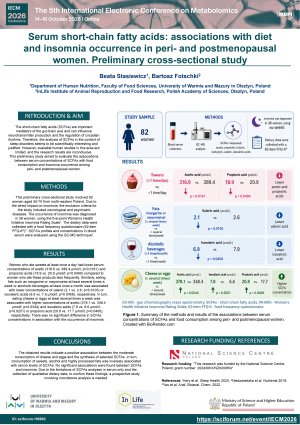
Introduction: The short-chain fatty acids (SCFAs) are important mediators of the gut-brain axis and can influence the regulation of circadian rhythms. The study aimed to evaluate the associations between serum concentrations of SCFAs with food consumption and insomnia occurrence among peri- and postmenopausal women.
Methods: This preliminary cross-sectional study involved 82 women aged 50-70 from north-eastern Poland. The occurrence of insomnia was diagnosed in 38 women, using the Women's Health Initiative Insomnia Rating Scale. Dietary data were collected with a food frequency questionnaire (62-item FFQ-6®). The serum concentrations of six SCFAs (acetic, propionic, butyric, isovaleric, valeric, isobutyric) were analysed using the GC-MS technique.
Results: Women who ate sweets at least once a day had lower serum concentrations of acetic (316.9 vs. 389.4 µmol/l;p=0.0161) and propionic acids (18.9 vs. 20.9 µmol/l;p=0.0490) compared to women who ate these products less frequently. Similarly, eating fats such as margarine or mayonnaise at least several times a week or alcoholic beverages at least once a month was associated with lower concentrations of valeric (2.1 vs. 2.6;p=0.0105) or isovaleric acids (6.9 vs. 7.9 µmol/l;p=0.0458), respectively. In turn, eating cheese or eggs at least several times/week was associated with higher concentrations of acetic (378.1 vs. 348.4 µmol/l;p=0.0344) and isovaleric acids (7.8 vs. 6.6 µmol/l;p=0.0251) or propionic acid (20.8 vs. 17.7 µmol/l;p=0.0400), respectively. There was no significant difference in SCFAs concentrations in association with the occurrence of insomnia.
Conclusions: The obtained results indicate a positive association between the moderate consumption of cheese and eggs and the synthesis of selected SCFAs. In turn, consumption of sweets, alcohol and highly processed fats was inversely associated with serum levels of SCFAs. No significant associations were found between SCFAs and insomnia. Due to the limitations of SCFAs analyses in serum only and the collection of qualitative dietary data, to confirm these findings, a prospective study involving microbiome analysis is needed.
Keywords
SCFAs
fatty acids
serum
diet
foods
insomnia
women
menopause
Poster
Stasiewicz and Fotschki_Metabolomics conference online_2026_poster.pdf
Metabolite Profiling of Selected Mauritian Endemic Fruits
Metabolic stratification of refractory Lennox Gastaut Syndrome and Controlled focal epilepsy using NMR spectroscopy