Event submissions
Published
This submission belongs to the session S4. Clinical Metabolomics and Drug Metabolism of the event The 5th International Electronic Conference on Metabolomics
Published date
09 Oct, 2026
Academic Editor
'%3e%3cpath%20d='M12.6657%2010.9104C12.4185%2010.325%2012.0599%209.79327%2011.6097%209.34482C11.1609%208.89508%2010.6293%208.5365%2010.0442%208.28888C10.0389%208.28626%2010.0337%208.28495%2010.0285%208.28233C10.8446%207.69279%2011.3752%206.73249%2011.3752%205.64904C11.3752%203.8542%209.92103%202.39999%208.1262%202.39999C6.33136%202.39999%204.87715%203.8542%204.87715%205.64904C4.87715%206.73249%205.40774%207.69279%206.22393%208.28364C6.21869%208.28626%206.21345%208.28757%206.20821%208.29019C5.62129%208.5378%205.09463%208.89284%204.64265%209.34613C4.1929%209.79493%203.83432%2010.3266%203.58671%2010.9117C3.34345%2011.4845%203.21226%2012.0987%203.20023%2012.7209C3.19988%2012.7349%203.20233%2012.7488%203.20744%2012.7619C3.21255%2012.7749%203.22022%2012.7867%203.22998%2012.7968C3.23975%2012.8068%203.25142%2012.8147%203.26431%2012.8202C3.2772%2012.8256%203.29105%2012.8284%203.30504%2012.8284H4.09109C4.14874%2012.8284%204.19459%2012.7825%204.1959%2012.7262C4.2221%2011.7148%204.62823%2010.7676%205.34617%2010.0497C6.08899%209.30683%207.0755%208.89808%208.1262%208.89808C9.17689%208.89808%2010.1634%209.30683%2010.9062%2010.0497C11.6242%2010.7676%2012.0303%2011.7148%2012.0565%2012.7262C12.0578%2012.7838%2012.1037%2012.8284%2012.1613%2012.8284H12.9474C12.9613%2012.8284%2012.9752%2012.8256%2012.9881%2012.8202C13.001%2012.8147%2013.0126%2012.8068%2013.0224%2012.7968C13.0322%2012.7867%2013.0398%2012.7749%2013.0449%2012.7619C13.0501%2012.7488%2013.0525%2012.7349%2013.0522%2012.7209C13.0391%2012.0947%2012.9094%2011.4855%2012.6657%2010.9104ZM8.1262%207.9024C7.52486%207.9024%206.9589%207.6679%206.53312%207.24211C6.10733%206.81633%205.87283%206.25037%205.87283%205.64904C5.87283%205.0477%206.10733%204.48174%206.53312%204.05596C6.9589%203.63018%207.52486%203.39567%208.1262%203.39567C8.72753%203.39567%209.29349%203.63018%209.71927%204.05596C10.1451%204.48174%2010.3796%205.0477%2010.3796%205.64904C10.3796%206.25037%2010.1451%206.81633%209.71927%207.24211C9.29349%207.6679%208.72753%207.9024%208.1262%207.9024Z'%20fill='%235D1EE1'/%3e%3c/g%3e%3c/svg%3e) Yunping Qiu
Yunping QiuCitation
Aditi Pandey, Firoz M Nizami, Manjari Dubey, Bikash Baishya, Jayantee Kalita, Metabolic stratification of refractory Lennox Gastaut Syndrome and Controlled focal epilepsy using NMR spectroscopy, in Proceedings of The 5th International Electronic Conference on Metabolomics, 14 October–16 October 2026, MDPI: Basel, Switzerland
Share
Email
Facebook
Twitter
LinkedIn
Metabolic stratification of refractory Lennox Gastaut Syndrome and Controlled focal epilepsy using NMR spectroscopy
'%3e%3cpath%20d='M12.6647%2010.9104C12.4176%2010.325%2012.0589%209.7933%2011.6088%209.34485C11.16%208.89511%2010.6283%208.53653%2010.0432%208.28891C10.038%208.28629%2010.0327%208.28498%2010.0275%208.28236C10.8437%207.69282%2011.3743%206.73252%2011.3743%205.64907C11.3743%203.85423%209.92005%202.40002%208.12522%202.40002C6.33038%202.40002%204.87618%203.85423%204.87618%205.64907C4.87618%206.73252%205.40677%207.69282%206.22296%208.28367C6.21772%208.28629%206.21248%208.2876%206.20724%208.29022C5.62031%208.53783%205.09365%208.89287%204.64167%209.34616C4.19192%209.79496%203.83334%2010.3266%203.58573%2010.9117C3.34247%2011.4846%203.21128%2012.0987%203.19925%2012.721C3.1989%2012.735%203.20135%2012.7489%203.20646%2012.7619C3.21157%2012.7749%203.21924%2012.7868%203.22901%2012.7968C3.23877%2012.8068%203.25045%2012.8148%203.26334%2012.8202C3.27623%2012.8256%203.29007%2012.8284%203.30406%2012.8284H4.09012C4.14776%2012.8284%204.19362%2012.7825%204.19493%2012.7262C4.22113%2011.7148%204.62726%2010.7676%205.34519%2010.0497C6.08802%209.30686%207.07452%208.89811%208.12522%208.89811C9.17592%208.89811%2010.1624%209.30686%2010.9052%2010.0497C11.6232%2010.7676%2012.0293%2011.7148%2012.0555%2012.7262C12.0568%2012.7839%2012.1027%2012.8284%2012.1603%2012.8284H12.9464C12.9604%2012.8284%2012.9742%2012.8256%2012.9871%2012.8202C13%2012.8148%2013.0117%2012.8068%2013.0214%2012.7968C13.0312%2012.7868%2013.0389%2012.7749%2013.044%2012.7619C13.0491%2012.7489%2013.0515%2012.735%2013.0512%2012.721C13.0381%2012.0947%2012.9084%2011.4856%2012.6647%2010.9104ZM8.12522%207.90243C7.52388%207.90243%206.95792%207.66793%206.53214%207.24215C6.10636%206.81636%205.87185%206.2504%205.87185%205.64907C5.87185%205.04773%206.10636%204.48177%206.53214%204.05599C6.95792%203.63021%207.52388%203.3957%208.12522%203.3957C8.72655%203.3957%209.29252%203.63021%209.7183%204.05599C10.1441%204.48177%2010.3786%205.04773%2010.3786%205.64907C10.3786%206.2504%2010.1441%206.81636%209.7183%207.24215C9.29252%207.66793%208.72655%207.90243%208.12522%207.90243Z'%20fill='%235D1EE1'/%3e%3c/g%3e%3c/svg%3e)
Aditi Pandey 1
Firoz M Nizami 2
Manjari Dubey 2
Bikash Baishya 1
Jayantee Kalita 2
1. Department of Advanced Spectrosopy and Imaging, Centre of BioMedical Research, Lucknow, India
2. Department of Neurology, Sanjay Gandhi Postgraduate Institute of Medical Sciences, Lucknow, India
Abstract
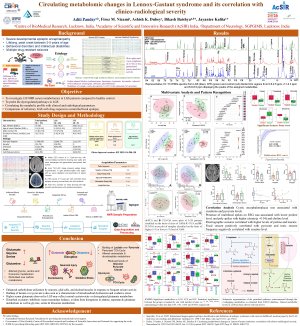
Lennox-Gastaut syndrome (LGS) is characterized by multiple seizure type, often refractory and cognitive impairment. Studies have shown biochemical alterations in epilepsy disorder, however, the metabolic differences between refractory and controlled epilepsy remain unexplored. Our study aims to detect the metabolic disparities across LGS, controlled focal epilepsy (CFE) and healthy controls.
Serum samples were analyzed using 1H nuclear magnetic resonance spectroscopy. Multivariate statistics including PCA (Principal Component Analysis) and PLS-DA (Partial Least Square Discriminant Analysis), followed by variable importance in projection (VIP) scoring and univariate analysis were employed to reveal differentially expressed metabolites. Cohen's d effect size analysis was performed to quantify the magnitude of metabolic differences between groups. Impact of anti-seizure medications (ASMs) class and load on metabolome was investigated in the LGS subgroup.
PCA revealed separate clustering and PLS-DA model showed robust performance in classifying the groups. LGS was characterized by elevated glutamate and acetate along with reduced pyruvate, citrate, creatinine, glutamine, glycine, serine, and acetone. Whereas, CFE demonstrated increased GABA, glycine, and acetone, reduced citrate and glutamine while glutamate, pyruvate and creatinine levels were comparable to healthy controls. No significant differences were observed in LGS patients categorized on the basis of ASM.
Refractory LGS is characterized by pronounced disruption of amino acid and energy metabolism, redox homeostasis, neurotransmitter regulation and ketone metabolism associated pathways, in comparison CFE retains features of metabolic compensation. These deviations may provide insight into mechanisms underlying disease severity and therapy resistance through clinically feasible serum metabolomics.
Keywords
Nuclear Magnetic Resonance
Epileptic encephalopathy
Lennox Gastaut syndrome
Controlled focal epilepsy.
Poster
Poster.pdf
Serum short-chain fatty acids: associations with diet and insomnia occurrence in peri- and postmenopausal women. Preliminary cross-sectional study
Immune-cell metabolomics in frailty reveals mitochondrial dysregulation potentially linked to functional vitamin B12 deficiency