Event submissions
Published
This submission belongs to the session S1. Lipid and Nutrition Metabolomics of the event The 5th International Electronic Conference on Metabolomics
Published date
09 Oct, 2026
Academic Editor
'%3e%3cpath%20d='M12.6657%2010.9104C12.4185%2010.325%2012.0599%209.79327%2011.6097%209.34482C11.1609%208.89508%2010.6293%208.5365%2010.0442%208.28888C10.0389%208.28626%2010.0337%208.28495%2010.0285%208.28233C10.8446%207.69279%2011.3752%206.73249%2011.3752%205.64904C11.3752%203.8542%209.92103%202.39999%208.1262%202.39999C6.33136%202.39999%204.87715%203.8542%204.87715%205.64904C4.87715%206.73249%205.40774%207.69279%206.22393%208.28364C6.21869%208.28626%206.21345%208.28757%206.20821%208.29019C5.62129%208.5378%205.09463%208.89284%204.64265%209.34613C4.1929%209.79493%203.83432%2010.3266%203.58671%2010.9117C3.34345%2011.4845%203.21226%2012.0987%203.20023%2012.7209C3.19988%2012.7349%203.20233%2012.7488%203.20744%2012.7619C3.21255%2012.7749%203.22022%2012.7867%203.22998%2012.7968C3.23975%2012.8068%203.25142%2012.8147%203.26431%2012.8202C3.2772%2012.8256%203.29105%2012.8284%203.30504%2012.8284H4.09109C4.14874%2012.8284%204.19459%2012.7825%204.1959%2012.7262C4.2221%2011.7148%204.62823%2010.7676%205.34617%2010.0497C6.08899%209.30683%207.0755%208.89808%208.1262%208.89808C9.17689%208.89808%2010.1634%209.30683%2010.9062%2010.0497C11.6242%2010.7676%2012.0303%2011.7148%2012.0565%2012.7262C12.0578%2012.7838%2012.1037%2012.8284%2012.1613%2012.8284H12.9474C12.9613%2012.8284%2012.9752%2012.8256%2012.9881%2012.8202C13.001%2012.8147%2013.0126%2012.8068%2013.0224%2012.7968C13.0322%2012.7867%2013.0398%2012.7749%2013.0449%2012.7619C13.0501%2012.7488%2013.0525%2012.7349%2013.0522%2012.7209C13.0391%2012.0947%2012.9094%2011.4855%2012.6657%2010.9104ZM8.1262%207.9024C7.52486%207.9024%206.9589%207.6679%206.53312%207.24211C6.10733%206.81633%205.87283%206.25037%205.87283%205.64904C5.87283%205.0477%206.10733%204.48174%206.53312%204.05596C6.9589%203.63018%207.52486%203.39567%208.1262%203.39567C8.72753%203.39567%209.29349%203.63018%209.71927%204.05596C10.1451%204.48174%2010.3796%205.0477%2010.3796%205.64904C10.3796%206.25037%2010.1451%206.81633%209.71927%207.24211C9.29349%207.6679%208.72753%207.9024%208.1262%207.9024Z'%20fill='%235D1EE1'/%3e%3c/g%3e%3c/svg%3e) Beate Fuchs
Beate FuchsCitation
Giovanni Aulisa, Isaac Amoah, Mauro Lombardo, Diet–Microbiota–Metabolome Interactions: The Role of Trimethylamine-N-Oxide (TMAO) as a Nutritional Metabolomics Biomarker in Humans, in Proceedings of The 5th International Electronic Conference on Metabolomics, 14 October–16 October 2026, MDPI: Basel, Switzerland
Share
Email
Facebook
Twitter
LinkedIn
Diet–Microbiota–Metabolome Interactions: The Role of Trimethylamine-N-Oxide (TMAO) as a Nutritional Metabolomics Biomarker in Humans
'%3e%3cpath%20d='M12.6647%2010.9104C12.4176%2010.325%2012.0589%209.7933%2011.6088%209.34485C11.16%208.89511%2010.6283%208.53653%2010.0432%208.28891C10.038%208.28629%2010.0327%208.28498%2010.0275%208.28236C10.8437%207.69282%2011.3743%206.73252%2011.3743%205.64907C11.3743%203.85423%209.92005%202.40002%208.12522%202.40002C6.33038%202.40002%204.87618%203.85423%204.87618%205.64907C4.87618%206.73252%205.40677%207.69282%206.22296%208.28367C6.21772%208.28629%206.21248%208.2876%206.20724%208.29022C5.62031%208.53783%205.09365%208.89287%204.64167%209.34616C4.19192%209.79496%203.83334%2010.3266%203.58573%2010.9117C3.34247%2011.4846%203.21128%2012.0987%203.19925%2012.721C3.1989%2012.735%203.20135%2012.7489%203.20646%2012.7619C3.21157%2012.7749%203.21924%2012.7868%203.22901%2012.7968C3.23877%2012.8068%203.25045%2012.8148%203.26334%2012.8202C3.27623%2012.8256%203.29007%2012.8284%203.30406%2012.8284H4.09012C4.14776%2012.8284%204.19362%2012.7825%204.19493%2012.7262C4.22113%2011.7148%204.62726%2010.7676%205.34519%2010.0497C6.08802%209.30686%207.07452%208.89811%208.12522%208.89811C9.17592%208.89811%2010.1624%209.30686%2010.9052%2010.0497C11.6232%2010.7676%2012.0293%2011.7148%2012.0555%2012.7262C12.0568%2012.7839%2012.1027%2012.8284%2012.1603%2012.8284H12.9464C12.9604%2012.8284%2012.9742%2012.8256%2012.9871%2012.8202C13%2012.8148%2013.0117%2012.8068%2013.0214%2012.7968C13.0312%2012.7868%2013.0389%2012.7749%2013.044%2012.7619C13.0491%2012.7489%2013.0515%2012.735%2013.0512%2012.721C13.0381%2012.0947%2012.9084%2011.4856%2012.6647%2010.9104ZM8.12522%207.90243C7.52388%207.90243%206.95792%207.66793%206.53214%207.24215C6.10636%206.81636%205.87185%206.2504%205.87185%205.64907C5.87185%205.04773%206.10636%204.48177%206.53214%204.05599C6.95792%203.63021%207.52388%203.3957%208.12522%203.3957C8.72655%203.3957%209.29252%203.63021%209.7183%204.05599C10.1441%204.48177%2010.3786%205.04773%2010.3786%205.64907C10.3786%206.2504%2010.1441%206.81636%209.7183%207.24215C9.29252%207.66793%208.72655%207.90243%208.12522%207.90243Z'%20fill='%235D1EE1'/%3e%3c/g%3e%3c/svg%3e)
Giovanni Aulisa 1

Isaac Amoah 2

Mauro Lombardo 3
1. Independent Researcher, largo Bacone 8, Rome, 00137, Italy
2. Department of Biochemistry and Biotechnology, Kwame Nkrumah University of Science and Technology, Kumasi, 0023351, Ghana
3. Department for the Promotion of Human Science and Quality of Life, San Raffaele Open University, Rome, Via di Val Cannuta, 247, 00166, Italy
Abstract
Introduction:
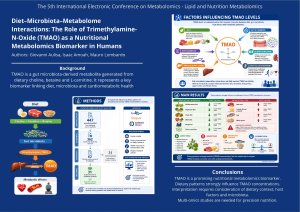
Trimethylamine-N-oxide (TMAO) is a gut microbiota-derived metabolite increasingly studied as a biomarker linking diet, host metabolism, and cardiometabolic health. It is produced from dietary precursors such as choline, betaine, and L-carnitine, making it a key component of the diet–microbiota–metabolome axis.
Methods:
A literature review was conducted to assess how dietary patterns influence circulating and urinary TMAO levels in humans. Studies were retrieved from PubMed, Scopus, and Cochrane databases up to July 2026. Eligible studies were original human research examining TMAO in relation to diet interventions or patterns. Out of 447 records, 31 studies met the inclusion criteria and were analyzed qualitatively, considering study quality and methodological limitations.
Results:
Dietary patterns strongly influence TMAO concentrations, supporting its role as a metabolomic marker of diet-related metabolic responses. Plant-based diets (Mediterranean, vegetarian, vegan, DASH) are generally linked to lower TMAO levels, while diets rich in red meat and animal products tend to increase them. Weight loss and caloric restriction are also associated with reduced TMAO. Intervention studies show that TMAO levels can change rapidly with dietary modifications. However, the relationship is complex: increases in TMAO have been observed after consuming foods considered cardioprotective, such as fish and whole grains. This suggests that elevated TMAO is not always indicative of unhealthy diets. Inter-individual variability, influenced by host and microbial factors, further complicates interpretation, and gut microbiota composition alone does not fully predict TMAO production.
Conclusions:
TMAO is a promising biomarker in nutritional metabolomics for studying interactions between diet, gut microbiota, and metabolism. While responsive to dietary changes, its interpretation in cardiometabolic risk requires caution, as its role depends on dietary context, host characteristics, and microbial activity. More longitudinal and controlled studies integrating metabolomic, microbiome, and clinical data are needed to clarify its biological significance and potential in precision nutrition.
Keywords
TMAO
Nutritional metabolomics
Gut microbiota
Diet-metabolome interaction
Plant-based diet
Biomarkers
Metabolic profiling
Cardiometabolic risk
Precision nutrition
Microbiome-derived metabolites
Poster
Metabolomics.pdf
The Kynurenine/Tryptophan Ratio as a Clinical Metabolomic Biomarker in Adults Living with HIV: A Systematic Review
Integrated HPLC–MS and NMR Data Fusion Improves Diagnostic Precision in Pediatric Chronic Kidney Disease