Event submissions
Published
This submission belongs to the session S4. Clinical Metabolomics and Drug Metabolism of the event The 5th International Electronic Conference on Metabolomics
Published date
09 Oct, 2026
Academic Editor
'%3e%3cpath%20d='M12.6657%2010.9104C12.4185%2010.325%2012.0599%209.79327%2011.6097%209.34482C11.1609%208.89508%2010.6293%208.5365%2010.0442%208.28888C10.0389%208.28626%2010.0337%208.28495%2010.0285%208.28233C10.8446%207.69279%2011.3752%206.73249%2011.3752%205.64904C11.3752%203.8542%209.92103%202.39999%208.1262%202.39999C6.33136%202.39999%204.87715%203.8542%204.87715%205.64904C4.87715%206.73249%205.40774%207.69279%206.22393%208.28364C6.21869%208.28626%206.21345%208.28757%206.20821%208.29019C5.62129%208.5378%205.09463%208.89284%204.64265%209.34613C4.1929%209.79493%203.83432%2010.3266%203.58671%2010.9117C3.34345%2011.4845%203.21226%2012.0987%203.20023%2012.7209C3.19988%2012.7349%203.20233%2012.7488%203.20744%2012.7619C3.21255%2012.7749%203.22022%2012.7867%203.22998%2012.7968C3.23975%2012.8068%203.25142%2012.8147%203.26431%2012.8202C3.2772%2012.8256%203.29105%2012.8284%203.30504%2012.8284H4.09109C4.14874%2012.8284%204.19459%2012.7825%204.1959%2012.7262C4.2221%2011.7148%204.62823%2010.7676%205.34617%2010.0497C6.08899%209.30683%207.0755%208.89808%208.1262%208.89808C9.17689%208.89808%2010.1634%209.30683%2010.9062%2010.0497C11.6242%2010.7676%2012.0303%2011.7148%2012.0565%2012.7262C12.0578%2012.7838%2012.1037%2012.8284%2012.1613%2012.8284H12.9474C12.9613%2012.8284%2012.9752%2012.8256%2012.9881%2012.8202C13.001%2012.8147%2013.0126%2012.8068%2013.0224%2012.7968C13.0322%2012.7867%2013.0398%2012.7749%2013.0449%2012.7619C13.0501%2012.7488%2013.0525%2012.7349%2013.0522%2012.7209C13.0391%2012.0947%2012.9094%2011.4855%2012.6657%2010.9104ZM8.1262%207.9024C7.52486%207.9024%206.9589%207.6679%206.53312%207.24211C6.10733%206.81633%205.87283%206.25037%205.87283%205.64904C5.87283%205.0477%206.10733%204.48174%206.53312%204.05596C6.9589%203.63018%207.52486%203.39567%208.1262%203.39567C8.72753%203.39567%209.29349%203.63018%209.71927%204.05596C10.1451%204.48174%2010.3796%205.0477%2010.3796%205.64904C10.3796%206.25037%2010.1451%206.81633%209.71927%207.24211C9.29349%207.6679%208.72753%207.9024%208.1262%207.9024Z'%20fill='%235D1EE1'/%3e%3c/g%3e%3c/svg%3e) Yunping Qiu
Yunping QiuCitation
Xiaoyang Wu, Dynamic Metabolomic Profiling Reveals Bile Acid and Lipid Metabolic Remodeling Associated with Pathological Response to Neoadjuvant Chemotherapy in Pancreatic Ductal Adenocarcinoma, in Proceedings of The 5th International Electronic Conference on Metabolomics, 14 October–16 October 2026, MDPI: Basel, Switzerland
Share
Email
Facebook
Twitter
LinkedIn
Dynamic Metabolomic Profiling Reveals Bile Acid and Lipid Metabolic Remodeling Associated with Pathological Response to Neoadjuvant Chemotherapy in Pancreatic Ductal Adenocarcinoma
'%3e%3cpath%20d='M12.6647%2010.9104C12.4176%2010.325%2012.0589%209.7933%2011.6088%209.34485C11.16%208.89511%2010.6283%208.53653%2010.0432%208.28891C10.038%208.28629%2010.0327%208.28498%2010.0275%208.28236C10.8437%207.69282%2011.3743%206.73252%2011.3743%205.64907C11.3743%203.85423%209.92005%202.40002%208.12522%202.40002C6.33038%202.40002%204.87618%203.85423%204.87618%205.64907C4.87618%206.73252%205.40677%207.69282%206.22296%208.28367C6.21772%208.28629%206.21248%208.2876%206.20724%208.29022C5.62031%208.53783%205.09365%208.89287%204.64167%209.34616C4.19192%209.79496%203.83334%2010.3266%203.58573%2010.9117C3.34247%2011.4846%203.21128%2012.0987%203.19925%2012.721C3.1989%2012.735%203.20135%2012.7489%203.20646%2012.7619C3.21157%2012.7749%203.21924%2012.7868%203.22901%2012.7968C3.23877%2012.8068%203.25045%2012.8148%203.26334%2012.8202C3.27623%2012.8256%203.29007%2012.8284%203.30406%2012.8284H4.09012C4.14776%2012.8284%204.19362%2012.7825%204.19493%2012.7262C4.22113%2011.7148%204.62726%2010.7676%205.34519%2010.0497C6.08802%209.30686%207.07452%208.89811%208.12522%208.89811C9.17592%208.89811%2010.1624%209.30686%2010.9052%2010.0497C11.6232%2010.7676%2012.0293%2011.7148%2012.0555%2012.7262C12.0568%2012.7839%2012.1027%2012.8284%2012.1603%2012.8284H12.9464C12.9604%2012.8284%2012.9742%2012.8256%2012.9871%2012.8202C13%2012.8148%2013.0117%2012.8068%2013.0214%2012.7968C13.0312%2012.7868%2013.0389%2012.7749%2013.044%2012.7619C13.0491%2012.7489%2013.0515%2012.735%2013.0512%2012.721C13.0381%2012.0947%2012.9084%2011.4856%2012.6647%2010.9104ZM8.12522%207.90243C7.52388%207.90243%206.95792%207.66793%206.53214%207.24215C6.10636%206.81636%205.87185%206.2504%205.87185%205.64907C5.87185%205.04773%206.10636%204.48177%206.53214%204.05599C6.95792%203.63021%207.52388%203.3957%208.12522%203.3957C8.72655%203.3957%209.29252%203.63021%209.7183%204.05599C10.1441%204.48177%2010.3786%205.04773%2010.3786%205.64907C10.3786%206.2504%2010.1441%206.81636%209.7183%207.24215C9.29252%207.66793%208.72655%207.90243%208.12522%207.90243Z'%20fill='%235D1EE1'/%3e%3c/g%3e%3c/svg%3e)
Xiaoyang Wu 1
1. Department of Hepatobiliary Surgery, The First Clinical Medical College, Shaanxi University of Chinese Medicine, Xianyang, 712046, China
Abstract
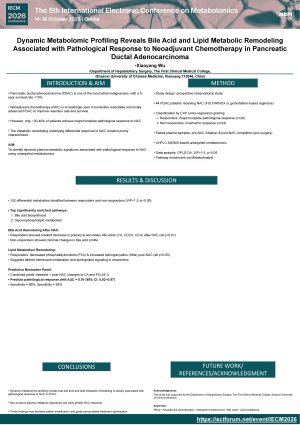
Background: Neoadjuvant chemotherapy (NAC) is increasingly used in borderline resectable and locally advanced pancreatic ductal adenocarcinoma (PDAC), yet metabolic remodeling underlying pathological response remains poorly characterized. This study aimed to identify dynamic plasma metabolic signatures associated with response to NAC using untargeted metabolomics. Methods: A total of 44 PDAC patients receiving NAC (FOLFIRINOX or gemcitabine-based regimens) were enrolled and classified as responders (major or complete pathological response, n=20) and non-responders (minimal or no response, n=24) according to the CAP tumor regression grading system. Paired plasma samples were collected before NAC initiation and after NAC completion (pre-surgery). UHPLC-MS/MS-based untargeted metabolomics was performed. Differential metabolites and pathway enrichment were analyzed using multivariate statistics and MetaboAnalyst. Results: A total of 152 differential metabolites were identified (VIP>1.5, p<0.05). Bile acid and glycerophospholipid metabolism were the most significantly enriched pathways. Responders exhibited a marked decrease in primary and secondary bile acids including cholic acid (CA), chenodeoxycholic acid (CDCA), and deoxycholic acid (DCA) after NAC (all p<0.01), while non-responders showed minimal changes. Additionally, responders demonstrated significant remodeling of lipid metabolites, with decreased phosphatidylcholines (PCs) and increased sphingomyelins (SMs) following NAC (all p<0.05). A panel combining baseline and post-NAC changes of CA and PC(34:1) predicted pathological response with an area under the curve (AUC) of 0.91 (95% CI: 0.82–0.97). Conclusions: Dynamic metabolomic profiling reveals that bile acid and lipid metabolic remodeling is closely associated with pathological response to NAC in PDAC. These findings may facilitate early identification of responders and guide treatment optimization.
Keywords
Pancreatic ductal adenocarcinoma
neoadjuvant chemotherapy
pathological response
dynamic metabolomics
bile acids
lipid metabolism
Poster
poster1_pdac_nac.pdf
Untargeted Metabolomics Reveals Bile Acid and Lipid Metabolic Signatures Associated with Gemcitabine Resistance in Cholangiocarcinoma Patients
Untargeted Metabolomics Reveals Bile Acid and Tryptophan Metabolic Signatures Associated with Lenvatinib Resistance in Hepatocellular Carcinoma Patients