Event submissions
Published
This submission belongs to the session S4. Clinical Metabolomics and Drug Metabolism of the event The 5th International Electronic Conference on Metabolomics
Published date
09 Oct, 2026
Academic Editor
'%3e%3cpath%20d='M12.6657%2010.9104C12.4185%2010.325%2012.0599%209.79327%2011.6097%209.34482C11.1609%208.89508%2010.6293%208.5365%2010.0442%208.28888C10.0389%208.28626%2010.0337%208.28495%2010.0285%208.28233C10.8446%207.69279%2011.3752%206.73249%2011.3752%205.64904C11.3752%203.8542%209.92103%202.39999%208.1262%202.39999C6.33136%202.39999%204.87715%203.8542%204.87715%205.64904C4.87715%206.73249%205.40774%207.69279%206.22393%208.28364C6.21869%208.28626%206.21345%208.28757%206.20821%208.29019C5.62129%208.5378%205.09463%208.89284%204.64265%209.34613C4.1929%209.79493%203.83432%2010.3266%203.58671%2010.9117C3.34345%2011.4845%203.21226%2012.0987%203.20023%2012.7209C3.19988%2012.7349%203.20233%2012.7488%203.20744%2012.7619C3.21255%2012.7749%203.22022%2012.7867%203.22998%2012.7968C3.23975%2012.8068%203.25142%2012.8147%203.26431%2012.8202C3.2772%2012.8256%203.29105%2012.8284%203.30504%2012.8284H4.09109C4.14874%2012.8284%204.19459%2012.7825%204.1959%2012.7262C4.2221%2011.7148%204.62823%2010.7676%205.34617%2010.0497C6.08899%209.30683%207.0755%208.89808%208.1262%208.89808C9.17689%208.89808%2010.1634%209.30683%2010.9062%2010.0497C11.6242%2010.7676%2012.0303%2011.7148%2012.0565%2012.7262C12.0578%2012.7838%2012.1037%2012.8284%2012.1613%2012.8284H12.9474C12.9613%2012.8284%2012.9752%2012.8256%2012.9881%2012.8202C13.001%2012.8147%2013.0126%2012.8068%2013.0224%2012.7968C13.0322%2012.7867%2013.0398%2012.7749%2013.0449%2012.7619C13.0501%2012.7488%2013.0525%2012.7349%2013.0522%2012.7209C13.0391%2012.0947%2012.9094%2011.4855%2012.6657%2010.9104ZM8.1262%207.9024C7.52486%207.9024%206.9589%207.6679%206.53312%207.24211C6.10733%206.81633%205.87283%206.25037%205.87283%205.64904C5.87283%205.0477%206.10733%204.48174%206.53312%204.05596C6.9589%203.63018%207.52486%203.39567%208.1262%203.39567C8.72753%203.39567%209.29349%203.63018%209.71927%204.05596C10.1451%204.48174%2010.3796%205.0477%2010.3796%205.64904C10.3796%206.25037%2010.1451%206.81633%209.71927%207.24211C9.29349%207.6679%208.72753%207.9024%208.1262%207.9024Z'%20fill='%235D1EE1'/%3e%3c/g%3e%3c/svg%3e) Yunping Qiu
Yunping QiuCitation
Xiaoyang Wu, Untargeted Metabolomics Reveals Bile Acid and Tryptophan Metabolic Signatures Associated with Lenvatinib Resistance in Hepatocellular Carcinoma Patients, in Proceedings of The 5th International Electronic Conference on Metabolomics, 14 October–16 October 2026, MDPI: Basel, Switzerland
Share
Email
Facebook
Twitter
LinkedIn
Untargeted Metabolomics Reveals Bile Acid and Tryptophan Metabolic Signatures Associated with Lenvatinib Resistance in Hepatocellular Carcinoma Patients
'%3e%3cpath%20d='M12.6647%2010.9104C12.4176%2010.325%2012.0589%209.7933%2011.6088%209.34485C11.16%208.89511%2010.6283%208.53653%2010.0432%208.28891C10.038%208.28629%2010.0327%208.28498%2010.0275%208.28236C10.8437%207.69282%2011.3743%206.73252%2011.3743%205.64907C11.3743%203.85423%209.92005%202.40002%208.12522%202.40002C6.33038%202.40002%204.87618%203.85423%204.87618%205.64907C4.87618%206.73252%205.40677%207.69282%206.22296%208.28367C6.21772%208.28629%206.21248%208.2876%206.20724%208.29022C5.62031%208.53783%205.09365%208.89287%204.64167%209.34616C4.19192%209.79496%203.83334%2010.3266%203.58573%2010.9117C3.34247%2011.4846%203.21128%2012.0987%203.19925%2012.721C3.1989%2012.735%203.20135%2012.7489%203.20646%2012.7619C3.21157%2012.7749%203.21924%2012.7868%203.22901%2012.7968C3.23877%2012.8068%203.25045%2012.8148%203.26334%2012.8202C3.27623%2012.8256%203.29007%2012.8284%203.30406%2012.8284H4.09012C4.14776%2012.8284%204.19362%2012.7825%204.19493%2012.7262C4.22113%2011.7148%204.62726%2010.7676%205.34519%2010.0497C6.08802%209.30686%207.07452%208.89811%208.12522%208.89811C9.17592%208.89811%2010.1624%209.30686%2010.9052%2010.0497C11.6232%2010.7676%2012.0293%2011.7148%2012.0555%2012.7262C12.0568%2012.7839%2012.1027%2012.8284%2012.1603%2012.8284H12.9464C12.9604%2012.8284%2012.9742%2012.8256%2012.9871%2012.8202C13%2012.8148%2013.0117%2012.8068%2013.0214%2012.7968C13.0312%2012.7868%2013.0389%2012.7749%2013.044%2012.7619C13.0491%2012.7489%2013.0515%2012.735%2013.0512%2012.721C13.0381%2012.0947%2012.9084%2011.4856%2012.6647%2010.9104ZM8.12522%207.90243C7.52388%207.90243%206.95792%207.66793%206.53214%207.24215C6.10636%206.81636%205.87185%206.2504%205.87185%205.64907C5.87185%205.04773%206.10636%204.48177%206.53214%204.05599C6.95792%203.63021%207.52388%203.3957%208.12522%203.3957C8.72655%203.3957%209.29252%203.63021%209.7183%204.05599C10.1441%204.48177%2010.3786%205.04773%2010.3786%205.64907C10.3786%206.2504%2010.1441%206.81636%209.7183%207.24215C9.29252%207.66793%208.72655%207.90243%208.12522%207.90243Z'%20fill='%235D1EE1'/%3e%3c/g%3e%3c/svg%3e)
Xiaoyang Wu 1
1. Department of Hepatobiliary Surgery, The First Clinical Medical College, Shaanxi University of Chinese Medicine, Xianyang, 712046, China
Abstract
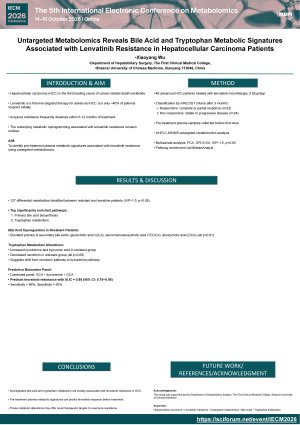
Background: Lenvatinib is a first-line targeted therapy for advanced hepatocellular carcinoma (HCC), but acquired resistance frequently develops, limiting long-term efficacy. The underlying metabolic reprogramming remains poorly understood. This study aimed to identify plasma metabolic signatures associated with lenvatinib resistance using untargeted metabolomics. Methods: A total of 46 advanced HCC patients treated with lenvatinib monotherapy were enrolled. After 3 months of treatment, patients were classified according to mRECIST criteria as responders (complete or partial response, n=22) or non-responders (stable or progressive disease, n=24). Pre-treatment plasma samples were collected and analyzed by ultra-high-performance liquid chromatography-tandem mass spectrometry (UHPLC-MS/MS). Multivariate statistical analyses including principal component analysis (PCA) and orthogonal partial least squares discriminant analysis (OPLS-DA) were performed to identify differential metabolites. Pathway enrichment analysis was conducted using MetaboAnalyst. Results: A total of 127 differential metabolites were identified (VIP>1.5, p<0.05, fold change >1.5 or <0.67). Bile acid and tryptophan metabolism were the most significantly enriched pathways. Compared with responders, non-responders showed significantly elevated levels of primary and secondary bile acids including glycocholic acid (GCA), taurochenodeoxycholic acid (TCDCA), and deoxycholic acid (DCA) (all p<0.01). Additionally, tryptophan-derived metabolites such as kynurenine and kynurenic acid were markedly increased, while serotonin was decreased in the resistant group (all p<0.05). A combined panel of three metabolites (GCA, kynurenine, and DCA) predicted lenvatinib resistance with an area under the curve (AUC) of 0.89 (95% CI: 0.79–0.96). Conclusions: Dysregulated bile acid and tryptophan metabolism are closely associated with lenvatinib resistance in HCC patients. These identified metabolic signatures may serve as predictive biomarkers and offer potential targets for overcoming resistance.
Keywords
Hepatocellular carcinoma
lenvatinib resistance
untargeted metabolomics
bile acids
tryptophan metabolism
Poster
poster3_hcc_lenvatinib.pdf
Dynamic Metabolomic Profiling Reveals Bile Acid and Lipid Metabolic Remodeling Associated with Pathological Response to Neoadjuvant Chemotherapy in Pancreatic Ductal Adenocarcinoma
AI-Assisted Pancreatic Metabolomics Reveals Metabolic Signatures Associated with β-Cell Dysfunction in Experimental Type 2 Diabetes