Event submissions
Published
This submission belongs to the session S3. Advanced Data Analysis and Integration in Metabolomics of the event The 5th International Electronic Conference on Metabolomics
Published date
09 Oct, 2026
Academic Editor
'%3e%3cpath%20d='M12.6657%2010.9104C12.4185%2010.325%2012.0599%209.79327%2011.6097%209.34482C11.1609%208.89508%2010.6293%208.5365%2010.0442%208.28888C10.0389%208.28626%2010.0337%208.28495%2010.0285%208.28233C10.8446%207.69279%2011.3752%206.73249%2011.3752%205.64904C11.3752%203.8542%209.92103%202.39999%208.1262%202.39999C6.33136%202.39999%204.87715%203.8542%204.87715%205.64904C4.87715%206.73249%205.40774%207.69279%206.22393%208.28364C6.21869%208.28626%206.21345%208.28757%206.20821%208.29019C5.62129%208.5378%205.09463%208.89284%204.64265%209.34613C4.1929%209.79493%203.83432%2010.3266%203.58671%2010.9117C3.34345%2011.4845%203.21226%2012.0987%203.20023%2012.7209C3.19988%2012.7349%203.20233%2012.7488%203.20744%2012.7619C3.21255%2012.7749%203.22022%2012.7867%203.22998%2012.7968C3.23975%2012.8068%203.25142%2012.8147%203.26431%2012.8202C3.2772%2012.8256%203.29105%2012.8284%203.30504%2012.8284H4.09109C4.14874%2012.8284%204.19459%2012.7825%204.1959%2012.7262C4.2221%2011.7148%204.62823%2010.7676%205.34617%2010.0497C6.08899%209.30683%207.0755%208.89808%208.1262%208.89808C9.17689%208.89808%2010.1634%209.30683%2010.9062%2010.0497C11.6242%2010.7676%2012.0303%2011.7148%2012.0565%2012.7262C12.0578%2012.7838%2012.1037%2012.8284%2012.1613%2012.8284H12.9474C12.9613%2012.8284%2012.9752%2012.8256%2012.9881%2012.8202C13.001%2012.8147%2013.0126%2012.8068%2013.0224%2012.7968C13.0322%2012.7867%2013.0398%2012.7749%2013.0449%2012.7619C13.0501%2012.7488%2013.0525%2012.7349%2013.0522%2012.7209C13.0391%2012.0947%2012.9094%2011.4855%2012.6657%2010.9104ZM8.1262%207.9024C7.52486%207.9024%206.9589%207.6679%206.53312%207.24211C6.10733%206.81633%205.87283%206.25037%205.87283%205.64904C5.87283%205.0477%206.10733%204.48174%206.53312%204.05596C6.9589%203.63018%207.52486%203.39567%208.1262%203.39567C8.72753%203.39567%209.29349%203.63018%209.71927%204.05596C10.1451%204.48174%2010.3796%205.0477%2010.3796%205.64904C10.3796%206.25037%2010.1451%206.81633%209.71927%207.24211C9.29349%207.6679%208.72753%207.9024%208.1262%207.9024Z'%20fill='%235D1EE1'/%3e%3c/g%3e%3c/svg%3e) Reza Salek
Reza SalekCitation
Linda Fantato, Valentina Giraldi, Leonardo Tenori, Alessia Vignoli, From 600 to 100 MHz: Developing Reliable Benchtop NMR Protocols for Urine Metabolomics, in Proceedings of The 5th International Electronic Conference on Metabolomics, 14 October–16 October 2026, MDPI: Basel, Switzerland
Share
Email
Facebook
Twitter
LinkedIn
From 600 to 100 MHz: Developing Reliable Benchtop NMR Protocols for Urine Metabolomics
'%3e%3cpath%20d='M12.6647%2010.9104C12.4176%2010.325%2012.0589%209.7933%2011.6088%209.34485C11.16%208.89511%2010.6283%208.53653%2010.0432%208.28891C10.038%208.28629%2010.0327%208.28498%2010.0275%208.28236C10.8437%207.69282%2011.3743%206.73252%2011.3743%205.64907C11.3743%203.85423%209.92005%202.40002%208.12522%202.40002C6.33038%202.40002%204.87618%203.85423%204.87618%205.64907C4.87618%206.73252%205.40677%207.69282%206.22296%208.28367C6.21772%208.28629%206.21248%208.2876%206.20724%208.29022C5.62031%208.53783%205.09365%208.89287%204.64167%209.34616C4.19192%209.79496%203.83334%2010.3266%203.58573%2010.9117C3.34247%2011.4846%203.21128%2012.0987%203.19925%2012.721C3.1989%2012.735%203.20135%2012.7489%203.20646%2012.7619C3.21157%2012.7749%203.21924%2012.7868%203.22901%2012.7968C3.23877%2012.8068%203.25045%2012.8148%203.26334%2012.8202C3.27623%2012.8256%203.29007%2012.8284%203.30406%2012.8284H4.09012C4.14776%2012.8284%204.19362%2012.7825%204.19493%2012.7262C4.22113%2011.7148%204.62726%2010.7676%205.34519%2010.0497C6.08802%209.30686%207.07452%208.89811%208.12522%208.89811C9.17592%208.89811%2010.1624%209.30686%2010.9052%2010.0497C11.6232%2010.7676%2012.0293%2011.7148%2012.0555%2012.7262C12.0568%2012.7839%2012.1027%2012.8284%2012.1603%2012.8284H12.9464C12.9604%2012.8284%2012.9742%2012.8256%2012.9871%2012.8202C13%2012.8148%2013.0117%2012.8068%2013.0214%2012.7968C13.0312%2012.7868%2013.0389%2012.7749%2013.044%2012.7619C13.0491%2012.7489%2013.0515%2012.735%2013.0512%2012.721C13.0381%2012.0947%2012.9084%2011.4856%2012.6647%2010.9104ZM8.12522%207.90243C7.52388%207.90243%206.95792%207.66793%206.53214%207.24215C6.10636%206.81636%205.87185%206.2504%205.87185%205.64907C5.87185%205.04773%206.10636%204.48177%206.53214%204.05599C6.95792%203.63021%207.52388%203.3957%208.12522%203.3957C8.72655%203.3957%209.29252%203.63021%209.7183%204.05599C10.1441%204.48177%2010.3786%205.04773%2010.3786%205.64907C10.3786%206.2504%2010.1441%206.81636%209.7183%207.24215C9.29252%207.66793%208.72655%207.90243%208.12522%207.90243Z'%20fill='%235D1EE1'/%3e%3c/g%3e%3c/svg%3e)
Linda Fantato 1
Valentina Giraldi 1

Leonardo Tenori 1,2

Alessia Vignoli 1,2
1. Department of Chemistry "Ugo Schiff", University of Florence, Florence, Italy
2. Magnetic Resonance Center (CERM/CIRMMP), University of Florence, Florence, Italy
Abstract
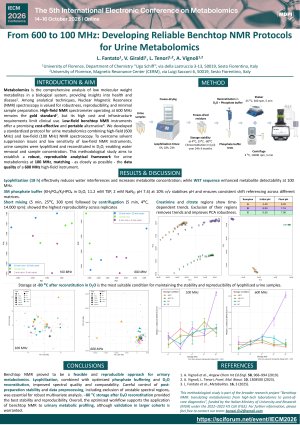
Metabolomics enables comprehensive analysis of low-molecular-weight metabolites, reflecting the interaction between genetic and environmental factors. Nuclear Magnetic Resonance (NMR) spectroscopy is valued for robustness, reproducibility and minimal sample preparation. However, high-field instruments (600 MHz) are costly and infrastructurally demanding. Low-field benchtop NMR instruments (100 MHz) represent a cost-effective alternative for point-of-care applications. This study describes the development and validation of optimized urine metabolomics protocols for benchtop NMR.
Urine samples collected from healthy volunteer were processed using lyophilization (1.2 mL aliquots, 18 h), followed by reconstitution in D₂O with phosphate buffer. WET solvent suppression was applied for ¹H NMR acquisition at 100 MHz; parallel spectra at 600 MHz served as reference. Lyophilization duration (6, 18, 24 h), buffer concentration (1.5-4.5 M), and three preparation procedure were evaluated. Metabolite kinetic stability was monitored over 2.5 days, and storage conditions (25°C, 4°C, −80°C, and −80°C after reconstitution in D₂O) were assessed at 24 h, 48 h, 1 week, and 1 month. Data were analyzed by Principal Component Analysis following spectral binning and normalization.
Eighteen hours of lyophilization achieved optimal water removal. WET suppression improved metabolite detectability at 100 MHz. Reconstitution in D₂O caused isotopic exchange of labile protons and minor chemical-shift variations; H₂O reconstitution yielded spectra closely matching non-lyophilized samples. The 3 M phosphate buffer provided the best buffering capacity. Kinetic analysis identified time-dependent spectral changes in creatinine and citrate, which were excluded from further analyses. Orbital shaking (5 min) followed by centrifugation (5 min, 4°C) showed the highest reproducibility. Results at 100 MHz and 600 MHz were substantially comparable.
This work establishes a reproducible analytical pipeline for urine metabolomics at 100 MHz. The optimized protocol ensures spectral quality, analytical reproducibility, and sample stability, supporting the translational potential of benchtop NMR for point-of-care metabolomics.
Keywords
Metabolomics
Nuclear Magnetic Resonance (NMR) spectroscopy
low-field
urine metabolomics
Poster
Fantato_IECM2026.pdf
TG-ME-Met: An Integrative Transformer-Graph Variational Autoencoder Framework for Multi-Modal Characterization of Tumor Microenvironments through Spatial Transcriptomics and Metabolomics
Beyond conventional matrices: optimization and validation of a targeted metabolomics kit for dried blood spots