Event submissions
Published
This submission belongs to the session S5. Advances in Metabolomics Technologies of the event The 5th International Electronic Conference on Metabolomics
Published date
09 Oct, 2026
Academic Editor
'%3e%3cpath%20d='M12.6657%2010.9104C12.4185%2010.325%2012.0599%209.79327%2011.6097%209.34482C11.1609%208.89508%2010.6293%208.5365%2010.0442%208.28888C10.0389%208.28626%2010.0337%208.28495%2010.0285%208.28233C10.8446%207.69279%2011.3752%206.73249%2011.3752%205.64904C11.3752%203.8542%209.92103%202.39999%208.1262%202.39999C6.33136%202.39999%204.87715%203.8542%204.87715%205.64904C4.87715%206.73249%205.40774%207.69279%206.22393%208.28364C6.21869%208.28626%206.21345%208.28757%206.20821%208.29019C5.62129%208.5378%205.09463%208.89284%204.64265%209.34613C4.1929%209.79493%203.83432%2010.3266%203.58671%2010.9117C3.34345%2011.4845%203.21226%2012.0987%203.20023%2012.7209C3.19988%2012.7349%203.20233%2012.7488%203.20744%2012.7619C3.21255%2012.7749%203.22022%2012.7867%203.22998%2012.7968C3.23975%2012.8068%203.25142%2012.8147%203.26431%2012.8202C3.2772%2012.8256%203.29105%2012.8284%203.30504%2012.8284H4.09109C4.14874%2012.8284%204.19459%2012.7825%204.1959%2012.7262C4.2221%2011.7148%204.62823%2010.7676%205.34617%2010.0497C6.08899%209.30683%207.0755%208.89808%208.1262%208.89808C9.17689%208.89808%2010.1634%209.30683%2010.9062%2010.0497C11.6242%2010.7676%2012.0303%2011.7148%2012.0565%2012.7262C12.0578%2012.7838%2012.1037%2012.8284%2012.1613%2012.8284H12.9474C12.9613%2012.8284%2012.9752%2012.8256%2012.9881%2012.8202C13.001%2012.8147%2013.0126%2012.8068%2013.0224%2012.7968C13.0322%2012.7867%2013.0398%2012.7749%2013.0449%2012.7619C13.0501%2012.7488%2013.0525%2012.7349%2013.0522%2012.7209C13.0391%2012.0947%2012.9094%2011.4855%2012.6657%2010.9104ZM8.1262%207.9024C7.52486%207.9024%206.9589%207.6679%206.53312%207.24211C6.10733%206.81633%205.87283%206.25037%205.87283%205.64904C5.87283%205.0477%206.10733%204.48174%206.53312%204.05596C6.9589%203.63018%207.52486%203.39567%208.1262%203.39567C8.72753%203.39567%209.29349%203.63018%209.71927%204.05596C10.1451%204.48174%2010.3796%205.0477%2010.3796%205.64904C10.3796%206.25037%2010.1451%206.81633%209.71927%207.24211C9.29349%207.6679%208.72753%207.9024%208.1262%207.9024Z'%20fill='%235D1EE1'/%3e%3c/g%3e%3c/svg%3e) Leonardo Tenori
Leonardo TenoriCitation
Eleonora Bossi, Cornelia Prehn, Lia Crotti, Gabriella Malfatto, Giuseppe Paglia, Michael Witting, Beyond conventional matrices: optimization and validation of a targeted metabolomics kit for dried blood spots, in Proceedings of The 5th International Electronic Conference on Metabolomics, 14 October–16 October 2026, MDPI: Basel, Switzerland
Share
Email
Facebook
Twitter
LinkedIn
Beyond conventional matrices: optimization and validation of a targeted metabolomics kit for dried blood spots
'%3e%3cpath%20d='M12.6647%2010.9104C12.4176%2010.325%2012.0589%209.7933%2011.6088%209.34485C11.16%208.89511%2010.6283%208.53653%2010.0432%208.28891C10.038%208.28629%2010.0327%208.28498%2010.0275%208.28236C10.8437%207.69282%2011.3743%206.73252%2011.3743%205.64907C11.3743%203.85423%209.92005%202.40002%208.12522%202.40002C6.33038%202.40002%204.87618%203.85423%204.87618%205.64907C4.87618%206.73252%205.40677%207.69282%206.22296%208.28367C6.21772%208.28629%206.21248%208.2876%206.20724%208.29022C5.62031%208.53783%205.09365%208.89287%204.64167%209.34616C4.19192%209.79496%203.83334%2010.3266%203.58573%2010.9117C3.34247%2011.4846%203.21128%2012.0987%203.19925%2012.721C3.1989%2012.735%203.20135%2012.7489%203.20646%2012.7619C3.21157%2012.7749%203.21924%2012.7868%203.22901%2012.7968C3.23877%2012.8068%203.25045%2012.8148%203.26334%2012.8202C3.27623%2012.8256%203.29007%2012.8284%203.30406%2012.8284H4.09012C4.14776%2012.8284%204.19362%2012.7825%204.19493%2012.7262C4.22113%2011.7148%204.62726%2010.7676%205.34519%2010.0497C6.08802%209.30686%207.07452%208.89811%208.12522%208.89811C9.17592%208.89811%2010.1624%209.30686%2010.9052%2010.0497C11.6232%2010.7676%2012.0293%2011.7148%2012.0555%2012.7262C12.0568%2012.7839%2012.1027%2012.8284%2012.1603%2012.8284H12.9464C12.9604%2012.8284%2012.9742%2012.8256%2012.9871%2012.8202C13%2012.8148%2013.0117%2012.8068%2013.0214%2012.7968C13.0312%2012.7868%2013.0389%2012.7749%2013.044%2012.7619C13.0491%2012.7489%2013.0515%2012.735%2013.0512%2012.721C13.0381%2012.0947%2012.9084%2011.4856%2012.6647%2010.9104ZM8.12522%207.90243C7.52388%207.90243%206.95792%207.66793%206.53214%207.24215C6.10636%206.81636%205.87185%206.2504%205.87185%205.64907C5.87185%205.04773%206.10636%204.48177%206.53214%204.05599C6.95792%203.63021%207.52388%203.3957%208.12522%203.3957C8.72655%203.3957%209.29252%203.63021%209.7183%204.05599C10.1441%204.48177%2010.3786%205.04773%2010.3786%205.64907C10.3786%206.2504%2010.1441%206.81636%209.7183%207.24215C9.29252%207.66793%208.72655%207.90243%208.12522%207.90243Z'%20fill='%235D1EE1'/%3e%3c/g%3e%3c/svg%3e)
Eleonora Bossi 1
Cornelia Prehn 2

Lia Crotti 1,3

Gabriella Malfatto 3

Giuseppe Paglia 1
Michael Witting 2,4
1. Department of Medicine and Surgery, University of Milano-Bicocca, Vedano al Lambro (MB), 20854, Italy
2. Metabolomics and Proteomics Core, Helmholtz Zentrum München, Ingolstädter Landstraße 1, Neuherberg, 85764, Germany
3. IRCCS, Istituto Auxologico Italiano, Department of Cardiology, Cardiac Rehabilitation Unit, S. Luca Hospital, Piazzale Brescia 20, Milan, Italy
4. TUM School of Life Sciences, Technical University of Munich, Maximus-von-Imhof-Forum 2, Freising-Weihenstephan, 85354, Germany
Abstract
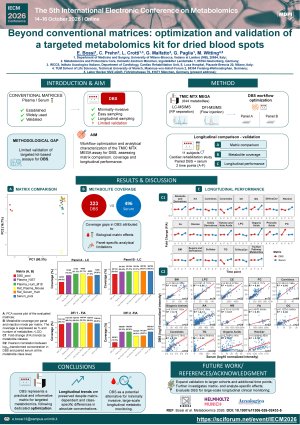
Targeted metabolomics kit-based assays are increasingly used for large-scale quantitative profiling in clinical research, yet their validation is largely limited to conventional matrices, like plasma and serum. Extending their applicability to minimally invasive matrices such as dried blood spots (DBS) requires dedicated optimization and validation. This highlights a rarely addressed methodological gap in targeted metabolomics.
This work describes the optimization of the TMIC MTX MEGA assay for DBS and its analytical characterization through a structured workflow including coverage analysis, matrix comparison, and longitudinal performance assessment. The assay combines reverse-phase liquid chromatography coupled to tandem mass spectrometry (LC-MS/MS) and direct flow-injection-MS analysis, enabling broad metabolite coverage across multiple classes. Paired DBS and serum samples from 11 participants in a cardiac rehabilitation study, collected at two timepoints, served as the validation set.
A total of 323 analytes were quantified in DBS and 496 in serum. Principal component analysis confirmed clear matrix-driven separation, reflecting well-characterized biological and pre-analytical differences. Coverage gaps in DBS were systematically attributed to either biological matrix effects or panel-specific analytical limitations. Despite differences in absolute concentrations, Pearson correlation and paired t-test (p-value <0.05) analyses demonstrated strong preservation of longitudinal trends both across metabolite classes and at the individual level. Class-specific exceptions were observed for triacylglycerols and metabolites with intracellular contributions, consistent with both analytical and biological factors.
This work provides a replicable framework for adapting the TMIC MTX MEGA assay to DBS, preserving the ability to track metabolic changes over time. These preliminary results position DBS as a viable and minimally invasive alternative for longitudinal metabolic monitoring in clinical settings, thus potentially opening the way for large-scale targeted metabolomics studies.
Keywords
Dried blood spots
Targeted metabolomics
Method optimization
LC-MS/MS
Poster
Poster_Bossi_IECM26.pdf
From 600 to 100 MHz: Developing Reliable Benchtop NMR Protocols for Urine Metabolomics
Cord Blood Metabolomic Profiling Reveals Fetal Reprogramming in Intrauterine Growth Restriction