Event submissions
Published
This submission belongs to the session S6. Plant and Animal Metabolism and Metabolic Modeling of the event The 5th International Electronic Conference on Metabolomics
Published date
09 Oct, 2026
Academic Editor
'%3e%3cpath%20d='M12.6657%2010.9104C12.4185%2010.325%2012.0599%209.79327%2011.6097%209.34482C11.1609%208.89508%2010.6293%208.5365%2010.0442%208.28888C10.0389%208.28626%2010.0337%208.28495%2010.0285%208.28233C10.8446%207.69279%2011.3752%206.73249%2011.3752%205.64904C11.3752%203.8542%209.92103%202.39999%208.1262%202.39999C6.33136%202.39999%204.87715%203.8542%204.87715%205.64904C4.87715%206.73249%205.40774%207.69279%206.22393%208.28364C6.21869%208.28626%206.21345%208.28757%206.20821%208.29019C5.62129%208.5378%205.09463%208.89284%204.64265%209.34613C4.1929%209.79493%203.83432%2010.3266%203.58671%2010.9117C3.34345%2011.4845%203.21226%2012.0987%203.20023%2012.7209C3.19988%2012.7349%203.20233%2012.7488%203.20744%2012.7619C3.21255%2012.7749%203.22022%2012.7867%203.22998%2012.7968C3.23975%2012.8068%203.25142%2012.8147%203.26431%2012.8202C3.2772%2012.8256%203.29105%2012.8284%203.30504%2012.8284H4.09109C4.14874%2012.8284%204.19459%2012.7825%204.1959%2012.7262C4.2221%2011.7148%204.62823%2010.7676%205.34617%2010.0497C6.08899%209.30683%207.0755%208.89808%208.1262%208.89808C9.17689%208.89808%2010.1634%209.30683%2010.9062%2010.0497C11.6242%2010.7676%2012.0303%2011.7148%2012.0565%2012.7262C12.0578%2012.7838%2012.1037%2012.8284%2012.1613%2012.8284H12.9474C12.9613%2012.8284%2012.9752%2012.8256%2012.9881%2012.8202C13.001%2012.8147%2013.0126%2012.8068%2013.0224%2012.7968C13.0322%2012.7867%2013.0398%2012.7749%2013.0449%2012.7619C13.0501%2012.7488%2013.0525%2012.7349%2013.0522%2012.7209C13.0391%2012.0947%2012.9094%2011.4855%2012.6657%2010.9104ZM8.1262%207.9024C7.52486%207.9024%206.9589%207.6679%206.53312%207.24211C6.10733%206.81633%205.87283%206.25037%205.87283%205.64904C5.87283%205.0477%206.10733%204.48174%206.53312%204.05596C6.9589%203.63018%207.52486%203.39567%208.1262%203.39567C8.72753%203.39567%209.29349%203.63018%209.71927%204.05596C10.1451%204.48174%2010.3796%205.0477%2010.3796%205.64904C10.3796%206.25037%2010.1451%206.81633%209.71927%207.24211C9.29349%207.6679%208.72753%207.9024%208.1262%207.9024Z'%20fill='%235D1EE1'/%3e%3c/g%3e%3c/svg%3e) Chi Chen
Chi ChenCitation
Luis Carlos Chitiva, Paula Rezende Teixeira, Ximena Londoño, Leticia V. Costa Lotufo, Juliet A. Prieto Rodríguez, Ian Castro Gamboa, Geison Modesti Costa, Metabolomics-Guided Profiling of Guadua incana Londoño Reveals Bioactive Phytocompounds Associated with Reduced HCT-116 Cell Viability, in Proceedings of The 5th International Electronic Conference on Metabolomics, 14 October–16 October 2026, MDPI: Basel, Switzerland
Share
Email
Facebook
Twitter
LinkedIn
Metabolomics-Guided Profiling of Guadua incana Londoño Reveals Bioactive Phytocompounds Associated with Reduced HCT-116 Cell Viability

Luis Carlos Chitiva 1,2
'%3e%3cpath%20d='M12.6647%2010.9104C12.4176%2010.325%2012.0589%209.7933%2011.6088%209.34485C11.16%208.89511%2010.6283%208.53653%2010.0432%208.28891C10.038%208.28629%2010.0327%208.28498%2010.0275%208.28236C10.8437%207.69282%2011.3743%206.73252%2011.3743%205.64907C11.3743%203.85423%209.92005%202.40002%208.12522%202.40002C6.33038%202.40002%204.87618%203.85423%204.87618%205.64907C4.87618%206.73252%205.40677%207.69282%206.22296%208.28367C6.21772%208.28629%206.21248%208.2876%206.20724%208.29022C5.62031%208.53783%205.09365%208.89287%204.64167%209.34616C4.19192%209.79496%203.83334%2010.3266%203.58573%2010.9117C3.34247%2011.4846%203.21128%2012.0987%203.19925%2012.721C3.1989%2012.735%203.20135%2012.7489%203.20646%2012.7619C3.21157%2012.7749%203.21924%2012.7868%203.22901%2012.7968C3.23877%2012.8068%203.25045%2012.8148%203.26334%2012.8202C3.27623%2012.8256%203.29007%2012.8284%203.30406%2012.8284H4.09012C4.14776%2012.8284%204.19362%2012.7825%204.19493%2012.7262C4.22113%2011.7148%204.62726%2010.7676%205.34519%2010.0497C6.08802%209.30686%207.07452%208.89811%208.12522%208.89811C9.17592%208.89811%2010.1624%209.30686%2010.9052%2010.0497C11.6232%2010.7676%2012.0293%2011.7148%2012.0555%2012.7262C12.0568%2012.7839%2012.1027%2012.8284%2012.1603%2012.8284H12.9464C12.9604%2012.8284%2012.9742%2012.8256%2012.9871%2012.8202C13%2012.8148%2013.0117%2012.8068%2013.0214%2012.7968C13.0312%2012.7868%2013.0389%2012.7749%2013.044%2012.7619C13.0491%2012.7489%2013.0515%2012.735%2013.0512%2012.721C13.0381%2012.0947%2012.9084%2011.4856%2012.6647%2010.9104ZM8.12522%207.90243C7.52388%207.90243%206.95792%207.66793%206.53214%207.24215C6.10636%206.81636%205.87185%206.2504%205.87185%205.64907C5.87185%205.04773%206.10636%204.48177%206.53214%204.05599C6.95792%203.63021%207.52388%203.3957%208.12522%203.3957C8.72655%203.3957%209.29252%203.63021%209.7183%204.05599C10.1441%204.48177%2010.3786%205.04773%2010.3786%205.64907C10.3786%206.2504%2010.1441%206.81636%209.7183%207.24215C9.29252%207.66793%208.72655%207.90243%208.12522%207.90243Z'%20fill='%235D1EE1'/%3e%3c/g%3e%3c/svg%3e)
Paula Rezende Teixeira 3
Ximena Londoño 4
Leticia V. Costa Lotufo 3

Juliet A. Prieto Rodríguez 1
Ian Castro Gamboa 2

Geison Modesti Costa 1
1. Grupo de Investigación Fitoquímica Universidad Javeriana (GIFUJ), Department of Chemistry, Faculty of Sciences, Pontificia Universidad Javeriana, Bogotá, 110231, Colombia
2. Núcleo de Bioensaios, Biossíntese e Ecofisiologia de Produtos Naturais (NuBBE), Institute of Chemistry, São Paulo State University (UNESP), Araraquara, SP 14800-900, Brazil
3. Laboratório de Farmacologia de Produtos Naturais Marinhos, Institute of Biomedical Sciences, University of São Paulo, São Paulo, SP 05508-000, Brazil
4. Faculty of Agricultural Sciences, Universidad Nacional de Colombia, Palmira, 763533, Colombia
Abstract
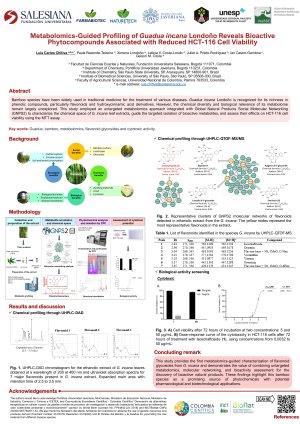
Bamboo species have been widely used in traditional medicine for the treatment of various diseases. Guadua incana Londoño is recognized for its richness in phenolic compounds, particularly flavonoids and hydroxycinnamic acid derivatives. However, the chemical diversity and biological relevance of its metabolome remain largely unexplored. This study employed an untargeted metabolomics approach integrated with Global Natural Products Social Molecular Networking (GNPS2) to characterize the chemical space of G. incana leaf extracts, guide the targeted isolation of bioactive metabolites, and assess their effects on HCT-116 cell viability using the MTT assay. Leaf extracts were prepared using 96% ethanol and analyzed by ultra-high-performance liquid chromatography coupled with quadrupole time-of-flight tandem mass spectrometry (UHPLC-QTOF-MS/MS). Metabolite annotation and chemical space exploration were performed through molecular networking analysis using GNPS2. Metabolomics-guided fractionation enabled the targeted isolation of major constituents by centrifugal partition chromatography (CPC), followed by purification using Sephadex LH-20. Structural characterization led to the identification of isoschaftoside (1) and a flavonoid-rich mixture (M1) containing orientin (2), flavone base + 3O, 1MeO, C-Hex (3), violanthin (4), vitexin (5), swertisin (6), and flavone base + 3O, 1MeO, O-dHex (7). Compound 1 reduced HCT-116 cell viability, exhibiting an IC50 value of 13.26 µM after 72 h of exposure, while M1 decreased cell viability by 94.35% at 50 µg/mL. Integrative metabolomic and biological analyses indicated that these flavonoids are associated with the observed reduction in cell viability. This study provides the first metabolomics-guided characterization of flavonoid glycosides from G. incana and demonstrates the value of combining untargeted metabolomics, molecular networking, and bioactivity assessment for the discovery of bioactive natural products. These findings highlight this bamboo species as a promising source of phytochemicals with potential pharmacological and biotechnological applications.
Keywords
Metabolomic profiling
GNPS2
HCT-116
Chemical space
Poster
Poster-IECM-2026_vfinal.pdf
Cord Blood Metabolomic Profiling Reveals Fetal Reprogramming in Intrauterine Growth Restriction
Characterization of Intra- and Extracellular Metabolic Profiles by ¹H NMR in Aβ1-42-Treated Human Astrocytes from Healthy and Alzheimer's Disease Subjects