Event submissions
Published
This submission belongs to the session S6. Plant and Animal Metabolism and Metabolic Modeling of the event The 5th International Electronic Conference on Metabolomics
Published date
09 Oct, 2026
Academic Editor
'%3e%3cpath%20d='M12.6657%2010.9104C12.4185%2010.325%2012.0599%209.79327%2011.6097%209.34482C11.1609%208.89508%2010.6293%208.5365%2010.0442%208.28888C10.0389%208.28626%2010.0337%208.28495%2010.0285%208.28233C10.8446%207.69279%2011.3752%206.73249%2011.3752%205.64904C11.3752%203.8542%209.92103%202.39999%208.1262%202.39999C6.33136%202.39999%204.87715%203.8542%204.87715%205.64904C4.87715%206.73249%205.40774%207.69279%206.22393%208.28364C6.21869%208.28626%206.21345%208.28757%206.20821%208.29019C5.62129%208.5378%205.09463%208.89284%204.64265%209.34613C4.1929%209.79493%203.83432%2010.3266%203.58671%2010.9117C3.34345%2011.4845%203.21226%2012.0987%203.20023%2012.7209C3.19988%2012.7349%203.20233%2012.7488%203.20744%2012.7619C3.21255%2012.7749%203.22022%2012.7867%203.22998%2012.7968C3.23975%2012.8068%203.25142%2012.8147%203.26431%2012.8202C3.2772%2012.8256%203.29105%2012.8284%203.30504%2012.8284H4.09109C4.14874%2012.8284%204.19459%2012.7825%204.1959%2012.7262C4.2221%2011.7148%204.62823%2010.7676%205.34617%2010.0497C6.08899%209.30683%207.0755%208.89808%208.1262%208.89808C9.17689%208.89808%2010.1634%209.30683%2010.9062%2010.0497C11.6242%2010.7676%2012.0303%2011.7148%2012.0565%2012.7262C12.0578%2012.7838%2012.1037%2012.8284%2012.1613%2012.8284H12.9474C12.9613%2012.8284%2012.9752%2012.8256%2012.9881%2012.8202C13.001%2012.8147%2013.0126%2012.8068%2013.0224%2012.7968C13.0322%2012.7867%2013.0398%2012.7749%2013.0449%2012.7619C13.0501%2012.7488%2013.0525%2012.7349%2013.0522%2012.7209C13.0391%2012.0947%2012.9094%2011.4855%2012.6657%2010.9104ZM8.1262%207.9024C7.52486%207.9024%206.9589%207.6679%206.53312%207.24211C6.10733%206.81633%205.87283%206.25037%205.87283%205.64904C5.87283%205.0477%206.10733%204.48174%206.53312%204.05596C6.9589%203.63018%207.52486%203.39567%208.1262%203.39567C8.72753%203.39567%209.29349%203.63018%209.71927%204.05596C10.1451%204.48174%2010.3796%205.0477%2010.3796%205.64904C10.3796%206.25037%2010.1451%206.81633%209.71927%207.24211C9.29349%207.6679%208.72753%207.9024%208.1262%207.9024Z'%20fill='%235D1EE1'/%3e%3c/g%3e%3c/svg%3e) Chi Chen
Chi ChenCitation
Abdulwaris Tijani, Gbenga Ayodele, Metabolomics for Characterizing Trace Metal Toxicity Responses in Marine Bivalves: Insights from Constraint-Based Metabolic Modeling—A Systematic Review, in Proceedings of The 5th International Electronic Conference on Metabolomics, 14 October–16 October 2026, MDPI: Basel, Switzerland
Share
Email
Facebook
Twitter
LinkedIn
Metabolomics for Characterizing Trace Metal Toxicity Responses in Marine Bivalves: Insights from Constraint-Based Metabolic Modeling—A Systematic Review
'%3e%3cpath%20d='M12.6647%2010.9104C12.4176%2010.325%2012.0589%209.7933%2011.6088%209.34485C11.16%208.89511%2010.6283%208.53653%2010.0432%208.28891C10.038%208.28629%2010.0327%208.28498%2010.0275%208.28236C10.8437%207.69282%2011.3743%206.73252%2011.3743%205.64907C11.3743%203.85423%209.92005%202.40002%208.12522%202.40002C6.33038%202.40002%204.87618%203.85423%204.87618%205.64907C4.87618%206.73252%205.40677%207.69282%206.22296%208.28367C6.21772%208.28629%206.21248%208.2876%206.20724%208.29022C5.62031%208.53783%205.09365%208.89287%204.64167%209.34616C4.19192%209.79496%203.83334%2010.3266%203.58573%2010.9117C3.34247%2011.4846%203.21128%2012.0987%203.19925%2012.721C3.1989%2012.735%203.20135%2012.7489%203.20646%2012.7619C3.21157%2012.7749%203.21924%2012.7868%203.22901%2012.7968C3.23877%2012.8068%203.25045%2012.8148%203.26334%2012.8202C3.27623%2012.8256%203.29007%2012.8284%203.30406%2012.8284H4.09012C4.14776%2012.8284%204.19362%2012.7825%204.19493%2012.7262C4.22113%2011.7148%204.62726%2010.7676%205.34519%2010.0497C6.08802%209.30686%207.07452%208.89811%208.12522%208.89811C9.17592%208.89811%2010.1624%209.30686%2010.9052%2010.0497C11.6232%2010.7676%2012.0293%2011.7148%2012.0555%2012.7262C12.0568%2012.7839%2012.1027%2012.8284%2012.1603%2012.8284H12.9464C12.9604%2012.8284%2012.9742%2012.8256%2012.9871%2012.8202C13%2012.8148%2013.0117%2012.8068%2013.0214%2012.7968C13.0312%2012.7868%2013.0389%2012.7749%2013.044%2012.7619C13.0491%2012.7489%2013.0515%2012.735%2013.0512%2012.721C13.0381%2012.0947%2012.9084%2011.4856%2012.6647%2010.9104ZM8.12522%207.90243C7.52388%207.90243%206.95792%207.66793%206.53214%207.24215C6.10636%206.81636%205.87185%206.2504%205.87185%205.64907C5.87185%205.04773%206.10636%204.48177%206.53214%204.05599C6.95792%203.63021%207.52388%203.3957%208.12522%203.3957C8.72655%203.3957%209.29252%203.63021%209.7183%204.05599C10.1441%204.48177%2010.3786%205.04773%2010.3786%205.64907C10.3786%206.2504%2010.1441%206.81636%209.7183%207.24215C9.29252%207.66793%208.72655%207.90243%208.12522%207.90243Z'%20fill='%235D1EE1'/%3e%3c/g%3e%3c/svg%3e)
Abdulwaris Tijani 1
Gbenga Ayodele 1
1. Department of Animal Production and Health, Federal University of Technology, Akure, Nigeria
Abstract
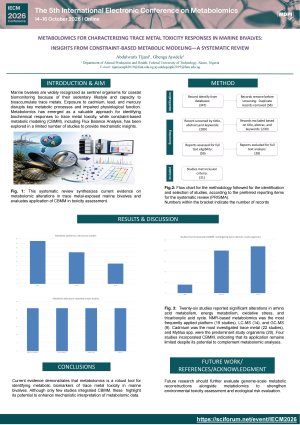
Marine bivalves are widely recognized as sentinel organisms for coastal biomonitoring because of their sedentary lifestyle and capacity to bioaccumulate trace metals. Exposure to cadmium, lead, and mercury disrupts key metabolic processes, impairing physiological function. Metabolomics has emerged as a valuable approach for identifying biochemical responses to trace metal toxicity, while constraint-based metabolic modeling (CBMM), including Flux Balance Analysis, has been explored in a limited number of studies to provide mechanistic insights. This systematic review synthesizes current evidence on metabolomic alterations in trace metal-exposed marine bivalves and evaluates application of CBMM in toxicity assessment.
Following PRISMA 2020 guidelines, PubMed, Scopus, Web of Science, and Google Scholar were searched for studies published between 2000 and 2025. Eligible studies investigated metabolomic responses to trace metal exposure in marine bivalves. Reviews, non-English publications, and studies lacking metabolomic analyses were excluded. Study was evaluated using predefined methodological criteria assessing study design, analytical methods, and reporting quality. Metabolic disturbances were synthesized according to affected biochemical pathways.
Of 347 records identified, 289 remained after duplicate removal, and 31 studies met the inclusion criteria. Twenty-six studies reported significant alterations in amino acid metabolism, energy metabolism, oxidative stress, and tricarboxylic acid cycle. NMR-based metabolomics was the most frequently applied platform (19 studies), LC-MS (14), and GC-MS (9). Cadmium was the most investigated trace metal (22 studies), and Mytilus spp. were the predominant study organisms (20). Four studies incorporated CBMM, indicating that its application remains limited despite its potential to complement metabolomic analyses.
Current evidence demonstrates that metabolomics is a robust tool for identifying metabolic biomarkers of trace metal toxicity in marine bivalves. Although only few studies integrated CBMM, these highlight its potential to enhance mechanistic interpretation of metabolomic data. Future research should further evaluate genome-scale metabolic reconstructions alongside metabolomics to strengthen environmental toxicity assessment and ecological risk evaluation.
Keywords
Marine bivalves; trace metals; metabolomics; flux balance analysis; constraint-based metabolic modeling; heavy metal toxicity
Poster
metabolomics_120047.pdf
Characterization of Intra- and Extracellular Metabolic Profiles by ¹H NMR in Aβ1-42-Treated Human Astrocytes from Healthy and Alzheimer's Disease Subjects
Breast Milk Oxylipin Signature Predicts Infant Gut Microbiota Maturation: A Prospective Lipidomics–Metagenomics Cohort Study