Event submissions
Published
This submission belongs to the session S2. Ecological and Environmental Metabolomics of the event The 5th International Electronic Conference on Metabolomics
Published date
09 Oct, 2026
Academic Editor
'%3e%3cpath%20d='M12.6657%2010.9104C12.4185%2010.325%2012.0599%209.79327%2011.6097%209.34482C11.1609%208.89508%2010.6293%208.5365%2010.0442%208.28888C10.0389%208.28626%2010.0337%208.28495%2010.0285%208.28233C10.8446%207.69279%2011.3752%206.73249%2011.3752%205.64904C11.3752%203.8542%209.92103%202.39999%208.1262%202.39999C6.33136%202.39999%204.87715%203.8542%204.87715%205.64904C4.87715%206.73249%205.40774%207.69279%206.22393%208.28364C6.21869%208.28626%206.21345%208.28757%206.20821%208.29019C5.62129%208.5378%205.09463%208.89284%204.64265%209.34613C4.1929%209.79493%203.83432%2010.3266%203.58671%2010.9117C3.34345%2011.4845%203.21226%2012.0987%203.20023%2012.7209C3.19988%2012.7349%203.20233%2012.7488%203.20744%2012.7619C3.21255%2012.7749%203.22022%2012.7867%203.22998%2012.7968C3.23975%2012.8068%203.25142%2012.8147%203.26431%2012.8202C3.2772%2012.8256%203.29105%2012.8284%203.30504%2012.8284H4.09109C4.14874%2012.8284%204.19459%2012.7825%204.1959%2012.7262C4.2221%2011.7148%204.62823%2010.7676%205.34617%2010.0497C6.08899%209.30683%207.0755%208.89808%208.1262%208.89808C9.17689%208.89808%2010.1634%209.30683%2010.9062%2010.0497C11.6242%2010.7676%2012.0303%2011.7148%2012.0565%2012.7262C12.0578%2012.7838%2012.1037%2012.8284%2012.1613%2012.8284H12.9474C12.9613%2012.8284%2012.9752%2012.8256%2012.9881%2012.8202C13.001%2012.8147%2013.0126%2012.8068%2013.0224%2012.7968C13.0322%2012.7867%2013.0398%2012.7749%2013.0449%2012.7619C13.0501%2012.7488%2013.0525%2012.7349%2013.0522%2012.7209C13.0391%2012.0947%2012.9094%2011.4855%2012.6657%2010.9104ZM8.1262%207.9024C7.52486%207.9024%206.9589%207.6679%206.53312%207.24211C6.10733%206.81633%205.87283%206.25037%205.87283%205.64904C5.87283%205.0477%206.10733%204.48174%206.53312%204.05596C6.9589%203.63018%207.52486%203.39567%208.1262%203.39567C8.72753%203.39567%209.29349%203.63018%209.71927%204.05596C10.1451%204.48174%2010.3796%205.0477%2010.3796%205.64904C10.3796%206.25037%2010.1451%206.81633%209.71927%207.24211C9.29349%207.6679%208.72753%207.9024%208.1262%207.9024Z'%20fill='%235D1EE1'/%3e%3c/g%3e%3c/svg%3e) Bei Gao
Bei GaoCitation
Erani Loku Umagiliyage, RuAngelie Edrada-Ebel, Saif Aldeen Mohammad Fayiz Jaber, Kirsty Neilson, Louise Young, Using metabolomic tools to bioprospect the antibacterial activity of a seaweed endophyte co-cultured with biofilm-forming bacteria Pseudomonas aeruginosa
, in Proceedings of The 5th International Electronic Conference on Metabolomics, 14 October–16 October 2026, MDPI: Basel, Switzerland
Share
Email
Facebook
Twitter
LinkedIn
Using metabolomic tools to bioprospect the antibacterial activity of a seaweed endophyte co-cultured with biofilm-forming bacteria Pseudomonas aeruginosa
'%3e%3cpath%20d='M12.6647%2010.9104C12.4176%2010.325%2012.0589%209.7933%2011.6088%209.34485C11.16%208.89511%2010.6283%208.53653%2010.0432%208.28891C10.038%208.28629%2010.0327%208.28498%2010.0275%208.28236C10.8437%207.69282%2011.3743%206.73252%2011.3743%205.64907C11.3743%203.85423%209.92005%202.40002%208.12522%202.40002C6.33038%202.40002%204.87618%203.85423%204.87618%205.64907C4.87618%206.73252%205.40677%207.69282%206.22296%208.28367C6.21772%208.28629%206.21248%208.2876%206.20724%208.29022C5.62031%208.53783%205.09365%208.89287%204.64167%209.34616C4.19192%209.79496%203.83334%2010.3266%203.58573%2010.9117C3.34247%2011.4846%203.21128%2012.0987%203.19925%2012.721C3.1989%2012.735%203.20135%2012.7489%203.20646%2012.7619C3.21157%2012.7749%203.21924%2012.7868%203.22901%2012.7968C3.23877%2012.8068%203.25045%2012.8148%203.26334%2012.8202C3.27623%2012.8256%203.29007%2012.8284%203.30406%2012.8284H4.09012C4.14776%2012.8284%204.19362%2012.7825%204.19493%2012.7262C4.22113%2011.7148%204.62726%2010.7676%205.34519%2010.0497C6.08802%209.30686%207.07452%208.89811%208.12522%208.89811C9.17592%208.89811%2010.1624%209.30686%2010.9052%2010.0497C11.6232%2010.7676%2012.0293%2011.7148%2012.0555%2012.7262C12.0568%2012.7839%2012.1027%2012.8284%2012.1603%2012.8284H12.9464C12.9604%2012.8284%2012.9742%2012.8256%2012.9871%2012.8202C13%2012.8148%2013.0117%2012.8068%2013.0214%2012.7968C13.0312%2012.7868%2013.0389%2012.7749%2013.044%2012.7619C13.0491%2012.7489%2013.0515%2012.735%2013.0512%2012.721C13.0381%2012.0947%2012.9084%2011.4856%2012.6647%2010.9104ZM8.12522%207.90243C7.52388%207.90243%206.95792%207.66793%206.53214%207.24215C6.10636%206.81636%205.87185%206.2504%205.87185%205.64907C5.87185%205.04773%206.10636%204.48177%206.53214%204.05599C6.95792%203.63021%207.52388%203.3957%208.12522%203.3957C8.72655%203.3957%209.29252%203.63021%209.7183%204.05599C10.1441%204.48177%2010.3786%205.04773%2010.3786%205.64907C10.3786%206.2504%2010.1441%206.81636%209.7183%207.24215C9.29252%207.66793%208.72655%207.90243%208.12522%207.90243Z'%20fill='%235D1EE1'/%3e%3c/g%3e%3c/svg%3e)
Erani Loku Umagiliyage 1

RuAngelie Edrada-Ebel 1
Saif Aldeen Mohammad Fayiz Jaber 1,2
Kirsty Neilson 3,4
Louise Young 1
1. Strathclyde Institute of Pharmacy and Biomedical Sciences, University of Strathclyde, Scotland, UK
2. Drug Discovery, Pharmaceutical analysis and Metabolomics Office, Middle East University, Amman, Jordan
3. Marine Biopolymers Ltd, Ayrshire, UK
4. Industrial Biotechnology Innovation Centre, Glasgow, UK
Abstract
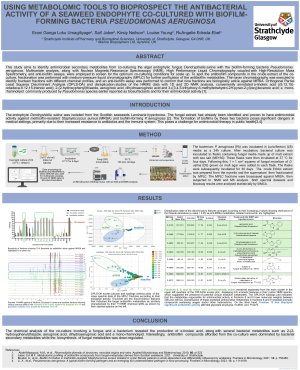
The increasing prevalence of bacterial biofilms and their tolerance to antimicrobial treatment highlight the need for new anti-biofilm agents. Microbial co-culture offers a promising strategy for inducing otherwise poorly expressed secondary metabolites; however, the metabolic responses to fungal–bacterial interactions and their contribution to antimicrobial activity remain insufficiently understood. This study investigated whether co-culturing the algal endophytic fungus Dendryphiella salina with the biofilm-forming bacterium Pseudomonas aeruginosa could induce bioactive metabolites with anti-biofilm activity.
An integrated workflow combining multivariate data analysis, Nuclear Magnetic Resonance (NMR) spectroscopy, High-Performance Liquid Chromatography–High-Resolution Mass Spectrometry (HPLC–HRMS), and antimicrobial and anti-biofilm assays was used to characterise co-culture-induced metabolic changes and identify bioactive metabolites. Optimised co-culture conditions were selected based on metabolic profiles and biological activity and subsequently scaled up for chemical investigation. Medium-pressure liquid chromatography fractionation of the crude extract generated fourteen fractions, nine of which exhibited significant anti-biofilm activity against methicillin-resistant Staphylococcus aureus (MRSA). OPLS-DA, HRMS-based dereplication, and 1D/2D NMR spectroscopy enabled the annotation of several metabolites, including linoleic acid, 2-(2-hydroxyphenyl)thiazole, 2-phenyl-4,5-dihydrothiazol-4-ol, aeruginoic acid, dihydroaeruginoic acid, and a mono-rhamnolipid.
The mono-rhamnolipid demonstrated the strongest overall activity, with a minimum inhibitory concentration (MIC) of 6.5 µg/mL, minimum biofilm prevention concentration (MBPC) of 5.0 µg/mL, and minimum biofilm inhibitory concentration (MBIC) of 7.2 µg/mL. A mixture of 2-phenyl-4,5-dihydrothiazol-4-ol and dihydroaeruginoic acid inhibited planktonic growth, biofilm formation, and established biofilms by 95.3%, 98.9%, and 85.1%, respectively. Overall, fungal–bacterial co-culture induced substantial metabolic and biological changes and facilitated the discovery of anti-MRSA metabolites. Notably, anti-biofilm activity was predominantly associated with bacterial secondary metabolites, suggesting that microbial interactions can redirect secondary metabolism towards bioactive compounds.
Keywords
Endophytic fungi
Pseudomonas aeruginosa
Dendryphiella salina
microbial co-culture
secondary metabolites
anti-biofilm activity
metabolomics
Poster
Poster FB.pdf
Untargeted metabolomics reveals phenology and cultivation-dependent signatures of vasodilatory activity in Heliopsis longipes leaves
Co-Culture-Induced Antibacterial Metabolites from Seaweed Endophytes: A Metabolomics Approach