Event submissions
Published
This submission belongs to the session S2. Ecological and Environmental Metabolomics of the event The 5th International Electronic Conference on Metabolomics
Published date
09 Oct, 2026
Academic Editor
'%3e%3cpath%20d='M12.6657%2010.9104C12.4185%2010.325%2012.0599%209.79327%2011.6097%209.34482C11.1609%208.89508%2010.6293%208.5365%2010.0442%208.28888C10.0389%208.28626%2010.0337%208.28495%2010.0285%208.28233C10.8446%207.69279%2011.3752%206.73249%2011.3752%205.64904C11.3752%203.8542%209.92103%202.39999%208.1262%202.39999C6.33136%202.39999%204.87715%203.8542%204.87715%205.64904C4.87715%206.73249%205.40774%207.69279%206.22393%208.28364C6.21869%208.28626%206.21345%208.28757%206.20821%208.29019C5.62129%208.5378%205.09463%208.89284%204.64265%209.34613C4.1929%209.79493%203.83432%2010.3266%203.58671%2010.9117C3.34345%2011.4845%203.21226%2012.0987%203.20023%2012.7209C3.19988%2012.7349%203.20233%2012.7488%203.20744%2012.7619C3.21255%2012.7749%203.22022%2012.7867%203.22998%2012.7968C3.23975%2012.8068%203.25142%2012.8147%203.26431%2012.8202C3.2772%2012.8256%203.29105%2012.8284%203.30504%2012.8284H4.09109C4.14874%2012.8284%204.19459%2012.7825%204.1959%2012.7262C4.2221%2011.7148%204.62823%2010.7676%205.34617%2010.0497C6.08899%209.30683%207.0755%208.89808%208.1262%208.89808C9.17689%208.89808%2010.1634%209.30683%2010.9062%2010.0497C11.6242%2010.7676%2012.0303%2011.7148%2012.0565%2012.7262C12.0578%2012.7838%2012.1037%2012.8284%2012.1613%2012.8284H12.9474C12.9613%2012.8284%2012.9752%2012.8256%2012.9881%2012.8202C13.001%2012.8147%2013.0126%2012.8068%2013.0224%2012.7968C13.0322%2012.7867%2013.0398%2012.7749%2013.0449%2012.7619C13.0501%2012.7488%2013.0525%2012.7349%2013.0522%2012.7209C13.0391%2012.0947%2012.9094%2011.4855%2012.6657%2010.9104ZM8.1262%207.9024C7.52486%207.9024%206.9589%207.6679%206.53312%207.24211C6.10733%206.81633%205.87283%206.25037%205.87283%205.64904C5.87283%205.0477%206.10733%204.48174%206.53312%204.05596C6.9589%203.63018%207.52486%203.39567%208.1262%203.39567C8.72753%203.39567%209.29349%203.63018%209.71927%204.05596C10.1451%204.48174%2010.3796%205.0477%2010.3796%205.64904C10.3796%206.25037%2010.1451%206.81633%209.71927%207.24211C9.29349%207.6679%208.72753%207.9024%208.1262%207.9024Z'%20fill='%235D1EE1'/%3e%3c/g%3e%3c/svg%3e) Bei Gao
Bei GaoCitation
Erani Ganga Loku Umagiliyage, RuAngelie Edrada-Ebel, Saif Aldeen Mohammad Fayiz Jaber, Louise Young, Kirsty Neilson, Co-Culture-Induced Antibacterial Metabolites from Seaweed Endophytes: A Metabolomics Approach, in Proceedings of The 5th International Electronic Conference on Metabolomics, 14 October–16 October 2026, MDPI: Basel, Switzerland
Share
Email
Facebook
Twitter
LinkedIn
Co-Culture-Induced Antibacterial Metabolites from Seaweed Endophytes: A Metabolomics Approach
'%3e%3cpath%20d='M12.6647%2010.9104C12.4176%2010.325%2012.0589%209.7933%2011.6088%209.34485C11.16%208.89511%2010.6283%208.53653%2010.0432%208.28891C10.038%208.28629%2010.0327%208.28498%2010.0275%208.28236C10.8437%207.69282%2011.3743%206.73252%2011.3743%205.64907C11.3743%203.85423%209.92005%202.40002%208.12522%202.40002C6.33038%202.40002%204.87618%203.85423%204.87618%205.64907C4.87618%206.73252%205.40677%207.69282%206.22296%208.28367C6.21772%208.28629%206.21248%208.2876%206.20724%208.29022C5.62031%208.53783%205.09365%208.89287%204.64167%209.34616C4.19192%209.79496%203.83334%2010.3266%203.58573%2010.9117C3.34247%2011.4846%203.21128%2012.0987%203.19925%2012.721C3.1989%2012.735%203.20135%2012.7489%203.20646%2012.7619C3.21157%2012.7749%203.21924%2012.7868%203.22901%2012.7968C3.23877%2012.8068%203.25045%2012.8148%203.26334%2012.8202C3.27623%2012.8256%203.29007%2012.8284%203.30406%2012.8284H4.09012C4.14776%2012.8284%204.19362%2012.7825%204.19493%2012.7262C4.22113%2011.7148%204.62726%2010.7676%205.34519%2010.0497C6.08802%209.30686%207.07452%208.89811%208.12522%208.89811C9.17592%208.89811%2010.1624%209.30686%2010.9052%2010.0497C11.6232%2010.7676%2012.0293%2011.7148%2012.0555%2012.7262C12.0568%2012.7839%2012.1027%2012.8284%2012.1603%2012.8284H12.9464C12.9604%2012.8284%2012.9742%2012.8256%2012.9871%2012.8202C13%2012.8148%2013.0117%2012.8068%2013.0214%2012.7968C13.0312%2012.7868%2013.0389%2012.7749%2013.044%2012.7619C13.0491%2012.7489%2013.0515%2012.735%2013.0512%2012.721C13.0381%2012.0947%2012.9084%2011.4856%2012.6647%2010.9104ZM8.12522%207.90243C7.52388%207.90243%206.95792%207.66793%206.53214%207.24215C6.10636%206.81636%205.87185%206.2504%205.87185%205.64907C5.87185%205.04773%206.10636%204.48177%206.53214%204.05599C6.95792%203.63021%207.52388%203.3957%208.12522%203.3957C8.72655%203.3957%209.29252%203.63021%209.7183%204.05599C10.1441%204.48177%2010.3786%205.04773%2010.3786%205.64907C10.3786%206.2504%2010.1441%206.81636%209.7183%207.24215C9.29252%207.66793%208.72655%207.90243%208.12522%207.90243Z'%20fill='%235D1EE1'/%3e%3c/g%3e%3c/svg%3e)
Erani Ganga Loku Umagiliyage 1

RuAngelie Edrada-Ebel 1
Saif Aldeen Mohammad Fayiz Jaber 1,2
Louise Young 1
Kirsty Neilson 3,4
1. Strathclyde Institute of Pharmacy and Biomedical Sciences, University of Strathclyde, Scotland, UK
2. Drug Discovery, Phamaceutical analysis and Metabolomics Office, Middle East University, Amman, Jordan
3. Marine Biopolymers Ltd, Ayrshire, UK
4. Industrial Biotechnology Innovation Centre, Glasgow, UK
Abstract
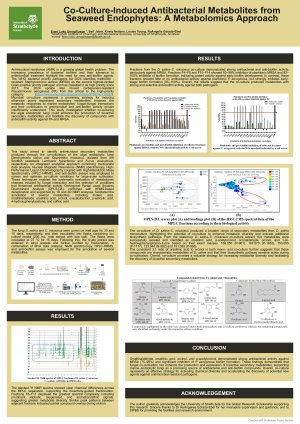
This study aimed to identify antimicrobial secondary metabolites produced through the co-cultivation of the algal endophytic fungi Dendryphiella salina and Coprinellus micaceus, isolated from the Scottish seaweeds Laminaria hyperborea and Fucus vesiculosus, respectively. An integrated analytical approach combining multivariate data analysis, Nuclear Magnetic Resonance (NMR) spectroscopy, High-Performance Liquid Chromatography coupled with High-Resolution Mass Spectrometry (HPLC–HRMS), and anti-biofilm assays was employed to screen and optimise co-culture conditions for large-scale cultivation. These techniques enabled the systematic evaluation of metabolomic changes induced by fungal interaction and the selection of conditions that enhanced antibacterial activity.
To identify antibacterial compounds present in the crude co-culture extract, fractionation was performed using medium-pressure liquid chromatography (MPLC) to purify the bioactive metabolites further. Thin-layer chromatography resolved sixteen fractions with distinct chemical profiles, of which ten exhibited significant antibacterial activity against methicillin-resistant Staphylococcus aureus (MRSA). Orthogonal Partial Least Squares Discriminant Analysis (OPLS-DA), combined with HRMS-based dereplication and supported by 1D and 2D NMR analyses, facilitated the annotation of several metabolites, including α-linoleic acid, orsellinaldehyde, orsellinic acid, orcinol, α-acetylorcinol, p-salicylic acid, 4-hydroxyphenylacetone, and caffeic acid.
Orsellinic acid, orcinol and 2,5-dihydroxy-3-(hydroxymethyl)benzoic acid were detected in the D. salina monoculture, whereas co-cultivation resulted in significant alterations in the metabolite profile of both fungi, indicating that interspecies interactions stimulated the production of additional secondary metabolites and enhanced antibacterial activity. These findings demonstrate the potential of co-culture-based metabolomic strategies for the discovery of bioactive natural products from marine-derived fungi.
Keywords
Endophytic fungi
Secondary metabolites
Co-culture
Poster
poster FF.pdf
Using metabolomic tools to bioprospect the antibacterial activity of a seaweed endophyte co-cultured with biofilm-forming bacteria Pseudomonas aeruginosa
Metabolomic Signatures of Parental Obesity in Childhood Obesity