Event submissions
Published
This submission belongs to the session S6. Plant and Animal Metabolism and Metabolic Modeling of the event The 5th International Electronic Conference on Metabolomics
Published date
09 Oct, 2026
Academic Editor
'%3e%3cpath%20d='M12.6657%2010.9104C12.4185%2010.325%2012.0599%209.79327%2011.6097%209.34482C11.1609%208.89508%2010.6293%208.5365%2010.0442%208.28888C10.0389%208.28626%2010.0337%208.28495%2010.0285%208.28233C10.8446%207.69279%2011.3752%206.73249%2011.3752%205.64904C11.3752%203.8542%209.92103%202.39999%208.1262%202.39999C6.33136%202.39999%204.87715%203.8542%204.87715%205.64904C4.87715%206.73249%205.40774%207.69279%206.22393%208.28364C6.21869%208.28626%206.21345%208.28757%206.20821%208.29019C5.62129%208.5378%205.09463%208.89284%204.64265%209.34613C4.1929%209.79493%203.83432%2010.3266%203.58671%2010.9117C3.34345%2011.4845%203.21226%2012.0987%203.20023%2012.7209C3.19988%2012.7349%203.20233%2012.7488%203.20744%2012.7619C3.21255%2012.7749%203.22022%2012.7867%203.22998%2012.7968C3.23975%2012.8068%203.25142%2012.8147%203.26431%2012.8202C3.2772%2012.8256%203.29105%2012.8284%203.30504%2012.8284H4.09109C4.14874%2012.8284%204.19459%2012.7825%204.1959%2012.7262C4.2221%2011.7148%204.62823%2010.7676%205.34617%2010.0497C6.08899%209.30683%207.0755%208.89808%208.1262%208.89808C9.17689%208.89808%2010.1634%209.30683%2010.9062%2010.0497C11.6242%2010.7676%2012.0303%2011.7148%2012.0565%2012.7262C12.0578%2012.7838%2012.1037%2012.8284%2012.1613%2012.8284H12.9474C12.9613%2012.8284%2012.9752%2012.8256%2012.9881%2012.8202C13.001%2012.8147%2013.0126%2012.8068%2013.0224%2012.7968C13.0322%2012.7867%2013.0398%2012.7749%2013.0449%2012.7619C13.0501%2012.7488%2013.0525%2012.7349%2013.0522%2012.7209C13.0391%2012.0947%2012.9094%2011.4855%2012.6657%2010.9104ZM8.1262%207.9024C7.52486%207.9024%206.9589%207.6679%206.53312%207.24211C6.10733%206.81633%205.87283%206.25037%205.87283%205.64904C5.87283%205.0477%206.10733%204.48174%206.53312%204.05596C6.9589%203.63018%207.52486%203.39567%208.1262%203.39567C8.72753%203.39567%209.29349%203.63018%209.71927%204.05596C10.1451%204.48174%2010.3796%205.0477%2010.3796%205.64904C10.3796%206.25037%2010.1451%206.81633%209.71927%207.24211C9.29349%207.6679%208.72753%207.9024%208.1262%207.9024Z'%20fill='%235D1EE1'/%3e%3c/g%3e%3c/svg%3e) Chi Chen
Chi ChenCitation
SONIA GUILERA BERMELL, ANTONIO M. INAREJOS GARCIA, Metabolomic characterization of a pomegranate (Punica granatum L.) water extract by LC-QTOF-MS, in Proceedings of The 5th International Electronic Conference on Metabolomics, 14 October–16 October 2026, MDPI: Basel, Switzerland
Share
Email
Facebook
Twitter
LinkedIn
Metabolomic characterization of a pomegranate (Punica granatum L.) water extract by LC-QTOF-MS
'%3e%3cpath%20d='M12.6647%2010.9104C12.4176%2010.325%2012.0589%209.7933%2011.6088%209.34485C11.16%208.89511%2010.6283%208.53653%2010.0432%208.28891C10.038%208.28629%2010.0327%208.28498%2010.0275%208.28236C10.8437%207.69282%2011.3743%206.73252%2011.3743%205.64907C11.3743%203.85423%209.92005%202.40002%208.12522%202.40002C6.33038%202.40002%204.87618%203.85423%204.87618%205.64907C4.87618%206.73252%205.40677%207.69282%206.22296%208.28367C6.21772%208.28629%206.21248%208.2876%206.20724%208.29022C5.62031%208.53783%205.09365%208.89287%204.64167%209.34616C4.19192%209.79496%203.83334%2010.3266%203.58573%2010.9117C3.34247%2011.4846%203.21128%2012.0987%203.19925%2012.721C3.1989%2012.735%203.20135%2012.7489%203.20646%2012.7619C3.21157%2012.7749%203.21924%2012.7868%203.22901%2012.7968C3.23877%2012.8068%203.25045%2012.8148%203.26334%2012.8202C3.27623%2012.8256%203.29007%2012.8284%203.30406%2012.8284H4.09012C4.14776%2012.8284%204.19362%2012.7825%204.19493%2012.7262C4.22113%2011.7148%204.62726%2010.7676%205.34519%2010.0497C6.08802%209.30686%207.07452%208.89811%208.12522%208.89811C9.17592%208.89811%2010.1624%209.30686%2010.9052%2010.0497C11.6232%2010.7676%2012.0293%2011.7148%2012.0555%2012.7262C12.0568%2012.7839%2012.1027%2012.8284%2012.1603%2012.8284H12.9464C12.9604%2012.8284%2012.9742%2012.8256%2012.9871%2012.8202C13%2012.8148%2013.0117%2012.8068%2013.0214%2012.7968C13.0312%2012.7868%2013.0389%2012.7749%2013.044%2012.7619C13.0491%2012.7489%2013.0515%2012.735%2013.0512%2012.721C13.0381%2012.0947%2012.9084%2011.4856%2012.6647%2010.9104ZM8.12522%207.90243C7.52388%207.90243%206.95792%207.66793%206.53214%207.24215C6.10636%206.81636%205.87185%206.2504%205.87185%205.64907C5.87185%205.04773%206.10636%204.48177%206.53214%204.05599C6.95792%203.63021%207.52388%203.3957%208.12522%203.3957C8.72655%203.3957%209.29252%203.63021%209.7183%204.05599C10.1441%204.48177%2010.3786%205.04773%2010.3786%205.64907C10.3786%206.2504%2010.1441%206.81636%209.7183%207.24215C9.29252%207.66793%208.72655%207.90243%208.12522%207.90243Z'%20fill='%235D1EE1'/%3e%3c/g%3e%3c/svg%3e)
SONIA GUILERA BERMELL 1
ANTONIO M. INAREJOS GARCIA 1
1. Nutrition Archer Daniels Midland (ADM) Health & Wellness, Biopolis S. L. Parc Cientific, Universitat de València, Paterna, 46980, Spain
Abstract
Introduction
Pomegranate (Punica granatum L.) is a fruit widely grown in the Mediterranean region and is widely recognized for its high content of natural antioxidants, including hydrolysable tannins, flavonoids, and phenolic acids. The present study focuses on the detailed metabolomic profiling of a pomegranate water extract using liquid chromatography.
Methods and materials
The metabolomic profile was determined using Ultra-high performance liquid chromatography coupled to a quadrupole time-of-flight mass spectrometer (HPLC-QTOF-MS) in negative mode.
Results and Discussion
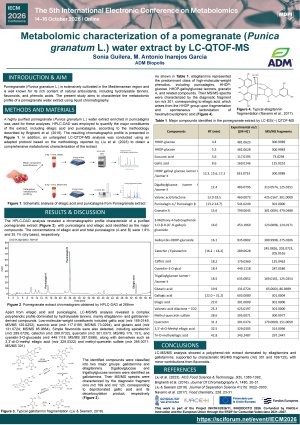
LC-MS/MS analysis revealed a complex polyphenolic profile dominated by hydrolysable tannins, mainly ellagitannin- and gallotannin-derived compounds. Low-molecular-weight constituents included gallic acid (m/z 169.0149; MS/MS 125.0252), succinic acid (m/z 117.0195; MS/MS 73.0294), and glutaric acid (m/z 131.0724; MS/MS 85.0664).
The high-mass fraction was characterized by multiple tannins, including digalloylglucose isomers (m/z 483.0795), galloyl-HHDP-hexosides (m/z 633.0751/633.0733; MS/MS m/z 301, 463), trigalloylglucose isomers (m/z 635.0852; MS/MS 483, 465, 301), punicalagins α/β (m/z 541.0288; MS/MS 301, 275, 249), valoneic acid dilactone derivatives (m/z 425.0176), granatin A (m/z 799.0645), and galloyl-bis-HHDP-glucoside (m/z 935.0802), all showing fragmentation patterns consistent with sequential loss of galloyl and Hexahydroxydiphenoyl (HHDP) groups.
Simple flavonoids were also detected, including epicatechin (m/z 289.0729), catechin (m/z 289.0732), quercetin (m/z 301.0373; MS/MS 179, 151), and cyanidin-3-O-glucoside (m/z 449.1118; MS/MS 287.0586), along with derivatives such as 3,3′-di-O-methyl ellagic acid (m/z 329.0322) and methyl-quercetin sulfate (m/z 395.0071; MS/MS 301).
Overall, the MS/MS data confirmed that the sample is highly enriched in ellagitannin and gallotannin-type polyphenols, characterized by characteristic fragment ions at m/z 301 (ellagic acid) and m/z 169/125 (galloyl units), together with flavan-3-ols and flavonols, supporting fingerprint.
Conclusions
LC-MS/MS analysis showed a polyphenol-rich extract dominated by ellagitannins and gallotannins, supported by characteristic MS/MS fragments (m/z 301 and 169/125), with minor contributions from flavonoids.
Keywords
pomegranate water extract
ellagic acid
hydrolysable tannins
liquid chromatography
Q-TOF.
Poster
Sciforum-191046.pdf
Metabolomic Signatures of Parental Obesity in Childhood Obesity
Decoding NAFLD Through Microbiome-Associated Metabolomics and Metabolic Phenotypic Expression