Event submissions
Published
This submission belongs to the session S4. Clinical Metabolomics and Drug Metabolism of the event The 5th International Electronic Conference on Metabolomics
Published date
09 Oct, 2026
Academic Editor
'%3e%3cpath%20d='M12.6657%2010.9104C12.4185%2010.325%2012.0599%209.79327%2011.6097%209.34482C11.1609%208.89508%2010.6293%208.5365%2010.0442%208.28888C10.0389%208.28626%2010.0337%208.28495%2010.0285%208.28233C10.8446%207.69279%2011.3752%206.73249%2011.3752%205.64904C11.3752%203.8542%209.92103%202.39999%208.1262%202.39999C6.33136%202.39999%204.87715%203.8542%204.87715%205.64904C4.87715%206.73249%205.40774%207.69279%206.22393%208.28364C6.21869%208.28626%206.21345%208.28757%206.20821%208.29019C5.62129%208.5378%205.09463%208.89284%204.64265%209.34613C4.1929%209.79493%203.83432%2010.3266%203.58671%2010.9117C3.34345%2011.4845%203.21226%2012.0987%203.20023%2012.7209C3.19988%2012.7349%203.20233%2012.7488%203.20744%2012.7619C3.21255%2012.7749%203.22022%2012.7867%203.22998%2012.7968C3.23975%2012.8068%203.25142%2012.8147%203.26431%2012.8202C3.2772%2012.8256%203.29105%2012.8284%203.30504%2012.8284H4.09109C4.14874%2012.8284%204.19459%2012.7825%204.1959%2012.7262C4.2221%2011.7148%204.62823%2010.7676%205.34617%2010.0497C6.08899%209.30683%207.0755%208.89808%208.1262%208.89808C9.17689%208.89808%2010.1634%209.30683%2010.9062%2010.0497C11.6242%2010.7676%2012.0303%2011.7148%2012.0565%2012.7262C12.0578%2012.7838%2012.1037%2012.8284%2012.1613%2012.8284H12.9474C12.9613%2012.8284%2012.9752%2012.8256%2012.9881%2012.8202C13.001%2012.8147%2013.0126%2012.8068%2013.0224%2012.7968C13.0322%2012.7867%2013.0398%2012.7749%2013.0449%2012.7619C13.0501%2012.7488%2013.0525%2012.7349%2013.0522%2012.7209C13.0391%2012.0947%2012.9094%2011.4855%2012.6657%2010.9104ZM8.1262%207.9024C7.52486%207.9024%206.9589%207.6679%206.53312%207.24211C6.10733%206.81633%205.87283%206.25037%205.87283%205.64904C5.87283%205.0477%206.10733%204.48174%206.53312%204.05596C6.9589%203.63018%207.52486%203.39567%208.1262%203.39567C8.72753%203.39567%209.29349%203.63018%209.71927%204.05596C10.1451%204.48174%2010.3796%205.0477%2010.3796%205.64904C10.3796%206.25037%2010.1451%206.81633%209.71927%207.24211C9.29349%207.6679%208.72753%207.9024%208.1262%207.9024Z'%20fill='%235D1EE1'/%3e%3c/g%3e%3c/svg%3e) Yunping Qiu
Yunping QiuCitation
Shreshta Vidhya, Adhiyaman Muniraj, Raja Ganesan, Decoding NAFLD Through Microbiome-Associated Metabolomics and Metabolic Phenotypic Expression, in Proceedings of The 5th International Electronic Conference on Metabolomics, 14 October–16 October 2026, MDPI: Basel, Switzerland
Share
Email
Facebook
Twitter
LinkedIn
Decoding NAFLD Through Microbiome-Associated Metabolomics and Metabolic Phenotypic Expression
'%3e%3cpath%20d='M12.6647%2010.9104C12.4176%2010.325%2012.0589%209.7933%2011.6088%209.34485C11.16%208.89511%2010.6283%208.53653%2010.0432%208.28891C10.038%208.28629%2010.0327%208.28498%2010.0275%208.28236C10.8437%207.69282%2011.3743%206.73252%2011.3743%205.64907C11.3743%203.85423%209.92005%202.40002%208.12522%202.40002C6.33038%202.40002%204.87618%203.85423%204.87618%205.64907C4.87618%206.73252%205.40677%207.69282%206.22296%208.28367C6.21772%208.28629%206.21248%208.2876%206.20724%208.29022C5.62031%208.53783%205.09365%208.89287%204.64167%209.34616C4.19192%209.79496%203.83334%2010.3266%203.58573%2010.9117C3.34247%2011.4846%203.21128%2012.0987%203.19925%2012.721C3.1989%2012.735%203.20135%2012.7489%203.20646%2012.7619C3.21157%2012.7749%203.21924%2012.7868%203.22901%2012.7968C3.23877%2012.8068%203.25045%2012.8148%203.26334%2012.8202C3.27623%2012.8256%203.29007%2012.8284%203.30406%2012.8284H4.09012C4.14776%2012.8284%204.19362%2012.7825%204.19493%2012.7262C4.22113%2011.7148%204.62726%2010.7676%205.34519%2010.0497C6.08802%209.30686%207.07452%208.89811%208.12522%208.89811C9.17592%208.89811%2010.1624%209.30686%2010.9052%2010.0497C11.6232%2010.7676%2012.0293%2011.7148%2012.0555%2012.7262C12.0568%2012.7839%2012.1027%2012.8284%2012.1603%2012.8284H12.9464C12.9604%2012.8284%2012.9742%2012.8256%2012.9871%2012.8202C13%2012.8148%2013.0117%2012.8068%2013.0214%2012.7968C13.0312%2012.7868%2013.0389%2012.7749%2013.044%2012.7619C13.0491%2012.7489%2013.0515%2012.735%2013.0512%2012.721C13.0381%2012.0947%2012.9084%2011.4856%2012.6647%2010.9104ZM8.12522%207.90243C7.52388%207.90243%206.95792%207.66793%206.53214%207.24215C6.10636%206.81636%205.87185%206.2504%205.87185%205.64907C5.87185%205.04773%206.10636%204.48177%206.53214%204.05599C6.95792%203.63021%207.52388%203.3957%208.12522%203.3957C8.72655%203.3957%209.29252%203.63021%209.7183%204.05599C10.1441%204.48177%2010.3786%205.04773%2010.3786%205.64907C10.3786%206.2504%2010.1441%206.81636%209.7183%207.24215C9.29252%207.66793%208.72655%207.90243%208.12522%207.90243Z'%20fill='%235D1EE1'/%3e%3c/g%3e%3c/svg%3e)
Shreshta Vidhya 1
Adhiyaman Muniraj 1

Raja Ganesan 1
1. Department of Biotechnology, SRM Institute of Science and Technology, Chengalpattu, 603 203, India
Abstract
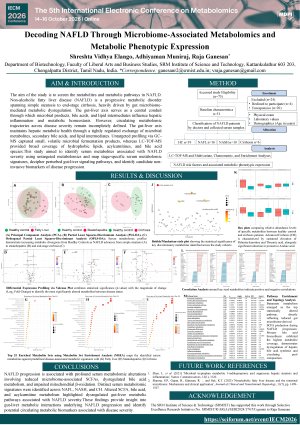
Background: Non-alcoholic fatty liver disease (NAFLD) is a progressive metabolic liver disorder strongly associated with gut microbiome-associated metabolic dysfunction. This study aimed to identify serum metabolomic signatures associated with NAFLD severity using untargeted metabolomics.
Methods: Serum samples were collected from healthy controls (HC, n = 19), non-alcoholic fatty liver (NAFL, n = 16), non-alcoholic steatohepatitis (NASH, n = 10), and cirrhosis patients (CH, n = 6). Untargeted metabolomic profiling was performed using gas chromatography-mass spectrometry (GC-MS) and liquid chromatography-time-of-flight mass spectrometry (LC-TOF-MS). Multivariate chemometric and pathway enrichment analyses were conducted to identify disease-associated metabolic alterations.
Results: A total of 105 metabolites were identified across all study groups. Distinct metabolic profiles were observed among HC, NAFL, NASH, and CH cohorts. Short-chain fatty acids (SCFAs), including acetate, butyrate, and propionate, were significantly reduced in NAFLD patients, whereas cholic acid, palmitoylcarnitine, and L-carnitine levels were elevated in advanced disease stages. Pathway analysis revealed perturbations in butanoate metabolism, primary bile acid biosynthesis, fatty acid degradation, and energy metabolism pathways. Multivariate analyses demonstrated clear metabolic segregation among disease groups.
Conclusions: NAFLD progression is associated with profound serum metabolomic alterations involving reduced microbiome-associated SCFAs, dysregulated bile acid metabolism, and impaired mitochondrial β-oxidation. These findings provide insight into gut-liver metabolic interactions underlying NAFLD progression and identify potential circulating metabolic biomarkers associated with disease severity.
Significance: Distinct serum metabolomic signatures were identified across NAFL, NASH, and CH. Altered SCFA, bile acid, and acylcarnitine metabolism highlighted dysregulated gut-liver metabolic pathways associated with NAFLD severity.
Keywords
NAFLD
metabolomics
NAFL
NASH
cirrhosis
untargeted metabolic activity
Poster
5 IECM Metabolomics conference POSTER .pdf
Metabolomic characterization of a pomegranate (Punica granatum L.) water extract by LC-QTOF-MS
The effect of antibiotics on the metabolism of nosocomial MDR strains of Klebsiella pneumoniae: exemplified by phenyllactic acid. In vitro experiment.