Event submissions
Published
This submission belongs to the session S4. Clinical Metabolomics and Drug Metabolism of the event The 5th International Electronic Conference on Metabolomics
Published date
09 Oct, 2026
Academic Editor
'%3e%3cpath%20d='M12.6657%2010.9104C12.4185%2010.325%2012.0599%209.79327%2011.6097%209.34482C11.1609%208.89508%2010.6293%208.5365%2010.0442%208.28888C10.0389%208.28626%2010.0337%208.28495%2010.0285%208.28233C10.8446%207.69279%2011.3752%206.73249%2011.3752%205.64904C11.3752%203.8542%209.92103%202.39999%208.1262%202.39999C6.33136%202.39999%204.87715%203.8542%204.87715%205.64904C4.87715%206.73249%205.40774%207.69279%206.22393%208.28364C6.21869%208.28626%206.21345%208.28757%206.20821%208.29019C5.62129%208.5378%205.09463%208.89284%204.64265%209.34613C4.1929%209.79493%203.83432%2010.3266%203.58671%2010.9117C3.34345%2011.4845%203.21226%2012.0987%203.20023%2012.7209C3.19988%2012.7349%203.20233%2012.7488%203.20744%2012.7619C3.21255%2012.7749%203.22022%2012.7867%203.22998%2012.7968C3.23975%2012.8068%203.25142%2012.8147%203.26431%2012.8202C3.2772%2012.8256%203.29105%2012.8284%203.30504%2012.8284H4.09109C4.14874%2012.8284%204.19459%2012.7825%204.1959%2012.7262C4.2221%2011.7148%204.62823%2010.7676%205.34617%2010.0497C6.08899%209.30683%207.0755%208.89808%208.1262%208.89808C9.17689%208.89808%2010.1634%209.30683%2010.9062%2010.0497C11.6242%2010.7676%2012.0303%2011.7148%2012.0565%2012.7262C12.0578%2012.7838%2012.1037%2012.8284%2012.1613%2012.8284H12.9474C12.9613%2012.8284%2012.9752%2012.8256%2012.9881%2012.8202C13.001%2012.8147%2013.0126%2012.8068%2013.0224%2012.7968C13.0322%2012.7867%2013.0398%2012.7749%2013.0449%2012.7619C13.0501%2012.7488%2013.0525%2012.7349%2013.0522%2012.7209C13.0391%2012.0947%2012.9094%2011.4855%2012.6657%2010.9104ZM8.1262%207.9024C7.52486%207.9024%206.9589%207.6679%206.53312%207.24211C6.10733%206.81633%205.87283%206.25037%205.87283%205.64904C5.87283%205.0477%206.10733%204.48174%206.53312%204.05596C6.9589%203.63018%207.52486%203.39567%208.1262%203.39567C8.72753%203.39567%209.29349%203.63018%209.71927%204.05596C10.1451%204.48174%2010.3796%205.0477%2010.3796%205.64904C10.3796%206.25037%2010.1451%206.81633%209.71927%207.24211C9.29349%207.6679%208.72753%207.9024%208.1262%207.9024Z'%20fill='%235D1EE1'/%3e%3c/g%3e%3c/svg%3e) Yunping Qiu
Yunping QiuCitation
Maria Getsina, Ekaterina Sorokina, Ekaterina Chernevskaya, The effect of antibiotics on the metabolism of nosocomial MDR strains of Klebsiella pneumoniae: exemplified by phenyllactic acid. In vitro experiment., in Proceedings of The 5th International Electronic Conference on Metabolomics, 14 October–16 October 2026, MDPI: Basel, Switzerland
Share
Email
Facebook
Twitter
LinkedIn
The effect of antibiotics on the metabolism of nosocomial MDR strains of Klebsiella pneumoniae: exemplified by phenyllactic acid. In vitro experiment.
'%3e%3cpath%20d='M12.6647%2010.9104C12.4176%2010.325%2012.0589%209.7933%2011.6088%209.34485C11.16%208.89511%2010.6283%208.53653%2010.0432%208.28891C10.038%208.28629%2010.0327%208.28498%2010.0275%208.28236C10.8437%207.69282%2011.3743%206.73252%2011.3743%205.64907C11.3743%203.85423%209.92005%202.40002%208.12522%202.40002C6.33038%202.40002%204.87618%203.85423%204.87618%205.64907C4.87618%206.73252%205.40677%207.69282%206.22296%208.28367C6.21772%208.28629%206.21248%208.2876%206.20724%208.29022C5.62031%208.53783%205.09365%208.89287%204.64167%209.34616C4.19192%209.79496%203.83334%2010.3266%203.58573%2010.9117C3.34247%2011.4846%203.21128%2012.0987%203.19925%2012.721C3.1989%2012.735%203.20135%2012.7489%203.20646%2012.7619C3.21157%2012.7749%203.21924%2012.7868%203.22901%2012.7968C3.23877%2012.8068%203.25045%2012.8148%203.26334%2012.8202C3.27623%2012.8256%203.29007%2012.8284%203.30406%2012.8284H4.09012C4.14776%2012.8284%204.19362%2012.7825%204.19493%2012.7262C4.22113%2011.7148%204.62726%2010.7676%205.34519%2010.0497C6.08802%209.30686%207.07452%208.89811%208.12522%208.89811C9.17592%208.89811%2010.1624%209.30686%2010.9052%2010.0497C11.6232%2010.7676%2012.0293%2011.7148%2012.0555%2012.7262C12.0568%2012.7839%2012.1027%2012.8284%2012.1603%2012.8284H12.9464C12.9604%2012.8284%2012.9742%2012.8256%2012.9871%2012.8202C13%2012.8148%2013.0117%2012.8068%2013.0214%2012.7968C13.0312%2012.7868%2013.0389%2012.7749%2013.044%2012.7619C13.0491%2012.7489%2013.0515%2012.735%2013.0512%2012.721C13.0381%2012.0947%2012.9084%2011.4856%2012.6647%2010.9104ZM8.12522%207.90243C7.52388%207.90243%206.95792%207.66793%206.53214%207.24215C6.10636%206.81636%205.87185%206.2504%205.87185%205.64907C5.87185%205.04773%206.10636%204.48177%206.53214%204.05599C6.95792%203.63021%207.52388%203.3957%208.12522%203.3957C8.72655%203.3957%209.29252%203.63021%209.7183%204.05599C10.1441%204.48177%2010.3786%205.04773%2010.3786%205.64907C10.3786%206.2504%2010.1441%206.81636%209.7183%207.24215C9.29252%207.66793%208.72655%207.90243%208.12522%207.90243Z'%20fill='%235D1EE1'/%3e%3c/g%3e%3c/svg%3e)
Maria Getsina 1
Ekaterina Sorokina 1
Ekaterina Chernevskaya 1
1. Federal Research and Clinical Center of Intensive Care Medicine and Rehabilitology, 25-2 Petrovka Str., Moscow, 107031, Russia
Abstract
Introduction
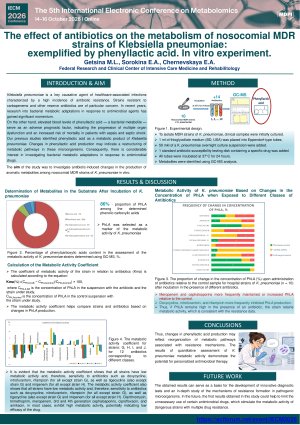
High levels of phenyllactic acid, a bacterial metabolite, in the blood are a poor prognostic factor, indicating the progression of multiple organ dysfunction and an increased risk of mortality in patients with sepsis and septic shock. Klebsiella pneumonia (K. pneumoniae) is a key pathogen in hospital-acquired infections that lead to multiple organ failure and are characterized by a high incidence of antibiotic resistance. Therefore, there is growing interest in the metabolic adaptations of bacteria in response to antimicrobial agents.
Methods
To isolate the MDR strain of K. pneumoniae, a primary culture of clinical material was performed. Eppendorf tubes were placed with 1 ml of thioglycollate medium, 50 µl of a 24-hour K. pneumoniae culture suspension, a disk soaked in antibiotic solution, and incubated at 37°C for 24 hours. The phenyllactic acid concentration in the resulting suspension was then determined by gas chromatography-mass spectrometry.
Results
The experiment examined the effects of 14 broad-spectrum antibiotics on the metabolic activity of nosocomial MDR K. pneumoniae strains. Our results demonstrate the heterogeneous response of K. pneumoniae to antimicrobials, highlighting that antibiotic exposure does not always suppress bacterial metabolism. Three clear patterns were identified: strong metabolic suppression, metabolic stimulation (a significant increase in metabolism with certain antibiotics), and intermediate effects (when metabolism is not altered by antibiotics). The obtained results are in good agreement with the classical method of assessing the sensitivity of K. pneumoniae strains to antibiotics.
Conclusions
Thus, changes in phenyllactic acid production may reflect reorganization of metabolic pathways associated with resistance mechanisms. The results of quantitative assessment of K. pneumoniae metabolic activity demonstrate the potential for personalized antimicrobial therapy. Continued research in this area will open opportunities for optimizing clinical selection of antimicrobial agents based on the metabolic characteristics of bacterial strains.
Keywords
Phenyllactic acid
Klebsiella pneumoniae
aromatic microbial metabolites
antibiotics
GC-MS
Poster
Getsina Poster 5IECM 2026 .pdf
Decoding NAFLD Through Microbiome-Associated Metabolomics and Metabolic Phenotypic Expression
Leveraging Artificial Intelligence-Driven Metabolomics to Discover Novel Anti-Cancer Therapies