Event submissions
Published
This submission belongs to the session S3. Advanced Data Analysis and Integration in Metabolomics of the event The 5th International Electronic Conference on Metabolomics
Published date
09 Oct, 2026
Academic Editor
'%3e%3cpath%20d='M12.6657%2010.9104C12.4185%2010.325%2012.0599%209.79327%2011.6097%209.34482C11.1609%208.89508%2010.6293%208.5365%2010.0442%208.28888C10.0389%208.28626%2010.0337%208.28495%2010.0285%208.28233C10.8446%207.69279%2011.3752%206.73249%2011.3752%205.64904C11.3752%203.8542%209.92103%202.39999%208.1262%202.39999C6.33136%202.39999%204.87715%203.8542%204.87715%205.64904C4.87715%206.73249%205.40774%207.69279%206.22393%208.28364C6.21869%208.28626%206.21345%208.28757%206.20821%208.29019C5.62129%208.5378%205.09463%208.89284%204.64265%209.34613C4.1929%209.79493%203.83432%2010.3266%203.58671%2010.9117C3.34345%2011.4845%203.21226%2012.0987%203.20023%2012.7209C3.19988%2012.7349%203.20233%2012.7488%203.20744%2012.7619C3.21255%2012.7749%203.22022%2012.7867%203.22998%2012.7968C3.23975%2012.8068%203.25142%2012.8147%203.26431%2012.8202C3.2772%2012.8256%203.29105%2012.8284%203.30504%2012.8284H4.09109C4.14874%2012.8284%204.19459%2012.7825%204.1959%2012.7262C4.2221%2011.7148%204.62823%2010.7676%205.34617%2010.0497C6.08899%209.30683%207.0755%208.89808%208.1262%208.89808C9.17689%208.89808%2010.1634%209.30683%2010.9062%2010.0497C11.6242%2010.7676%2012.0303%2011.7148%2012.0565%2012.7262C12.0578%2012.7838%2012.1037%2012.8284%2012.1613%2012.8284H12.9474C12.9613%2012.8284%2012.9752%2012.8256%2012.9881%2012.8202C13.001%2012.8147%2013.0126%2012.8068%2013.0224%2012.7968C13.0322%2012.7867%2013.0398%2012.7749%2013.0449%2012.7619C13.0501%2012.7488%2013.0525%2012.7349%2013.0522%2012.7209C13.0391%2012.0947%2012.9094%2011.4855%2012.6657%2010.9104ZM8.1262%207.9024C7.52486%207.9024%206.9589%207.6679%206.53312%207.24211C6.10733%206.81633%205.87283%206.25037%205.87283%205.64904C5.87283%205.0477%206.10733%204.48174%206.53312%204.05596C6.9589%203.63018%207.52486%203.39567%208.1262%203.39567C8.72753%203.39567%209.29349%203.63018%209.71927%204.05596C10.1451%204.48174%2010.3796%205.0477%2010.3796%205.64904C10.3796%206.25037%2010.1451%206.81633%209.71927%207.24211C9.29349%207.6679%208.72753%207.9024%208.1262%207.9024Z'%20fill='%235D1EE1'/%3e%3c/g%3e%3c/svg%3e) Reza Salek
Reza SalekCitation
Theodoros Karalis, Aurelien Tripp, Agustina Salis Torres, Manas Kohli, Rachel Alcraft, Dandan Zhang, George Poulogiannis, Leveraging Artificial Intelligence-Driven Metabolomics to Discover Novel Anti-Cancer Therapies, in Proceedings of The 5th International Electronic Conference on Metabolomics, 14 October–16 October 2026, MDPI: Basel, Switzerland
Share
Email
Facebook
Twitter
LinkedIn
Leveraging Artificial Intelligence-Driven Metabolomics to Discover Novel Anti-Cancer Therapies
'%3e%3cpath%20d='M12.6647%2010.9104C12.4176%2010.325%2012.0589%209.7933%2011.6088%209.34485C11.16%208.89511%2010.6283%208.53653%2010.0432%208.28891C10.038%208.28629%2010.0327%208.28498%2010.0275%208.28236C10.8437%207.69282%2011.3743%206.73252%2011.3743%205.64907C11.3743%203.85423%209.92005%202.40002%208.12522%202.40002C6.33038%202.40002%204.87618%203.85423%204.87618%205.64907C4.87618%206.73252%205.40677%207.69282%206.22296%208.28367C6.21772%208.28629%206.21248%208.2876%206.20724%208.29022C5.62031%208.53783%205.09365%208.89287%204.64167%209.34616C4.19192%209.79496%203.83334%2010.3266%203.58573%2010.9117C3.34247%2011.4846%203.21128%2012.0987%203.19925%2012.721C3.1989%2012.735%203.20135%2012.7489%203.20646%2012.7619C3.21157%2012.7749%203.21924%2012.7868%203.22901%2012.7968C3.23877%2012.8068%203.25045%2012.8148%203.26334%2012.8202C3.27623%2012.8256%203.29007%2012.8284%203.30406%2012.8284H4.09012C4.14776%2012.8284%204.19362%2012.7825%204.19493%2012.7262C4.22113%2011.7148%204.62726%2010.7676%205.34519%2010.0497C6.08802%209.30686%207.07452%208.89811%208.12522%208.89811C9.17592%208.89811%2010.1624%209.30686%2010.9052%2010.0497C11.6232%2010.7676%2012.0293%2011.7148%2012.0555%2012.7262C12.0568%2012.7839%2012.1027%2012.8284%2012.1603%2012.8284H12.9464C12.9604%2012.8284%2012.9742%2012.8256%2012.9871%2012.8202C13%2012.8148%2013.0117%2012.8068%2013.0214%2012.7968C13.0312%2012.7868%2013.0389%2012.7749%2013.044%2012.7619C13.0491%2012.7489%2013.0515%2012.735%2013.0512%2012.721C13.0381%2012.0947%2012.9084%2011.4856%2012.6647%2010.9104ZM8.12522%207.90243C7.52388%207.90243%206.95792%207.66793%206.53214%207.24215C6.10636%206.81636%205.87185%206.2504%205.87185%205.64907C5.87185%205.04773%206.10636%204.48177%206.53214%204.05599C6.95792%203.63021%207.52388%203.3957%208.12522%203.3957C8.72655%203.3957%209.29252%203.63021%209.7183%204.05599C10.1441%204.48177%2010.3786%205.04773%2010.3786%205.64907C10.3786%206.2504%2010.1441%206.81636%209.7183%207.24215C9.29252%207.66793%208.72655%207.90243%208.12522%207.90243Z'%20fill='%235D1EE1'/%3e%3c/g%3e%3c/svg%3e)
Theodoros Karalis 1
Aurelien Tripp 1
Agustina Salis Torres 1
Manas Kohli 1
Rachel Alcraft 1
Dandan Zhang 2
George Poulogiannis 1
1. Signalling and Cancer Metabolism Laboratory, Division of Cell and Molecular Biology, The Institute of Cancer Research; 237 Fulham Road, London, SW3 6JB, UK
2. Department of Bioengineering, Translation and Innovation Hub, Imperial College, London, W12 0BZ, UK
Abstract
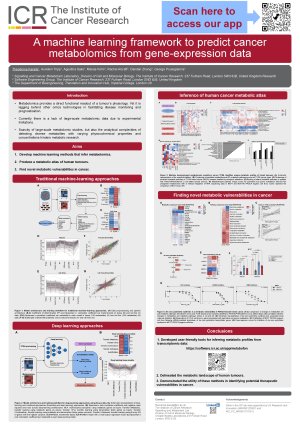
Recent developments in omics platforms have generated large datasets that offer unprecedented opportunities for data mining and discovery. Among omics, metabolomics yields an immediate, functional readout of tumor biology and cellular state. Despite that, its integration into oncological research continues to fall behind genomics and transcriptomics. This delay is largely driven by a scarcity of extensive patient cohorts, compounded by technical hurdles in measuring diverse metabolites across wide dynamic ranges. For example, distinct metabolites require unique extraction protocols, whereas metabolomics cannot be run on archived tissues, since flash freezing is required, and paraffin-embedding is the most common method of tissue storage. Consequently, expanding access to large metabolomic repositories remains a critical priority for the field.
To bridge this data gap, we established a machine learning framework incorporating statistical models, deep learning architectures, and generative AI. Our strategy relies on two main pillars: (1) synthesizing realistic metabolomic profiles and (2) predicting metabolic abundance directly from transcriptomic signatures. Deploying this pipeline allowed us to identify patterns of tumor metabolic reprogramming associated with patient survival, and pinpoint distinct metabolic vulnerabilities across specific cancer subtypes. Crucially, these computationally prioritized targets were experimentally verified in vitro using targeted pharmacological and genetic perturbation assays.
In summary, this work presents a suite of computational tools that resolve longstanding bottlenecks in metabolomics, offering actionable pathways toward target discovery in oncology.
Keywords
artificial intelligence
metabolism
cancer
therapy
Poster
IECM_2026_conference_poster_A0_TK.pdf
The effect of antibiotics on the metabolism of nosocomial MDR strains of Klebsiella pneumoniae: exemplified by phenyllactic acid. In vitro experiment.
Fluorine-Tagging Strategies for Amino Acid Detection by Low-Field ¹⁹F NMR Spectroscopy