Event submissions
Published
This submission belongs to the session S1. Lipid and Nutrition Metabolomics of the event The 5th International Electronic Conference on Metabolomics
Published date
12 Oct, 2026
Academic Editor
'%3e%3cpath%20d='M12.6657%2010.9104C12.4185%2010.325%2012.0599%209.79327%2011.6097%209.34482C11.1609%208.89508%2010.6293%208.5365%2010.0442%208.28888C10.0389%208.28626%2010.0337%208.28495%2010.0285%208.28233C10.8446%207.69279%2011.3752%206.73249%2011.3752%205.64904C11.3752%203.8542%209.92103%202.39999%208.1262%202.39999C6.33136%202.39999%204.87715%203.8542%204.87715%205.64904C4.87715%206.73249%205.40774%207.69279%206.22393%208.28364C6.21869%208.28626%206.21345%208.28757%206.20821%208.29019C5.62129%208.5378%205.09463%208.89284%204.64265%209.34613C4.1929%209.79493%203.83432%2010.3266%203.58671%2010.9117C3.34345%2011.4845%203.21226%2012.0987%203.20023%2012.7209C3.19988%2012.7349%203.20233%2012.7488%203.20744%2012.7619C3.21255%2012.7749%203.22022%2012.7867%203.22998%2012.7968C3.23975%2012.8068%203.25142%2012.8147%203.26431%2012.8202C3.2772%2012.8256%203.29105%2012.8284%203.30504%2012.8284H4.09109C4.14874%2012.8284%204.19459%2012.7825%204.1959%2012.7262C4.2221%2011.7148%204.62823%2010.7676%205.34617%2010.0497C6.08899%209.30683%207.0755%208.89808%208.1262%208.89808C9.17689%208.89808%2010.1634%209.30683%2010.9062%2010.0497C11.6242%2010.7676%2012.0303%2011.7148%2012.0565%2012.7262C12.0578%2012.7838%2012.1037%2012.8284%2012.1613%2012.8284H12.9474C12.9613%2012.8284%2012.9752%2012.8256%2012.9881%2012.8202C13.001%2012.8147%2013.0126%2012.8068%2013.0224%2012.7968C13.0322%2012.7867%2013.0398%2012.7749%2013.0449%2012.7619C13.0501%2012.7488%2013.0525%2012.7349%2013.0522%2012.7209C13.0391%2012.0947%2012.9094%2011.4855%2012.6657%2010.9104ZM8.1262%207.9024C7.52486%207.9024%206.9589%207.6679%206.53312%207.24211C6.10733%206.81633%205.87283%206.25037%205.87283%205.64904C5.87283%205.0477%206.10733%204.48174%206.53312%204.05596C6.9589%203.63018%207.52486%203.39567%208.1262%203.39567C8.72753%203.39567%209.29349%203.63018%209.71927%204.05596C10.1451%204.48174%2010.3796%205.0477%2010.3796%205.64904C10.3796%206.25037%2010.1451%206.81633%209.71927%207.24211C9.29349%207.6679%208.72753%207.9024%208.1262%207.9024Z'%20fill='%235D1EE1'/%3e%3c/g%3e%3c/svg%3e) Giuseppe Paglia
Giuseppe PagliaCitation
Parham Jalali, Navid Moravej, Aida Mohammadi, Alireza Shirin, Javad Mehrabani, Hadi Nobari, Skeletal Muscle Metabolomics and Targeted Lipidomics of the Gluteus Maximus Following Acute Eccentric-Overload Exercise: An Exploratory Pilot Study, in Proceedings of The 5th International Electronic Conference on Metabolomics, 14 October–16 October 2026, MDPI: Basel, Switzerland
Share
Email
Facebook
Twitter
LinkedIn
Skeletal Muscle Metabolomics and Targeted Lipidomics of the Gluteus Maximus Following Acute Eccentric-Overload Exercise: An Exploratory Pilot Study

Parham Jalali 1
'%3e%3cpath%20d='M12.6647%2010.9104C12.4176%2010.325%2012.0589%209.7933%2011.6088%209.34485C11.16%208.89511%2010.6283%208.53653%2010.0432%208.28891C10.038%208.28629%2010.0327%208.28498%2010.0275%208.28236C10.8437%207.69282%2011.3743%206.73252%2011.3743%205.64907C11.3743%203.85423%209.92005%202.40002%208.12522%202.40002C6.33038%202.40002%204.87618%203.85423%204.87618%205.64907C4.87618%206.73252%205.40677%207.69282%206.22296%208.28367C6.21772%208.28629%206.21248%208.2876%206.20724%208.29022C5.62031%208.53783%205.09365%208.89287%204.64167%209.34616C4.19192%209.79496%203.83334%2010.3266%203.58573%2010.9117C3.34247%2011.4846%203.21128%2012.0987%203.19925%2012.721C3.1989%2012.735%203.20135%2012.7489%203.20646%2012.7619C3.21157%2012.7749%203.21924%2012.7868%203.22901%2012.7968C3.23877%2012.8068%203.25045%2012.8148%203.26334%2012.8202C3.27623%2012.8256%203.29007%2012.8284%203.30406%2012.8284H4.09012C4.14776%2012.8284%204.19362%2012.7825%204.19493%2012.7262C4.22113%2011.7148%204.62726%2010.7676%205.34519%2010.0497C6.08802%209.30686%207.07452%208.89811%208.12522%208.89811C9.17592%208.89811%2010.1624%209.30686%2010.9052%2010.0497C11.6232%2010.7676%2012.0293%2011.7148%2012.0555%2012.7262C12.0568%2012.7839%2012.1027%2012.8284%2012.1603%2012.8284H12.9464C12.9604%2012.8284%2012.9742%2012.8256%2012.9871%2012.8202C13%2012.8148%2013.0117%2012.8068%2013.0214%2012.7968C13.0312%2012.7868%2013.0389%2012.7749%2013.044%2012.7619C13.0491%2012.7489%2013.0515%2012.735%2013.0512%2012.721C13.0381%2012.0947%2012.9084%2011.4856%2012.6647%2010.9104ZM8.12522%207.90243C7.52388%207.90243%206.95792%207.66793%206.53214%207.24215C6.10636%206.81636%205.87185%206.2504%205.87185%205.64907C5.87185%205.04773%206.10636%204.48177%206.53214%204.05599C6.95792%203.63021%207.52388%203.3957%208.12522%203.3957C8.72655%203.3957%209.29252%203.63021%209.7183%204.05599C10.1441%204.48177%2010.3786%205.04773%2010.3786%205.64907C10.3786%206.2504%2010.1441%206.81636%209.7183%207.24215C9.29252%207.66793%208.72655%207.90243%208.12522%207.90243Z'%20fill='%235D1EE1'/%3e%3c/g%3e%3c/svg%3e)
Navid Moravej 2

Aida Mohammadi 3
Alireza Shirin 2

Javad Mehrabani 4

Hadi Nobari 5
1. Wellness Sport and Health Program, University of Bologna, Rimini, Italy
2. Independent Researcher, Santa Ana, CA, USA
3. Sport and Health Promotion Program, University of torvergata, Rome, Italy
4. Department of Exercise Physiology, University of Guilan, Rasht, Iran
5. LFE Research Group, Department of Health and Human Performance, Faculty of Physical Activity and Sport Science (INEF), Universidad Politécnica de Madrid, Madrid, Spain
Abstract
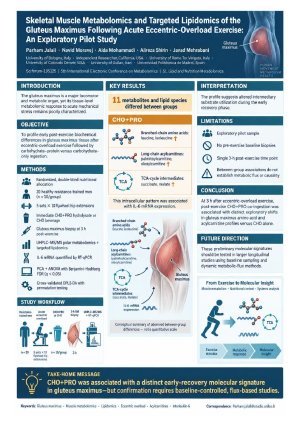
introduction: The gluteus maximus is a major locomotor and metabolic organ, yet characterization of its tissue-level metabolomic response to acute mechanical stress remains limited. This exploratory pilot study utilized integrated muscle metabolomics and targeted lipidomics to profile the acute post-exercise biochemical alterations in GM tissue following a single bout of eccentric-overload exercise with post-workout carbohydrate-protein versus carbohydrate-only ingestion.
Methods:In a randomized, double-blind nutritional allocation design, 20 healthy, resistance-trained men (n = 10/group) performed an acute EO session (5 sets of 10 flywheel hip extensions), immediately followed by either a carbohydrate-protein hydrolysate (CHO+PRO) or a carbohydrate-only (CHO) beverage. To capture early-phase metabolic and transcriptional responses, percutaneous muscle biopsies of the GM were obtained 3 hours post-exercise. Pre-exercise baseline biopsies were not obtained in this pilot study to minimize participant burden. Flash-frozen tissue specimens underwent polar metabolite and hydrophobic lipid extraction for UHPLC-MS/MS profiling. To minimize overfitting, unsupervised Principal Component Analysis (PCA) and univariate ANOVA with Benjamini-Hochberg FDR correction (q < 0.05) were utilized, supplemented by cross-validated OPLS-DA with permutation testing. Localized Interleukin-6 (IL-6) mRNA expression was quantified via RT-qPCR.
Results:Univariate and multivariate profiling identified significant alterations in 11 muscle metabolites and lipid species between groups. The CHO+PRO cohort exhibited a distinct accumulation of branched-chain amino acids (leucine and isoleucine), alongside elevated levels of specific long-chain acylcarnitines (palmitoylcarnitine and oleoylcarnitine) and tricarboxylic acid cycle intermediates (succinate and malate). This intracellular pattern was associated with IL-6 mRNA expression. These preliminary findings suggest altered intermediary substrate utilization within muscle tissue during the early recovery phase.
Conclusions: Acute post-exercise protein-carbohydrate co-ingestion was associated with distinct exploratory shifts in the acylcarnitine and amino acid profiles of the GM 3 hours following EO stress. Given the small sample size and absence of baseline metabolomic data, these findings should be interpreted cautiously. Nevertheless, they provide preliminary molecular signatures that may inform future dynamic metabolic flux-based studies.
Keywords
Gluteus maximus
Muscle metabolomics
Lipidomics
Eccentric overload
Acylcarnitines
Interleukin-6.
Poster
BAC43094-5EC2-4142-9B53-FCCF5C9C3E8D.pdf
Identification of Metabolic Marker Profile and Study on Metabolic Pathway Regulation in the Progression of Non-Alcoholic Steatohepatitis to Hepatocellular Carcinoma