Event submissions
EventsMOL2NET'16, Conference on Molecular, Biomed., Comput. & Network Science and Engineering, 2nd ed.
Published

This submission belongs to the session 02. CHEMBIOMOL-02: Chem. Biol. & Med. Chem. Workshop, Rostock, Germany-Bilbao, Spain-Galveston, Texas, USA, 2016 of the event MOL2NET'16, Conference on Molecular, Biomed., Comput. & Network Science and Engineering, 2nd ed.
Published date
12 Oct, 2016
Citation
Uxue Uria, Jose Luis Vicario, Efraim Reyes Martín, Luisa Carrillo Fernández, Ane Orue, The Role of Pyranones in Asymmetric Organocatalytic Cascade Reactions, in Proceedings of MOL2NET'16, Conference on Molecular, Biomed., Comput. & Network Science and Engineering, 2nd ed., 15 October–20 October 2022, MDPI: Basel, Switzerland, doi: 10.3390/mol2net-02-08014
Share
Email
Facebook
Twitter
LinkedIn
The Role of Pyranones in Asymmetric Organocatalytic Cascade Reactions
'%3e%3cpath%20d='M12.6647%2010.9104C12.4176%2010.325%2012.0589%209.7933%2011.6088%209.34485C11.16%208.89511%2010.6283%208.53653%2010.0432%208.28891C10.038%208.28629%2010.0327%208.28498%2010.0275%208.28236C10.8437%207.69282%2011.3743%206.73252%2011.3743%205.64907C11.3743%203.85423%209.92005%202.40002%208.12522%202.40002C6.33038%202.40002%204.87618%203.85423%204.87618%205.64907C4.87618%206.73252%205.40677%207.69282%206.22296%208.28367C6.21772%208.28629%206.21248%208.2876%206.20724%208.29022C5.62031%208.53783%205.09365%208.89287%204.64167%209.34616C4.19192%209.79496%203.83334%2010.3266%203.58573%2010.9117C3.34247%2011.4846%203.21128%2012.0987%203.19925%2012.721C3.1989%2012.735%203.20135%2012.7489%203.20646%2012.7619C3.21157%2012.7749%203.21924%2012.7868%203.22901%2012.7968C3.23877%2012.8068%203.25045%2012.8148%203.26334%2012.8202C3.27623%2012.8256%203.29007%2012.8284%203.30406%2012.8284H4.09012C4.14776%2012.8284%204.19362%2012.7825%204.19493%2012.7262C4.22113%2011.7148%204.62726%2010.7676%205.34519%2010.0497C6.08802%209.30686%207.07452%208.89811%208.12522%208.89811C9.17592%208.89811%2010.1624%209.30686%2010.9052%2010.0497C11.6232%2010.7676%2012.0293%2011.7148%2012.0555%2012.7262C12.0568%2012.7839%2012.1027%2012.8284%2012.1603%2012.8284H12.9464C12.9604%2012.8284%2012.9742%2012.8256%2012.9871%2012.8202C13%2012.8148%2013.0117%2012.8068%2013.0214%2012.7968C13.0312%2012.7868%2013.0389%2012.7749%2013.044%2012.7619C13.0491%2012.7489%2013.0515%2012.735%2013.0512%2012.721C13.0381%2012.0947%2012.9084%2011.4856%2012.6647%2010.9104ZM8.12522%207.90243C7.52388%207.90243%206.95792%207.66793%206.53214%207.24215C6.10636%206.81636%205.87185%206.2504%205.87185%205.64907C5.87185%205.04773%206.10636%204.48177%206.53214%204.05599C6.95792%203.63021%207.52388%203.3957%208.12522%203.3957C8.72655%203.3957%209.29252%203.63021%209.7183%204.05599C10.1441%204.48177%2010.3786%205.04773%2010.3786%205.64907C10.3786%206.2504%2010.1441%206.81636%209.7183%207.24215C9.29252%207.66793%208.72655%207.90243%208.12522%207.90243Z'%20fill='%235D1EE1'/%3e%3c/g%3e%3c/svg%3e)
Uxue Uria 1
Jose Luis Vicario 1
Efraim Reyes Martín 1
Luisa Carrillo Fernández 1
Ane Orue 1
1. Department of Organic Chemistry II, University of the Basque Country UPV/EHU, 48940, Bilbao, Spain.
Abstract
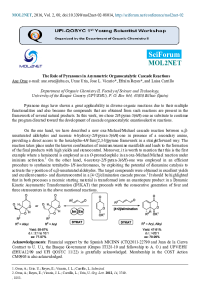
Pyranone rings have shown a great applicability in diverse organic reactions due to their multiple functionalities and also because the compounds that are obtained from such reactions are present in the framework of several natural products. In this work, we chose 2H-pyran-3(6H)-one as substrate to continue the program directed toward the development of cascade organocatalytic enantioselective reactions. On the one hand, we have described a new oxa-Michael/Michael cascade reaction between a,b-unsaturated aldehydes and racemic 6-hydroxy-2H-pyran-3(6H)-one in presence of a secondary amine, providing a direct access to the hexahydro-4H-furo[2,3-b]pyrane framework in a straightforward way. The reaction takes place under the known combination of iminium/enamine manifolds and leads to the formation of the final products with high yields and stereocontrol. Moreover, it is worth to mention that this is the first example where a hemiacetal is employed as an O-pronucleophile in an oxa-Michael/Michael reaction under iminium activation.1 On the other hand, 6-acetoxy-2H-pyran-3(6H)-one was employed in an efficient procedure to synthesize tetrahydro-1H-isochromanes, by exploiting the potential of dienamine catalysis to activate the g-position of a,b-unsaturated aldehydes. The target compounds were obtained in excellent yields and excellent enantio- and diastereocontrol in a [4+2]/elimination cascade process.2 It should be highlighted that in both processes a racemic starting material is transformed into an enantiopure product in a Dynamic Kinetic Asymmetric Transformation (DYKAT) that proceeds with the consecutive generation of four and three stereocenters in the above mentioned reactions.
Keywords
DYKAT Dynamic Kinetic Asymmetric Transformation
Pyranone
Michael cascade reaction
Poster
SL2. Ane Orue.pdf
The seasonality of upper respiratory tract infections and their relationship to asthma
Propargylic-Amines and Alcohols Through anti-Selective Mannich and Aldol Reactions