Event submissions
Published
This submission belongs to the session S1. Mathematical Physics of the event The 1st International Online Conference on Symmetry
Published date
15 Oct, 2026
Academic Editor
'%3e%3cpath%20d='M12.6657%2010.9104C12.4185%2010.325%2012.0599%209.79327%2011.6097%209.34482C11.1609%208.89508%2010.6293%208.5365%2010.0442%208.28888C10.0389%208.28626%2010.0337%208.28495%2010.0285%208.28233C10.8446%207.69279%2011.3752%206.73249%2011.3752%205.64904C11.3752%203.8542%209.92103%202.39999%208.1262%202.39999C6.33136%202.39999%204.87715%203.8542%204.87715%205.64904C4.87715%206.73249%205.40774%207.69279%206.22393%208.28364C6.21869%208.28626%206.21345%208.28757%206.20821%208.29019C5.62129%208.5378%205.09463%208.89284%204.64265%209.34613C4.1929%209.79493%203.83432%2010.3266%203.58671%2010.9117C3.34345%2011.4845%203.21226%2012.0987%203.20023%2012.7209C3.19988%2012.7349%203.20233%2012.7488%203.20744%2012.7619C3.21255%2012.7749%203.22022%2012.7867%203.22998%2012.7968C3.23975%2012.8068%203.25142%2012.8147%203.26431%2012.8202C3.2772%2012.8256%203.29105%2012.8284%203.30504%2012.8284H4.09109C4.14874%2012.8284%204.19459%2012.7825%204.1959%2012.7262C4.2221%2011.7148%204.62823%2010.7676%205.34617%2010.0497C6.08899%209.30683%207.0755%208.89808%208.1262%208.89808C9.17689%208.89808%2010.1634%209.30683%2010.9062%2010.0497C11.6242%2010.7676%2012.0303%2011.7148%2012.0565%2012.7262C12.0578%2012.7838%2012.1037%2012.8284%2012.1613%2012.8284H12.9474C12.9613%2012.8284%2012.9752%2012.8256%2012.9881%2012.8202C13.001%2012.8147%2013.0126%2012.8068%2013.0224%2012.7968C13.0322%2012.7867%2013.0398%2012.7749%2013.0449%2012.7619C13.0501%2012.7488%2013.0525%2012.7349%2013.0522%2012.7209C13.0391%2012.0947%2012.9094%2011.4855%2012.6657%2010.9104ZM8.1262%207.9024C7.52486%207.9024%206.9589%207.6679%206.53312%207.24211C6.10733%206.81633%205.87283%206.25037%205.87283%205.64904C5.87283%205.0477%206.10733%204.48174%206.53312%204.05596C6.9589%203.63018%207.52486%203.39567%208.1262%203.39567C8.72753%203.39567%209.29349%203.63018%209.71927%204.05596C10.1451%204.48174%2010.3796%205.0477%2010.3796%205.64904C10.3796%206.25037%2010.1451%206.81633%209.71927%207.24211C9.29349%207.6679%208.72753%207.9024%208.1262%207.9024Z'%20fill='%235D1EE1'/%3e%3c/g%3e%3c/svg%3e) Kazuharu Bamba
Kazuharu BambaCitation
Cleber Souza Correa, Thiago Braido Nogueira de Melo, Holonomic Resonances as Emergent Signatures of a Trigonometric Topological Mapping in the Extended Alpha Group Matrix, in Proceedings of The 1st International Online Conference on Symmetry, 20 October–22 October 2026, MDPI: Basel, Switzerland
Share
Email
Facebook
Twitter
LinkedIn
Holonomic Resonances as Emergent Signatures of a Trigonometric Topological Mapping in the Extended Alpha Group Matrix

Cleber Souza Correa 1
'%3e%3cpath%20d='M12.6647%2010.9104C12.4176%2010.325%2012.0589%209.7933%2011.6088%209.34485C11.16%208.89511%2010.6283%208.53653%2010.0432%208.28891C10.038%208.28629%2010.0327%208.28498%2010.0275%208.28236C10.8437%207.69282%2011.3743%206.73252%2011.3743%205.64907C11.3743%203.85423%209.92005%202.40002%208.12522%202.40002C6.33038%202.40002%204.87618%203.85423%204.87618%205.64907C4.87618%206.73252%205.40677%207.69282%206.22296%208.28367C6.21772%208.28629%206.21248%208.2876%206.20724%208.29022C5.62031%208.53783%205.09365%208.89287%204.64167%209.34616C4.19192%209.79496%203.83334%2010.3266%203.58573%2010.9117C3.34247%2011.4846%203.21128%2012.0987%203.19925%2012.721C3.1989%2012.735%203.20135%2012.7489%203.20646%2012.7619C3.21157%2012.7749%203.21924%2012.7868%203.22901%2012.7968C3.23877%2012.8068%203.25045%2012.8148%203.26334%2012.8202C3.27623%2012.8256%203.29007%2012.8284%203.30406%2012.8284H4.09012C4.14776%2012.8284%204.19362%2012.7825%204.19493%2012.7262C4.22113%2011.7148%204.62726%2010.7676%205.34519%2010.0497C6.08802%209.30686%207.07452%208.89811%208.12522%208.89811C9.17592%208.89811%2010.1624%209.30686%2010.9052%2010.0497C11.6232%2010.7676%2012.0293%2011.7148%2012.0555%2012.7262C12.0568%2012.7839%2012.1027%2012.8284%2012.1603%2012.8284H12.9464C12.9604%2012.8284%2012.9742%2012.8256%2012.9871%2012.8202C13%2012.8148%2013.0117%2012.8068%2013.0214%2012.7968C13.0312%2012.7868%2013.0389%2012.7749%2013.044%2012.7619C13.0491%2012.7489%2013.0515%2012.735%2013.0512%2012.721C13.0381%2012.0947%2012.9084%2011.4856%2012.6647%2010.9104ZM8.12522%207.90243C7.52388%207.90243%206.95792%207.66793%206.53214%207.24215C6.10636%206.81636%205.87185%206.2504%205.87185%205.64907C5.87185%205.04773%206.10636%204.48177%206.53214%204.05599C6.95792%203.63021%207.52388%203.3957%208.12522%203.3957C8.72655%203.3957%209.29252%203.63021%209.7183%204.05599C10.1441%204.48177%2010.3786%205.04773%2010.3786%205.64907C10.3786%206.2504%2010.1441%206.81636%209.7183%207.24215C9.29252%207.66793%208.72655%207.90243%208.12522%207.90243Z'%20fill='%235D1EE1'/%3e%3c/g%3e%3c/svg%3e)
Thiago Braido Nogueira de Melo 1
1. Institute of Aeronautics and Space, São José dos Campos, SP, Brazil
Abstract
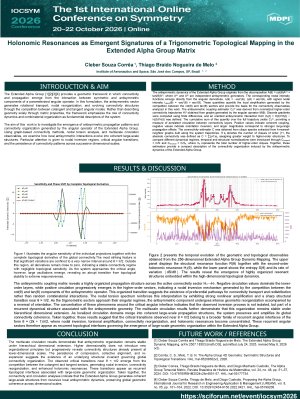
The Extended Alpha Group Matrix M(θ) is a 4×4 hypercomplex operator composed of coupled symmetric and antisymmetric sectors parameterized by trigonometric functions. In this work, we investigate the emergence of a trigonometric topological mapping generated by the competition between the cot(θ) and tan(θ) sectors of the matrix and its relationship with connectivity dynamics and holonomic resonances over the angular cycle 0 ≤ θ ≤ 2π.
For each angular value, a normalized trajectory is generated in a four-dimensional state space through successive applications of M(θ). Pairwise distances between trajectory points are used to construct graph representations of the dynamics, enabling the extraction of connectivity layers and the tracking of their evolution throughout the angular cycle.
To characterize structural interactions, connectivity layers are coupled through antisymmetric circulation operators, producing angular holonomic fluxes between graph levels. The accumulation of these fluxes defines a discrete absolute connectivity estimate C, obtained from the magnitude of the resulting circulation matrix. This quantity provides a global measure of connectivity dynamics.
Within this framework, the trigonometric topological mapping is defined as the angular correspondence Φ:S^1 → G, which associates each angular state of the Extended Alpha Group Matrix with a connectivity topology generated by the corresponding dynamical trajectory. Its topological nature stems from the continuous reorganization of connectivity structures driven by the interplay between the cot(θ) and tan(θ) sectors, giving rise to localized transition interfaces and emergent holonomic resonances.
The analysis reveals that the competition between the cot(θ) and tan(θ) sectors generates transition interfaces characterized by variations in connectivity, entropy, and holonomic behavior.
These findings support the interpretation that holonomic resonances are emergent signatures of global topological organization induced by the coupled action of the symmetric and antisymmetric sectors of M(θ), providing a novel framework for the study of connectivity-driven dynamical structures.
Keywords
Extended Alpha Group
Trigonometric Topological Mapping
Graph Dynamics
Connectivity Dynamics
Holonomic Resonances
Hypercomplex Matrix Systems.
Poster
sciforum-195347.pdf
Cross-couplings between a Weyl graviton and a massless conformal gravitino: a local BRST cohomological analysis
Quantized Curvature Reconstruction via SU(2) Generators: Extending Absolute Unified Mathematics of Quantum Gravitation